

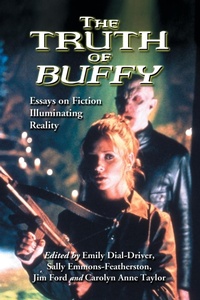
The Truth of Buffy
Essays on Fiction Illuminating Reality
Published on 24. June 2008
Book
Paperback/Softback
248 pages
978-0-7864-3799-3 (ISBN)
Description
Seemingly the most fantastical of television series, Buffy the Vampire Slayer proves on close examination to be firmly rooted in real-world concerns. In this collection of critical essays, 15 authors from several disciplines, including literature, the visual arts, theatre, philosophy, and political science, study ways in which Buffy illuminates viewers' real-life experiences.
Topics include the series' complicated portrayals of the relationship between soul, morality, and identity; whether Buffy can truly be described as a feminist icon; stereotypes of Native Americans in the episode "Pangs"; the role of signs in the interaction between Buffy's aesthetics and audience; and the problem of power and underhanded politics in the Buffy universe.
Topics include the series' complicated portrayals of the relationship between soul, morality, and identity; whether Buffy can truly be described as a feminist icon; stereotypes of Native Americans in the episode "Pangs"; the role of signs in the interaction between Buffy's aesthetics and audience; and the problem of power and underhanded politics in the Buffy universe.
More details
Language
English
Place of publication
Jefferson, NC
United States
Target group
Interest Age: From 18 years
Product notice
Paperback (trade)
Illustrations
appendix, notes, bibliography, index
Dimensions
Height: 229 mm
Width: 152 mm
Thickness: 15 mm
Weight
412 gr
ISBN-13
978-0-7864-3799-3 (9780786437993)
Copyright in bibliographic data and cover images is held by Nielsen Book Services Limited or by the publishers or by their respective licensors: all rights reserved.
Schweitzer Classification
Persons
Emily Dial-Driver is a professor of English at Rogers State University in Claremore, Oklahoma, and fiction editor of RSU's Cooweescoowee: A Journal of Arts and Letters. Sally Emmons-Featherston is an associate professor of English at Rogers State University and the managing editor of Cooweescoowee. Jim Ford teaches humanities, philosophy, and religion at Rogers State University and is director of the honors program. His articles have been published in the Journal of Religion, the Journal of the National Collegiate Honors Council, and Honors in Practice. Carolyn Anne Taylor is an associate professor of political science at Rogers State University and previously served in the Oklahoma House of Representatives. She lives in Claremore, Oklahoma.
Content
Table of Contents
Preface
Emily Dial-Driver
Introduction
Jim Ford
What's It All About, Buffy? Victor Frank and Buffy
Emily Dial-Driver
Got Myself a Soul? The Puzzling Treatment of the Soul in Buffy
J. Renee Cox
Not Just Another Love Song: Buffy's Music as Representation of Emerging Adulthood
Jacqueline Bach
Is That Stereotype Dead? Working with and Against "Western" Stereotypes in Buffy
Sally Emmons-Featherston
Lord Acton Is Alive and Well in Sunnydale: Politics and Power in Buffy
Kenneth S. Hicks
Willow's Electric Arcs: Moral Choices Sparked by Connections
Frances E. Morris
Is It Art? The Artful "Hush" of St. Francis and the Gentlemen Blue Meanies
Gary Moeller
Signs, Signs, Everywhere Signs: Brechtian Techniques in Buffy
David Blakely
"The Ants Go Marching": Effective Lyrics in Buffy Episodes
Lori M. Butler
"Love the One You're With": Developing Xander
J. Michael McKeon
Texting Buffy: Allusions of Many Kinds
Emily Dial-Driver and Jesse Stallings
"What Shall Cordelia Say?" Buffy as Morality Play for the Twenty-First Century's Therapeutic Ethos
Gregory J. Thompson and Sally Emmons-Featherston
Witchy Women: Witchcraft in Buffy and in Contemporary African Culture
Juliet Evusa
"I'm Cookie Dough": Exploring Buffy Iconography
Kenneth S. Hicks and Carolyn Anne Taylor
A Life Well-Lived: Buffy and the Pursuit of Happiness
Jim Ford
Appendix: Buffy the Vampire Slayer Episodes
Works Cited
About the Contributors
Index
Preface
Emily Dial-Driver
Introduction
Jim Ford
What's It All About, Buffy? Victor Frank and Buffy
Emily Dial-Driver
Got Myself a Soul? The Puzzling Treatment of the Soul in Buffy
J. Renee Cox
Not Just Another Love Song: Buffy's Music as Representation of Emerging Adulthood
Jacqueline Bach
Is That Stereotype Dead? Working with and Against "Western" Stereotypes in Buffy
Sally Emmons-Featherston
Lord Acton Is Alive and Well in Sunnydale: Politics and Power in Buffy
Kenneth S. Hicks
Willow's Electric Arcs: Moral Choices Sparked by Connections
Frances E. Morris
Is It Art? The Artful "Hush" of St. Francis and the Gentlemen Blue Meanies
Gary Moeller
Signs, Signs, Everywhere Signs: Brechtian Techniques in Buffy
David Blakely
"The Ants Go Marching": Effective Lyrics in Buffy Episodes
Lori M. Butler
"Love the One You're With": Developing Xander
J. Michael McKeon
Texting Buffy: Allusions of Many Kinds
Emily Dial-Driver and Jesse Stallings
"What Shall Cordelia Say?" Buffy as Morality Play for the Twenty-First Century's Therapeutic Ethos
Gregory J. Thompson and Sally Emmons-Featherston
Witchy Women: Witchcraft in Buffy and in Contemporary African Culture
Juliet Evusa
"I'm Cookie Dough": Exploring Buffy Iconography
Kenneth S. Hicks and Carolyn Anne Taylor
A Life Well-Lived: Buffy and the Pursuit of Happiness
Jim Ford
Appendix: Buffy the Vampire Slayer Episodes
Works Cited
About the Contributors
Index