

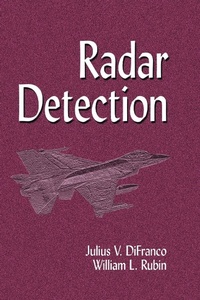
Radar Detection
Published on 30. June 2004
Book
Paperback/Softback
670 pages
978-1-891121-36-4 (ISBN)
Description
This book presents a comprehensive tutorial exposition of radar detection using the methods and techniques of mathematical statistics. The material presented is as current and useful to today's engineers as when the book was first published by Prentice-Hall in 1968 and then republished by Artech House in 1980. The book is divided into six parts. Part I is introductory and describes the nature of the radar detection problem. Part II reviews the mathematical tools necessary for a study of detection theory. Part III contains tutorial expositions in a radar context of the classical signal-to-noise and a posteriori theories, both of which have played important roles in the evolution of modern radar. The unifying theme of the book is provided by statistical decision theory, introduced in the last chapter of Part III, which provides the framework for the chapters that follow. The first three chapters of Part IV contain a unified tutorial exposition of single and multiple hit detection theory. The last two chapters are respectively devoted to the use of the radar equation and a discussion of cumulative detection probability. The latter includes a procedure for minimizing the power-aperture product of a search radar. The performance of near-optimum multiple hit detection strategies are considered in Part V. These include binary and pulse train detection strategies. The first chapter in Part VI applies sequential detection theory to the radar detection problem. It includes the Marcus and Swerling test strategy and a two-step approximation to sequential detection. The second chapter contains the development of Bayes decision rules and Bayes receivers for optimizing the detection of multiple targets with unknown parameters, such as range, velocity, angle, etc.
More details
Series
Language
English
Place of publication
New York
United States
Target group
College/higher education
Professional and scholarly
Dimensions
Height: 229 mm
Width: 152 mm
Thickness: 35 mm
Weight
960 gr
ISBN-13
978-1-891121-36-4 (9781891121364)
Copyright in bibliographic data and cover images is held by Nielsen Book Services Limited or by the publishers or by their respective licensors: all rights reserved.
Schweitzer Classification
Other editions
Additional editions
Julius V. DiFranco | William L. Rubin
Radar Detection
E-Book
05/2014
1st Edition
SciTech Publishing Inc
€161.29
Available for download
Persons
Content
Part I: Introduction
Chapter 1: Introduction to Radar
Part II: Mathematic Description of Signal and Noise Waveforms
Chapter 2: Mathematical Representation of Waveforms
Chapter 3: Probability Theory
Chapter 4: Random Processes
Part III: Optimum Reception of Signals in Noise
Chapter 5: Maximization of Signal-to-Noise Ratio and the Matched Filter
Chapter 6: Optimum Filter for Colored Noise
Chapter 7: The A Posteriori Theory of Reception
Chapter 8: Statistical Decision Theory
Part IV: Optimum Radar Detection
Chapter 9: Detection Based on a Single Observation
Chapter 10: Detection Based on Multiple Observations: Nonfluctuating Model
Chapter 11: Detection Based on Multiple Observations: Swerling Fluctuating Models
Chapter 12: The Radar Equation
Chapter 13: Cumulative Detection Probability of Stationary and Moving Targets
Part V: Suboptimum Detection Techniques
Chapter 14: The Binary Detector
Chapter 15: Weighted Integrators
Part VI: Special Topics in Detection
Chapter 16: Sequential Detection
Chapter 17: Multiple-Target Detection
Appendix A: Narrowband Representation of Echoes From Moving Targets
Appendix B: False-Alarm Rate of Narrowband Noise
Chapter 1: Introduction to Radar
Part II: Mathematic Description of Signal and Noise Waveforms
Chapter 2: Mathematical Representation of Waveforms
Chapter 3: Probability Theory
Chapter 4: Random Processes
Part III: Optimum Reception of Signals in Noise
Chapter 5: Maximization of Signal-to-Noise Ratio and the Matched Filter
Chapter 6: Optimum Filter for Colored Noise
Chapter 7: The A Posteriori Theory of Reception
Chapter 8: Statistical Decision Theory
Part IV: Optimum Radar Detection
Chapter 9: Detection Based on a Single Observation
Chapter 10: Detection Based on Multiple Observations: Nonfluctuating Model
Chapter 11: Detection Based on Multiple Observations: Swerling Fluctuating Models
Chapter 12: The Radar Equation
Chapter 13: Cumulative Detection Probability of Stationary and Moving Targets
Part V: Suboptimum Detection Techniques
Chapter 14: The Binary Detector
Chapter 15: Weighted Integrators
Part VI: Special Topics in Detection
Chapter 16: Sequential Detection
Chapter 17: Multiple-Target Detection
Appendix A: Narrowband Representation of Echoes From Moving Targets
Appendix B: False-Alarm Rate of Narrowband Noise