


Reframing Failure in Behavior Change
1st Edition
Will be published approx. on 13. July 2026
Book
Hardback
226 pages
978-1-4625-6279-4 (ISBN)
Description
Reoccurrence or relapse happens with almost all types of behavior change--and too often is stigmatized. This compelling work from leading experts provides a fresh perspective on the function of failure in a person's journey through the stages of change. Whether in addiction treatment or other health care contexts, setbacks can help clinicians and clients identify what went wrong and adapt their approaches. The book examines the critical tasks of each of the pre-action and action stages of change and highlights key processes needed to move through them. It provides a vital multidimensional blueprint for using failure to make subsequent change efforts more effective.
Reviews / Votes
This inspiring work reimagines what it means to fail. Across nearly every kind of health behavior, relapse is the rule rather than the exception--but it can also be a teacher. This book is special because it reframes failure as part of the process of change, rather than the end of it. I recommend this book for practitioners and students in public health, social work, psychology, and health promotion. It would work well in classrooms, given its blend of storytelling, science, and practical tools.aEUR--Scott T. Walters, PhD, Regents Professor, College of Public Health, UNT Health Fort WorthPhenomenally engaging, clear, and concise. True to its title, this excellent book from leaders in the field focuses on the heart of the matter regarding behavior change--change is hard, and failure is common along the way. Despite this seemingly grim reality, the book describes theory and tangible interventions that can promote and sustain successful behavior change. In doing so, it provides a great deal of hope regarding people's capacity to change, even when the pathway is difficult.--Katie Witkiewitz, PhD, Distinguished Professor of Psychology and Director, Center on Alcohol, Substance use, And Addictions (CAASA), University of New Mexico
aEURoeWe have only to reflect on our own experiences to acknowledge the difficulty of change. This book shifts the conversation about the concept of relapse. The authors draw from the addictions literature, the transtheoretical model, and elements of learning theory to destigmatize interruptions that may occur during the behavior change process. In the field of addiction, this is a critically important message that can support clinicians and clients alike.--Molly Magill, LICSW, PhD, Department of Behavioral and Social Sciences, Brown University School of Public Health
The authors challenge conventional thinking with the powerful insight that failure can be the source of innovation for future success. This book emphasizes the dynamic nature of the transtheoretical model, showing how individuals recycle through the stages of change and how this process is essential to growth. DiClemente and Velasquez illuminate the interplay between stages and processes, helping practitioners understand that progress often emerges from persistence through failure. This book is not just insightful--itaEUR (TM)s indispensable.--Cynthia Moreno Tuohy, Senior Consultant and Former Executive Director, NAADAC, the Association for Addiction Professionals
-
More details
Language
English
Place of publication
New York
United States
Publishing group
Guilford Publications
Dimensions
Height: 229 mm
Width: 152 mm
Thickness: 18 mm
Weight
494 gr
ISBN-13
978-1-4625-6279-4 (9781462562794)
Copyright in bibliographic data and cover images is held by Nielsen Book Services Limited or by the publishers or by their respective licensors: all rights reserved.
Schweitzer Classification
Other editions
Additional editions
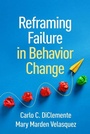
Carlo C. DiClemente | Mary Marden Velasquez
Reframing Failure in Behavior Change
Book
approx. 07/2026
1st Edition
Guilford Press
€42.50
Not yet published
Persons
Carlo C. DiClemente, PhD, ABPP, is Emeritus Professor of Psychology at the University of Maryland, Baltimore County. He is codeveloper of the transtheoretical model of behavior change, used by researchers and clinicians internationally. Dr. DiClemente's contributions have been recognized with awards from the Robert Wood Johnson Foundation, the American Society of Addiction Medicine, the Association for Behavioral and Cognitive Therapies, and the American Psychological Association. Most recently, he was invited to deliver the Jack Mendelson Honorary Lecture at the National Institute on Alcohol Abuse and Alcoholism and received a Lifetime Achievement Award from the National Register of Health Services Psychologists. Dr. DiClemente has authored or coauthored over 250 articles, book chapters, and books on motivation and behavior change.
Mary Marden Velasquez, PhD, is Centennial Professor in Leadership for Community, Professional, and Corporate Excellence and Director of the Health Behavior Research and Training Institute at The University of Texas at Austin (UT Austin) School of Social Work. She also holds appointments in the Department of Population Health and the Department of Psychiatry and Behavioral Sciences at UT Austin's Dell Medical School. A Distinguished Fellow of the American Academy of Social Work and Social Welfare, Dr. Velasquez is a recipient of the Betty Ford Award from the Association for Multidisciplinary Education and Research in Substance use and Addiction and the Charles C. Shepard Science Award from the Centers for Disease Control and Prevention, and a founding member of the Motivational Interviewing Network of Trainers.
Mary Marden Velasquez, PhD, is Centennial Professor in Leadership for Community, Professional, and Corporate Excellence and Director of the Health Behavior Research and Training Institute at The University of Texas at Austin (UT Austin) School of Social Work. She also holds appointments in the Department of Population Health and the Department of Psychiatry and Behavioral Sciences at UT Austin's Dell Medical School. A Distinguished Fellow of the American Academy of Social Work and Social Welfare, Dr. Velasquez is a recipient of the Betty Ford Award from the Association for Multidisciplinary Education and Research in Substance use and Addiction and the Charles C. Shepard Science Award from the Centers for Disease Control and Prevention, and a founding member of the Motivational Interviewing Network of Trainers.
Content
1. Why Is It So Hard to Change Our Behaviors?
2. The Function of Failure in Success
3. A Comprehensive Blueprint for Behavior Change
4. The Initial Building Block: Personal Interest and Concern for Change
5. Effective Decision Making
6. Committing to Change
7. Planning and Preparation
8. Beginning the Journey of Behavior Change
9. Making Change Last
10. Relapse, Recycling, and Recovery in Addictive Behaviors
11. What Makes Successful Health Behavior Change?
12. Overcoming Barriers to Learning from Failure
References
Index
2. The Function of Failure in Success
3. A Comprehensive Blueprint for Behavior Change
4. The Initial Building Block: Personal Interest and Concern for Change
5. Effective Decision Making
6. Committing to Change
7. Planning and Preparation
8. Beginning the Journey of Behavior Change
9. Making Change Last
10. Relapse, Recycling, and Recovery in Addictive Behaviors
11. What Makes Successful Health Behavior Change?
12. Overcoming Barriers to Learning from Failure
References
Index