

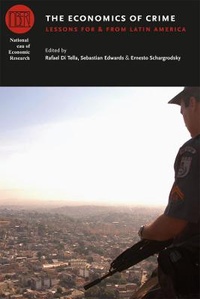
The Economics of Crime
Lessons For and From Latin America
Published on 15. June 2012
Book
Paperback/Softback
488 pages
978-0-226-79185-2 (ISBN)
Description
Crime rates in Latin America are among the highest in the world, creating climates of fear and lawlessness in several countries. Despite this situation, there has been a lack of systematic effort to study crime in the region or the effectiveness of policies designed to tackle it. "The Economics of Crime" is a powerful corrective to this academic blind spot and makes an important contribution to the current debate on causes and solutions by applying lessons learned from recent developments in the economics of crime. "The Economics of Crime" addresses a variety of topics, including the impact of kidnappings on investment, mandatory arrest laws, education in prisons, and the relationship between poverty and crime. Utilizing research from within and without Latin America, this book illustrates the broad range of approaches that have been efficacious in studying crime in both developing and developed nations. "The Economics of Crime" is a vital text for researchers, policymakers, and students of both crime and Latin American economic policy.
More details
Series
Language
English
Place of publication
Chicago
United States
Publishing group
The University of Chicago Press
Target group
College/higher education
Professional and scholarly
Dimensions
Height: 23 mm
Width: 16 mm
Thickness: 3 mm
Weight
737 gr
ISBN-13
978-0-226-79185-2 (9780226791852)
Copyright in bibliographic data and cover images is held by Nielsen Book Services Limited or by the publishers or by their respective licensors: all rights reserved.
Schweitzer Classification
Other editions
Additional editions
Rafael Di Tella | Sebastian Edwards | Ernesto Schargrodsky
Economics of Crime
Lessons For and From Latin America
E-Book
08/2010
1st Edition
University of Chicago Press
€131.89
Available for download
Persons
Rafael Di Tella is the Joseph C. Wilson Professor of Business Administration at Harvard Business School and a research associate of the NBER. Sebastian Edwards is the Henry Ford II Professor of International Economics at the Anderson Graduate School of Management, University of California, Los Angeles, and a research associate of the NBER. Ernesto Schargrodsky is professor and president of Universidad Torcuato Di Tella.