

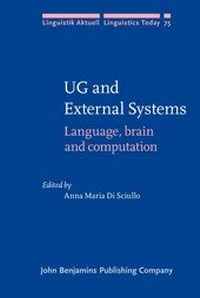
UG and External Systems
Language, brain and computation
Published on 26. April 2005
Book
Hardback
398 pages
978-90-272-2799-7 (ISBN)
Description
This book explores the interaction of the grammar with the external systems, conceptual-intentional and sensori-motor. The papers in the Language section include configurational analyses of the interface properties of depictives, clitic clusters, imperatives, conditionals, clefts, as well as asymmetries in the structure of syllables and feet. The Brain section discusses questions related to human learning and comprehension of language: the acquisition of compounds, the acquisition of the definite article, the subject/object asymmetry in the comprehension of D-Linked vs. non D-linked questions, the evidence for syntactic asymmetries in American Sign Language, the acquisition of syllable types, and the role of stress shift in the determination of phrase ending. The papers in the Computation section present different perspectives on how the properties of UG can be implemented in a parser; implementations of different theories including configurational selection, incorporation, and minimalism; and the role of statistical and quantitative approaches in natural language processing.
More details
Series
Language
English
Place of publication
Amsterdam
Netherlands
Target group
Professional and scholarly
Dimensions
Height: 245 mm
Width: 164 mm
Weight
905 gr
ISBN-13
978-90-272-2799-7 (9789027227997)
Copyright in bibliographic data and cover images is held by Nielsen Book Services Limited or by the publishers or by their respective licensors: all rights reserved.
Schweitzer Classification
Other editions
Additional editions
E-Book
04/2005
1st Edition
John Benjamins Publishing Company
€167.99
Available for download
Content
1. Introduction: UG and External Systems (by Di Sciullo, Anna Maria); 2. Language; 3. Depictives: Syntactic and interpretive asymmetries (by Isac, Daniela); 4. On two issues related to the clitic clusters in Romance languages (by Somesfalean, Stanca); 5. On the question of (non)-agreement in the uses of Russian imperatives (by Jakab, Edit); 6. Computational puzzles of conditional clause preposing (by Munaro, Nicola); 7. Clefts and tense asymmetries (by Ambar, Manuela); 8. Generating configurational asymmetries in prosodic phonology (by Mellander, Evan W.); 9. Brain; 10. Language learnability and the forms of recursion (by Roeper, Thomas); 11. The autonomous contribution of syntax and pragmatics to the acquisition of the Hebrew definite article (by Armon-Lotem, Sharon); 12. D(iscourse)-Linking and question formation: Comprehension effects in children and Broca's aphasics (by Goodluck, Helen); 13. Evidence from ASL and OGS for asymmetries in UG (by Wilbur, Ronnie B.); 14. Acquisition of phonological empty categories: A case study of early child Dutch (by Pan, Ning); 15. Prosodic cues during online processing of speech: Evidence from stress shift in American English (by Bauer, Matt); 16. Computation; 17. Morpho-syntax parsing (by Di Sciullo, Anna Maria); 18. A Minimalist implementation of Hale-Keyser incorporation theory (by Niyogi, Sourabh); 19. Minimalist languages and the correct prefix property (by Harkema, Henk); 20. Computation with probes and goals: A parsing perspective (by Fong, Sandiway); 21. Deep & shallow linguistically based parsing: Parameterizing ambiguity in a hybrid parser (by Delmonte, Rodolfo); 22. Towards a quantitative theory of variability (by Blache, Philippe); 23. Index