

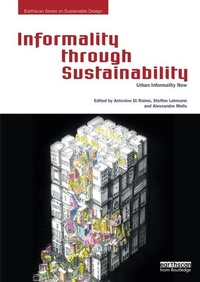
Informality through Sustainability
Urban Informality Now
1st Edition
Published on 30. January 2025
Book
Paperback/Softback
444 pages
978-0-367-64275-4 (ISBN)
Description
Informality through Sustainability explores the phenomenon of informality within urban settlements and aims to unravel the subtle links between informal settlements and sustainability.
Penetrating its global profile and considering urban informality through an understanding of local implications, the authors collectively reveal specific correlations between sites and their local inhabitants. The book opposes simplistic calls to legalise informal settlements or to view them as 'problems' to be solved. It comes at a time when common notions of 'informality' are being increasingly challenged.
In 25 chapters, the book presents contributions from well-known scholars and practitioners whose theoretical or practical work addresses informality and sustainability at various levels, from city planning and urban design to public space and architectural education. Whilst previous studies on informal settlements have mainly focused on cases in developing countries, approaching the topic through social, cultural and material dimensions, the book explores the concept across a range of contexts, including former Communist countries and those in the so-called Global North. Contributions also explore understandings of informality at various scalar levels - region, precinct, neighbourhood and individual building. Thus, this work helps reposition informality as a relational concept at various scales of urbanisation.
This book will be of great benefit to planners, architects, researchers and policymakers interested in the interplay between informality and sustainability.
Penetrating its global profile and considering urban informality through an understanding of local implications, the authors collectively reveal specific correlations between sites and their local inhabitants. The book opposes simplistic calls to legalise informal settlements or to view them as 'problems' to be solved. It comes at a time when common notions of 'informality' are being increasingly challenged.
In 25 chapters, the book presents contributions from well-known scholars and practitioners whose theoretical or practical work addresses informality and sustainability at various levels, from city planning and urban design to public space and architectural education. Whilst previous studies on informal settlements have mainly focused on cases in developing countries, approaching the topic through social, cultural and material dimensions, the book explores the concept across a range of contexts, including former Communist countries and those in the so-called Global North. Contributions also explore understandings of informality at various scalar levels - region, precinct, neighbourhood and individual building. Thus, this work helps reposition informality as a relational concept at various scales of urbanisation.
This book will be of great benefit to planners, architects, researchers and policymakers interested in the interplay between informality and sustainability.
Reviews / Votes
"This is a novel reflection on informal settlements and their conditions linking a robust range of contexts at multiple levels of urbanization with crucial issues of environmental regeneration, economic as well as social equality and racial justice. Inevitably, the discourse on sustainable and responsible practices encompasses the urgency to prioritize a human centered design approach in order to observe and register those patterns. It is in this pursuit of interdisciplinary contributions through the lens of sustainability, where the book might well make compelling revelations."Maria Perbellini, Dean and Professor, School of Architecture and Design, New York Institute of Technology, USA
"Antonino Di Raimo, Steffen Lehmann and Alessandro Melis explore new directions into understanding the phenomenon of Informality. Presented as a three-part unified framework, Informality opens new research directions and is a must-read for future multidisciplinary thinking and creation of sustainable urbanized worlds."
Tom Kovac, Professor, RMIT University, Australia
"A breakthrough book outside of stereotypes! The authors demonstrate with clarity and methodological rigor that cities are never the product of a single deterministic will, but they are the result of the rise of sudden innovations, of independent - often informal - dynamics which are consolidated by the creativity of the inhabitants, by actions produced by individual and collective actors, whose outcome often exceeds the intentions and control of the most powerful actors. The book explores different resilient communities that, through fertile bricolage, produce powerful alliances between intentionality, spontaneity, causality and design."
Maurizio Carta, Full Professor of Urban Design, University of Palermo, Italy
More details
Series
Language
English
Place of publication
London
United Kingdom
Publishing group
Taylor & Francis Ltd
Target group
Professional and scholarly
Professional Practice & Development
Product notice
Paperback (trade)
Unsewn / adhesive bound
Illustrations
137 s/w Abbildungen, 122 s/w Photographien bzw. Rasterbilder, 15 s/w Zeichnungen
15 Line drawings, black and white; 122 Halftones, black and white; 137 Illustrations, black and white
Dimensions
Height: 173 mm
Width: 246 mm
Thickness: 27 mm
Weight
449 gr
ISBN-13
978-0-367-64275-4 (9780367642754)
Copyright in bibliographic data and cover images is held by Nielsen Book Services Limited or by the publishers or by their respective licensors: all rights reserved.
Schweitzer Classification
Other editions
Additional editions
Antonino Di Raimo | Steffen Lehmann | Alessandro Melis
Informality through Sustainability
Urban Informality Now
Book
12/2020
1st Edition
Routledge
€164.70
Shipment within 15-20 days
Antonino Di Raimo | Steffen Lehmann | Alessandro Melis
Informality through Sustainability
Urban Informality Now
E-Book
12/2020
1st Edition
Routledge
€45.99
Available for download
Antonino Di Raimo | Steffen Lehmann | Alessandro Melis
Informality through Sustainability
Urban Informality Now
E-Book
12/2020
1st Edition
Routledge
€45.99
Available for download
Persons
Antonino Di Raimo, FEA, is a Reader in Architecture at the University of Portsmouth's School of Architecture (UK), where he is also a Co-Lead in research. He joined the University of Portsmouth in 2017. Prior to this, he had been teaching in Italy (University of La Sapienza) and Albania (Polis University, Tirana).
Steffen Lehmann, Assoc. AIA, RIBA, AoU, is Director of the School of Architecture at the University of Nevada Las Vegas (USA), and a full Professor of Architecture. He is also Founding Director of the interdisciplinary Urban Futures Lab and Director of the Future Cities Leadership Institute.
Alessandro Melis, RIBA, ARB, AoU, is a full Professor of Architecture Innovation at the University of Portsmouth (UK) and the co-director of the Cluster for Sustainable Cities. He is the curator of the Italian Pavilion at the 17th International Biennale of Architecture in Venice 2020-21.
Steffen Lehmann, Assoc. AIA, RIBA, AoU, is Director of the School of Architecture at the University of Nevada Las Vegas (USA), and a full Professor of Architecture. He is also Founding Director of the interdisciplinary Urban Futures Lab and Director of the Future Cities Leadership Institute.
Alessandro Melis, RIBA, ARB, AoU, is a full Professor of Architecture Innovation at the University of Portsmouth (UK) and the co-director of the Cluster for Sustainable Cities. He is the curator of the Italian Pavilion at the 17th International Biennale of Architecture in Venice 2020-21.
Content
Preface David Turnbull Introduction Antonino Di Raimo, Steffen Lehmann and Alessandro Melis Part 1 Part 1. Introduction - What does Informality have to say to Architecture?: Decolonising the Enquire and the Enquirer Antonino Di Raimo 1. Visualizing the Political: Teddy Cruz and Fonna Forman, in conversation with Kathy Waghorn Teddy Cruz and Fonna Forman, in conversation with Kathy Waghorn 2. From a Marxist Arcadia to High-tech Favelas: The Latency of Informality in Archizoom and Andrea Branzi Pablo Martinez Capdevila 3. "I'm an imposter" [a Goedel-Cassandra incompleteness] Francois Roche - New-Territories 4. Informality and Dissent: The Culture of Self-sufficiency of the American Rural Poor David Franco Santa Cruz 5. The Urbanism of Individual Arrangements: Understanding Specific Realities - The Case of Tirana Sotir Dhamo 6. Informality and Temporary Appropriation in Atlanta as a Prototype for Resilient Communities William Carpenter 7. Effected Butterflies: Informal Urban Migration of Monarchs and Humans Across the US-Mexico Border Mitchell Joachim and Nicholas Gervasi 8. Informality and Commons Simone Sfriso, Massimo Lepore, Raul Pantaleo, Barbora Foerster Part 2 Part 2. Introduction - Informality as a Mode of Sustainability Steffen Lehmann 9. The Self-Organising City and Its Modus Operandi: Informal Urbanism and Public Space Steffen Lehmann 10. Housing the Majority, Destroying Agrarian Land: The Irreconcilable Dilemma of Cairo's Informal areas Charlotte Malterre-Barthes 11. Informality and Mass Housing in Seoul: The Role of Informal Settlements in the Formation of Megaprojects Dario Pedrabissi 12. The Role of Adaptation in Changing the Micro-Morphology of Informal Settlements Paul Jones 13. Urban (in)formality and the New Unsustainable Landscape of the Global South: Case Study of Megacity Dhaka Mohammad S,H, Swapan, Atiq Zaman and Steffen Lehmann 14. Landscape - Infrastructure: Formal - informal Entanglements across Political Ecologies of Resource Use Daniela Perrotti 15. 'AQUI ESTAMOS Y NO NOS VAMOS': Contested Ground, Sustainable Informal Settlement and Human Consequence in the Urban Landscape of South Los Angeles Danny H. Ortega 16. The Hill and the Asphalt: a 50-year Perspective on Informality in Rio de Janeiro Janice Perlman Part 3 Part 3. Introduction - Informal Behavior as a Form of Community Resilience Alessandro Melis 17. Informal Microclimates: Study on Self-Built Settlements and Human Comfort in Amman Ata Chokhachian, Daniele Santucci, Thomas Auer 18. Urban Form of Informal Settlements in the Western Balkans Dorina Pojani 19. Understanding Temporary Appropriation and the Streetscape Design: The case of Algiers, Auckland and Mexico City J. Antonio Lara- Hernandez, M. Yazid Khemri and Alessandro Melis 20. Reinventing City Planning in a Context that "Hates" Planning!: A New Role for Architects, City Planners, and Institutions Besnik Aliaj 21. Roman Lessons: What if Informality was not a bug to be Corrected but a Bacterium Capable of Reactivating a Dormant Urban Metabolism? Alessandra Lai and Francesco Careri 22. Informality in Formality: The Case of a Neighbourhood in a Nigerian City Olufunto, Ayoola, Melis 23. Achieving Community Resilience through Informal Urban Practices: The Case of El Houma in Algiers Yazid Khemri and Alessandro Melis 24. Learning Place Attachment from the Informal City Cristina Dreifuss 25. Designing the "Off-Grid" City: Empowering the Transactions of Infrastructure Aseem Inam Index