

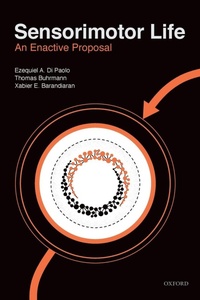
Sensorimotor Life
An enactive proposal
Published on 4. May 2017
Book
Hardback
296 pages
978-0-19-878684-9 (ISBN)
Description
How accurate is the picture of the human mind that has emerged from studies in neuroscience, psychology, and cognitive science? Anybody with an interest in how minds work - how we learn about the world and how we remember people and events - may feel dissatisfied with the answers contemporary science has to offer.
Sensorimotor Life draws on current theoretical developments in the enactive approach to life and mind. It examines and expands the premises of the sciences of the human mind, while developing an alternative picture closer to people's daily experiences. Enactive ideas are applied and extended, providing a theoretically rich, naturalistic account of meaning and agency. The book includes a dynamical systems description of different types of sensorimotor regularities or sensorimotor contingencies; a dynamical interpretation of Piaget's theory of equilibration to ground the concept of sensorimotor mastery; and a theory of agency as organized networks of sensorimotor schemes, as well as its implicatons for embodied subjectivity.
Written for students and researchers of cognitive science, the authors offer a fuller view of the mind, a view better attuned to the experiences of people who live, work, love, struggle, and age, thrown into a world of meaningful relations they help create. Additionally, the book is of interest to neuroscientists, psychiatrists, and philosophers of science.
Sensorimotor Life draws on current theoretical developments in the enactive approach to life and mind. It examines and expands the premises of the sciences of the human mind, while developing an alternative picture closer to people's daily experiences. Enactive ideas are applied and extended, providing a theoretically rich, naturalistic account of meaning and agency. The book includes a dynamical systems description of different types of sensorimotor regularities or sensorimotor contingencies; a dynamical interpretation of Piaget's theory of equilibration to ground the concept of sensorimotor mastery; and a theory of agency as organized networks of sensorimotor schemes, as well as its implicatons for embodied subjectivity.
Written for students and researchers of cognitive science, the authors offer a fuller view of the mind, a view better attuned to the experiences of people who live, work, love, struggle, and age, thrown into a world of meaningful relations they help create. Additionally, the book is of interest to neuroscientists, psychiatrists, and philosophers of science.
More details
Language
English
Place of publication
Oxford
United Kingdom
Target group
Professional and scholarly
College/higher education
Dimensions
Height: 260 mm
Width: 183 mm
Thickness: 21 mm
Weight
756 gr
ISBN-13
978-0-19-878684-9 (9780198786849)
Copyright in bibliographic data and cover images is held by Nielsen Book Services Limited or by the publishers or by their respective licensors: all rights reserved.
Schweitzer Classification
Other editions
Additional editions
E-Book
06/2017
1st Edition
OUP eBook
€47.99
Available for download
E-Book
06/2017
1st Edition
OUP eBook
€47.99
Available for download
Persons
Prof. Ezequiel Di Paolo is a full-time Research Professor working at Ikerbasque, the Basque Science Foundation, in San Sebastian, Spain. He received an MSc in Nuclear Engineering from the Instituto Balseiro in Argentina and a DPhil in Computer Science and Artificial Intelligence from the University of Sussex. His interdisciplinary work on the enactive approach to life, mind, and society integrates insights from cognitive science, phenomenology, philosophy of mind and computational modelling. His recent research focus is on embodied intersubjectivity. He is the author of over 150 peer-reviewed publications and Editor-in-Chief of the journal Adaptive Behavior.
Dr. Thomas Buhrmann is a postdoctoral researcher in the department of Philosophy at the University of the Basque Country. He completed both his Ph.D. in Artificial Intelligence and his M.Sc. in Evolutionary and Adaptive Systems at the University of Sussex. His research interests lie in the areas of enactive cognition and sensorimotor coordination, with a focus on models of non-computational cognitive processes. His recent work, as part of the EU project "Extending sensorimotor contingencies to cognition", has focused on the development of agent-based simulation models and the conceptual clarification and extension of the sensorimotor approach to perception.
Dr. Xabier E. Barandiaran is a philosopher of mind and cognitive science, with a special focus on simulation modelling techniques and complex system analysis applied to the study of the foundations of cognitive systems and philosophy of mind. He obtained his MSc on Evolutionary and Adaptive System from the University of Sussex (UK), and his PhD from the University of the Basque Country (Spain). Dr. Barandiaran currently holds a Lecturer position at the Department of Philosophy of the University of the Basque Country (UPV/EHU), and works as a researcher at the IAS-Research Center for Life, Mind, and Society.
Dr. Thomas Buhrmann is a postdoctoral researcher in the department of Philosophy at the University of the Basque Country. He completed both his Ph.D. in Artificial Intelligence and his M.Sc. in Evolutionary and Adaptive Systems at the University of Sussex. His research interests lie in the areas of enactive cognition and sensorimotor coordination, with a focus on models of non-computational cognitive processes. His recent work, as part of the EU project "Extending sensorimotor contingencies to cognition", has focused on the development of agent-based simulation models and the conceptual clarification and extension of the sensorimotor approach to perception.
Dr. Xabier E. Barandiaran is a philosopher of mind and cognitive science, with a special focus on simulation modelling techniques and complex system analysis applied to the study of the foundations of cognitive systems and philosophy of mind. He obtained his MSc on Evolutionary and Adaptive System from the University of Sussex (UK), and his PhD from the University of the Basque Country (Spain). Dr. Barandiaran currently holds a Lecturer position at the Department of Philosophy of the University of the Basque Country (UPV/EHU), and works as a researcher at the IAS-Research Center for Life, Mind, and Society.
Author
Research ProfessorResearch Professor, Ikerbasque, Basque Foundation for Science
Postdoctoral researcherPostdoctoral researcher, Department of Logic and Philosophy of Science, University of the Basque Country
Researcher and LecturerResearcher and Lecturer, Department of Philosophy, IAS-Research Centre for Life, Mind, and Society, University of the Basque Country
Content
1: Introduction
2: Representational pull, enactive escape velocity
3: Structures of sensorimotor engagement
4: Mastery - Learning to act and perceive
5: The missing theory of agency
6: Sensorimotor agency
7: The sense of agency
8: Virtual actions and abstract attitudes
9: Epilogue
2: Representational pull, enactive escape velocity
3: Structures of sensorimotor engagement
4: Mastery - Learning to act and perceive
5: The missing theory of agency
6: Sensorimotor agency
7: The sense of agency
8: Virtual actions and abstract attitudes
9: Epilogue