

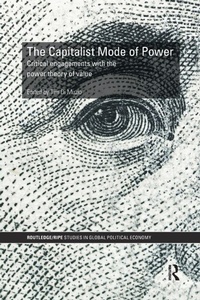
The Capitalist Mode of Power
Critical Engagements with the Power Theory of Value
1st Edition
Published on 31. July 2018
Book
Paperback/Softback
200 pages
978-1-138-49016-1 (ISBN)
Description
This edited volume offers the first critical engagement with one of the most provocative and controversial theories in political economy: the thesis that capital can be theorized as power and that capital is finance and only finance. The book also includes a detailed introduction to this novel thesis first put forward by Nitzan and Bichler in their Capital as Power.
Although endorsing the capital as power argument to varying extents, contributors to this volume agree that a new understanding of capital that radically departs from Marxist and Neoclassical theories cannot be ignored. Offering the first application and appraisal of Nitzan and Bichler's theory, chapters examine the thesis in the context of energy and global capitalization, US Investment Banks, trade and investment agreements between Canada, the US and Mexico, and multinational corporations in Apartheid South Africa. Balancing theory, methodology and empirical analysis throughout, this book is accessible to new readers, whilst contextualising and advancing the original theoretical debate.
The Capitalist Mode of Power will be of interest to students and scholars of International Relations, Political Economy, Globalization and Critical Theory.
Although endorsing the capital as power argument to varying extents, contributors to this volume agree that a new understanding of capital that radically departs from Marxist and Neoclassical theories cannot be ignored. Offering the first application and appraisal of Nitzan and Bichler's theory, chapters examine the thesis in the context of energy and global capitalization, US Investment Banks, trade and investment agreements between Canada, the US and Mexico, and multinational corporations in Apartheid South Africa. Balancing theory, methodology and empirical analysis throughout, this book is accessible to new readers, whilst contextualising and advancing the original theoretical debate.
The Capitalist Mode of Power will be of interest to students and scholars of International Relations, Political Economy, Globalization and Critical Theory.
More details
Series
Language
English
Place of publication
London
United Kingdom
Publishing group
Taylor & Francis Ltd
Target group
College/higher education
Illustrations
14 s/w Abbildungen, 14 s/w Zeichnungen, 3 s/w Tabellen
3 Tables, black and white; 14 Line drawings, black and white; 14 Illustrations, black and white
Dimensions
Height: 234 mm
Width: 156 mm
Thickness: 11 mm
Weight
313 gr
ISBN-13
978-1-138-49016-1 (9781138490161)
Copyright in bibliographic data and cover images is held by Nielsen Book Services Limited or by the publishers or by their respective licensors: all rights reserved.
Schweitzer Classification
Other editions
Additional editions
E-Book
08/2013
1st Edition
Routledge
€52.49
Available for download
E-Book
08/2013
1st Edition
Routledge
€52.49
Available for download
Book
08/2013
1st Edition
Routledge
€231.40
Shipment within 15-20 days
Person
Tim Di Muzio is Lecturer in International Relations and Public Policy at the University of Wollongong, Australia.
Content
1. Introduction: The Provocations of Capital as Power Tim Di Muzio Part I: The Provocation of History 2. Historicizing Capital as Power: Energy, Capitalization and Globalized Social Reproduction Tim Di Muzio Part II: The Provocations of a New Theory 3. The Power of Investment Banks: Surplus Absorption or Differential Capitalization? Sandy Brian Hager 4. NAFTA, Investiture and Distribution: The Power Underpinnings of Trade and Investment Liberalization in Canada Jordan Brennan 5. 'A Degree of Control': Corporations and the Struggle against South African Apartheid DT Cochrane and Jeffrey Monaghan Part III: The Provocation of Critique 6. Fighting the Power? Struggle and Resistance in 'Capital as Power' Dan Bousfield 7. State and Capital: False Dichotomy, Structural Super-Determinism, and Moving Beyond Sean Starrs 8. Differential Accumulation and the Political Economy of Power Samuel Knafo, Matthieu Hughes and Steffan Wyn-Jones 9. Conclusion