

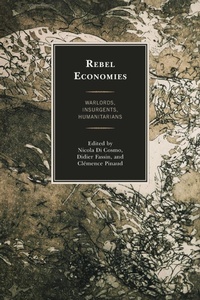
Rebel Economies
Warlords, Insurgents, Humanitarians
Published on 15. March 2023
Book
Paperback/Softback
290 pages
978-1-7936-3521-1 (ISBN)
Description
As a pervasive occurrence in the contemporary world, wars and their economic sources are defining social and political processes in a variety of national and transnational contexts. Rebel Economies: Warlords, Insurgents, Humanitarians explores historical, anthropological and political dimensions of war economies by non-state actors across different periods and regions, while presenting their multiple manifestations as a unified, congruent phenomenon. Through a variety of conceptual and disciplinary approaches, the authors investigate, in the past and present and across three continents, the nexuses between economy, war, social transformation and state-building, revealing in the process differences and similarities that would otherwise remain hidden. Through this broad-gauge approach, the book aims, first, to rethink much of the debate around "non-state war economies," and, secondly, to expand the conversation by consciously treating this theme as a conspicuous and distinct aspect of both economy and war. This is not just a different approach but a fundamental departure from the ways in which current discussions over the economy of wars, civil conflicts, and revolutions, have informed research orientations over several decades.
Reviews / Votes
The editors of Rebel economies have assembled a unique, multidisciplinary collection of contributions on how non-state actors organize their economies, finance their activities and interact with formal economic and financial systems. This multidisciplinary approach is welcome addition to International Relations' understanding of rebel economies, and opens doors for other disciplines to make contributions to these fields. This book would make a good supplemental text for a course on conflict economics, or work as an introduction to conflict economics in a course on intra-state conflict. * International Affairs * "This is a fascinating and important addition to our understanding of war economies. Much of the literature tends to focus on how wars are financed and the impact of conflict on the local economy. Rebel Economies expands the scope to include how rebels organize economic life with multiple aims, including resource extraction for war and profit, and uses their own ideas of good governance to organize economic life. In other words, rebel economies resemble state economies but without the state. The subject alone makes the book unusual and well-worth engaging, and the individual chapters are fascinating and highly rewarding." -- Michael Barnett, George Washington University "Rebel Economies: Warlords, Insurgents, Humanitarians is a rich, empirically-based analysis of similarities and differences in non-state war economies within superficially incommensurate contexts of space and time, viewed from a range of disciplinary perspectives. Among its many striking insights are the often incomplete separation of state and non-state actors, and the prevalence of complex networks of stakeholders in which local and global interests increasingly are intertwined." -- Joanna Waley-Cohen, NYU ShanghaiMore details
Language
English
Place of publication
United States
Publishing group
Bloomsbury Publishing Plc
Target group
Professional and scholarly
Illustrations
1 b/w illustrations; 2 tables;
Dimensions
Height: 229 mm
Width: 152 mm
Thickness: 17 mm
Weight
474 gr
ISBN-13
978-1-7936-3521-1 (9781793635211)
Copyright in bibliographic data and cover images is held by Nielsen Book Services Limited or by the publishers or by their respective licensors: all rights reserved.
Schweitzer Classification
Other editions
Additional editions
Rebel Economies
Warlords, Insurgents, Humanitarians
E-Book
05/2021
1st Edition
Lexington Books
€33.49
Available for download
Persons
Nicola Di Cosmo is the Henry Luce Foundation Professor of east Asian Studies at the Institute for Advanced Study
Didier Fassin is the James D. Wolfensohn Professor at the Institute for Advanced Study, director of studies at the Ecole des Hautes Etudes en Sciences Sociales, and annual chair of public ealth at the College de France.
Clemence Pinaud is assistant professor at the department of international studies of Indiana University, Bloomington.
Didier Fassin is the James D. Wolfensohn Professor at the Institute for Advanced Study, director of studies at the Ecole des Hautes Etudes en Sciences Sociales, and annual chair of public ealth at the College de France.
Clemence Pinaud is assistant professor at the department of international studies of Indiana University, Bloomington.
Content
Introduction: Revisiting Non-State War Economies
Nicola Di Cosmo, Didier Fassin and Clemence Pinaud.
Part I: Frameworks
Chapter 1: What are Non-State War Economies? Prefatory Remarks
Didier Fassin.
Chapter 2: War Economies and War Economics
Christopher Cramer.
Chapter 3: War Economies and Humanitarian Action
Gilles Carbonnier.
Chapter 4: Rebel Taxation. Between Moral and Market Economy
Zachariah Mampilly.
Part II: Historical Perspective
Chapter 5: The War Economy of Nomadic Empires
Nicola Di Cosmo
Chapter 6: Non-State War Economy in Renaissance Italy
William Caferro.
Chapter 7: The Economy of Warlordism in Early Twentieth Century China
Edward McCord.
Part III: Contemporary Worlds
Chapter 8: Friend, Foe, or In-Between? Humanitarian Action and the Soviet-Afghan War
Jonathan Benthall.
Chapter 9: War Economy, Warlordism and Social Class Formation in South Sudan
Clemence Pinaud.
Chapter 10: Resource Wars, Oil and the Islamic State
Philippe Le Billon
Conclusion: New Perspectives on W
Nicola Di Cosmo, Didier Fassin and Clemence Pinaud.
Part I: Frameworks
Chapter 1: What are Non-State War Economies? Prefatory Remarks
Didier Fassin.
Chapter 2: War Economies and War Economics
Christopher Cramer.
Chapter 3: War Economies and Humanitarian Action
Gilles Carbonnier.
Chapter 4: Rebel Taxation. Between Moral and Market Economy
Zachariah Mampilly.
Part II: Historical Perspective
Chapter 5: The War Economy of Nomadic Empires
Nicola Di Cosmo
Chapter 6: Non-State War Economy in Renaissance Italy
William Caferro.
Chapter 7: The Economy of Warlordism in Early Twentieth Century China
Edward McCord.
Part III: Contemporary Worlds
Chapter 8: Friend, Foe, or In-Between? Humanitarian Action and the Soviet-Afghan War
Jonathan Benthall.
Chapter 9: War Economy, Warlordism and Social Class Formation in South Sudan
Clemence Pinaud.
Chapter 10: Resource Wars, Oil and the Islamic State
Philippe Le Billon
Conclusion: New Perspectives on W