

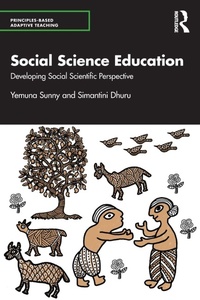
Social Science Education
Developing Social Scientific Perspective
1st Edition
Published on 26. August 2024
Book
Paperback/Softback
242 pages
978-1-032-56846-1 (ISBN)
Description
This book provides an introduction into social science pedagogy in India. It delves into the interrelationships between society, social relationships, education, and learning.
Social science education in schools helps build a critical understanding of social processes and institutions. This book critically examines school spaces and approaches to social science teaching and pedagogy in Indian schools. It outlines distinguishing features, differences, and similarities in pedagogical models and also explains how these varied approaches can be applied in the teaching process. The book also addresses the challenges and possibilities of integrating technology in teaching social sciences.
Part of the series, 'Principles-based Adaptive Teaching', this book will be of interest to students and teachers of education and the social sciences. It will also be of interest to teachers, educators, curriculum designers, policy makers and social science course developers, NGOs, and public and private sector bodies who focus on teaching and learning practices.
Social science education in schools helps build a critical understanding of social processes and institutions. This book critically examines school spaces and approaches to social science teaching and pedagogy in Indian schools. It outlines distinguishing features, differences, and similarities in pedagogical models and also explains how these varied approaches can be applied in the teaching process. The book also addresses the challenges and possibilities of integrating technology in teaching social sciences.
Part of the series, 'Principles-based Adaptive Teaching', this book will be of interest to students and teachers of education and the social sciences. It will also be of interest to teachers, educators, curriculum designers, policy makers and social science course developers, NGOs, and public and private sector bodies who focus on teaching and learning practices.
More details
Series
Language
English
Place of publication
London
United Kingdom
Publishing group
Taylor & Francis Ltd
Target group
Professional and scholarly
Postgraduate and Undergraduate Core
Illustrations
62 s/w Abbildungen, 62 s/w Photographien bzw. Rasterbilder, 3 s/w Tabellen
3 Tables, black and white; 62 Halftones, black and white; 62 Illustrations, black and white
Dimensions
Height: 234 mm
Width: 156 mm
Thickness: 14 mm
Weight
404 gr
ISBN-13
978-1-032-56846-1 (9781032568461)
Copyright in bibliographic data and cover images is held by Nielsen Book Services Limited or by the publishers or by their respective licensors: all rights reserved.
Schweitzer Classification
Other editions
Additional editions
Book
08/2024
1st Edition
Routledge India
€205.70
Shipment within 15-20 days
E-Book
08/2024
1st Edition
Routledge India
€53.99
Available for download
E-Book
08/2024
1st Edition
Routledge India
€53.99
Available for download
Persons
Yemuna Sunny is a researcher, teacher and writer who has been engaged with social science education for nearly three decades. She has been a senior fellow in the Eklavya Foundation in Madhya Pradesh. She has been part of the focus group for social science for the National Curriculum Framework, 2005, and played a pivotal role in guiding teachers to write social science text books in Kerala state in 2008. She was central to the evolution of the course 'Pedagogy of social studies' in the Masters of Arts in Education (Elementary) (MAEE) programme at the Tata Institute of Social Sciences, Mumbai, which she taught for nine years. She has vast experience in writing for teachers, students, and curriculum developers. Her research and publications are based mostly on social geography, politics of knowledge, and critiques of curriculum and educational policies, tribal issues and sustainable development. She has authored a number of articles and books. Her recent writings, along with innovative cartographies, are being published as books for young readers.
Simantini Dhuru is the Director of the Avehi Abacus Project, Mumbai - a unique educational initiative devoted to strengthening and transforming public education. She has played a key role in policy-making and curriculum development bodies at state and national levels (particularly actively contributing her experiences and insights in the capacity of a member to the National Executive Committee for Sarva Shikha Abhiyan, NCERT and Maharashtra SCERT). She is a visiting faculty with the Centre of Excellence in Teacher Education (CETE, formerly CEIAR), where she developed and taught the integrated B.Ed. M.Ed. course, and the School of Education at the Tata Institute of Social Sciences. She also developed and taught a course in Indian Education at the Department of Asian Languages and Cultures, University of Michigan, Ann Arbor campus. She is also a documentary filmmaker with national and international awards to her credit.
Simantini Dhuru is the Director of the Avehi Abacus Project, Mumbai - a unique educational initiative devoted to strengthening and transforming public education. She has played a key role in policy-making and curriculum development bodies at state and national levels (particularly actively contributing her experiences and insights in the capacity of a member to the National Executive Committee for Sarva Shikha Abhiyan, NCERT and Maharashtra SCERT). She is a visiting faculty with the Centre of Excellence in Teacher Education (CETE, formerly CEIAR), where she developed and taught the integrated B.Ed. M.Ed. course, and the School of Education at the Tata Institute of Social Sciences. She also developed and taught a course in Indian Education at the Department of Asian Languages and Cultures, University of Michigan, Ann Arbor campus. She is also a documentary filmmaker with national and international awards to her credit.
Content
List of Figures. Series editors' preface. Foreword. Acknowledgements. Introduction. Part 1: Society, state, and consciousness 1..Studying society 2. State formation and social consciousness 3. The modern state and citizenship education Part 2: Democracy, education, technology 4. Approaches to teaching social sciences: Why, what, and how? 5. Technology, teaching, and the practice of social sciences Part 3: Challenges and possibilities 6. Can classrooms transform? 7. Teachers, society, and the classroom. Bibliography. Index.