

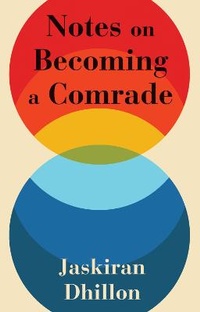
Notes on Becoming a Comrade
Book
Paperback/Softback
144 pages
978-1-942173-46-5 (ISBN)
Description
As the devastating effects of capitalist-driven climate crisis grow, Indigenous-led pipeline struggles, landback campaigns, movements against militarism and policing, and the fight to end the patriarchal, colonial violence against Indigenous women, girls, and two-spirit people have become more urgent than ever. In Notes on Becoming a Comrade, Jaskiran Dhillon explores ways to practice politicized allyship and the necessity for non-Indigenous comrades to stand in direct support of Indigenous people-from Turtle Island to Palestine. But what does it actually mean to be a comrade and what challenges must we overcome to become one?
Approaching these questions through an Indigenous feminist framework, this autoethnographic study charts Dhillon's own political trajectory as an anticolonial organizer and researcher. In humble, generous, lithe prose she brings her experiences to life-foregrounding relationality, trust, humility, critical self-reflexivity, and learning as the cornerstones of being a good comrade in struggle. From the politics of writing and research to the paralysis of guilt to the complexity of history and identity, Notes on Becoming a Comrade demands we understand and accept the responsibility we all have to fight against colonialism and global capitalism-in all its forms. Learning from the leadership of Indigenous women, Dhillon explicates how gender violence and Indigenous sovereignty; revolutionary environmentalism; and abolition all converge in a global, active, and growing anticolonial and anticapitalist movement that relies on the existence of comrades standing shoulder-to-shoulder in all corners of the world.
Notes on Becoming a Comrade is a powerful call-to-action that uncompromisingly demands us to question what risks we must take and what solidarity we must practice for all of us to truly be free.
Approaching these questions through an Indigenous feminist framework, this autoethnographic study charts Dhillon's own political trajectory as an anticolonial organizer and researcher. In humble, generous, lithe prose she brings her experiences to life-foregrounding relationality, trust, humility, critical self-reflexivity, and learning as the cornerstones of being a good comrade in struggle. From the politics of writing and research to the paralysis of guilt to the complexity of history and identity, Notes on Becoming a Comrade demands we understand and accept the responsibility we all have to fight against colonialism and global capitalism-in all its forms. Learning from the leadership of Indigenous women, Dhillon explicates how gender violence and Indigenous sovereignty; revolutionary environmentalism; and abolition all converge in a global, active, and growing anticolonial and anticapitalist movement that relies on the existence of comrades standing shoulder-to-shoulder in all corners of the world.
Notes on Becoming a Comrade is a powerful call-to-action that uncompromisingly demands us to question what risks we must take and what solidarity we must practice for all of us to truly be free.
Reviews / Votes
"Dhillon makes rich theoretical arguments accessible to readers. Indeed, it is Dhillon's candid, engaging, and imaginative language that makes this book a pleasure to read."-Janique Dubois, The Journal of Native Studies"[Prairie Rising] is moreover a model of how to bridge academic scholarship and responsible community advocacy."-Robert Nichols author of Theft is Property! in Theory and Event
"By offering a politics of materiality derived from the lived experiences of urban Indigenous youth caught in the teeth of colonial violence, Prairie Rising offers a productive ground for an effective decolonial praxis."-Melanie K. Yazzie - NAIS
"Prairie Rising is an ambitious first book, and makes helpful contributions to the areas of youth studies, the anthropology of the modern state, discourses and institutional practices of neoliberalism, as well as Indigenous resistance and survivance under settler colonial conditions on Turtle Island. Prairie Rising is a useful and thorough reminder that our neighbours to the north themselves have a long way to go before they can speak of true reconciliation, much less justice."-Smaran Dayal in Critical Ethnic Studies
"Jaskiran Dhillon completely unmasks the discourse of 'participation' as a neoliberal, multicultural, and settler-colonial governmental ruse."-Audra Simpson, Professor, Department of Anthropology, Columbia University
"If we are truly committed to reconciliation, the political analysis offered in this accessible ethnographic book must become the foundation of decolonizing education in psychology, educational studies, criminal justice, and child welfare."-Verna St. Denis, Department of Educational Foundations, University of Saskatchewan
"Jaskiran Dhillon's beautifully written, deeply engaging, and well-argued critique of inclusion is truly a pleasure to read."-Sherene H. Razack, Penney Kanner Endowed Chair in Women's Studies, University of California, Los Angeles
More details
Language
English
Place of publication
Matawan
United Kingdom
Product notice
Paperback (trade)
Dimensions
Height: 177 mm
Width: 127 mm
ISBN-13
978-1-942173-46-5 (9781942173465)
Copyright in bibliographic data and cover images is held by Nielsen Book Services Limited or by the publishers or by their respective licensors: all rights reserved.
Schweitzer Classification
Person
Jaskiran Dhillon is a first generation anticolonial scholar and organizer who grew up on Treaty Six Cree Territory in Saskatchewan, Canada. Her work spans the fields of settler colonialism, anthropology of the state, environmental justice, antiracist feminism, colonial violence, political ecology, youth studies, and Indigenous studies and has been published in The Guardian, Cultural Anthropology, Truthout, Public Seminar, Feminist Formations, Social Texts, and Decolonization among other venues. She is the author of Prairie Rising: Indigenous Youth, Decolonization, and the Politics of Intervention (University of Toronto Press) and the co-editor of Standing with Standing Rock: Voices from the #NoDAPL Movement (University of Minnesota Press). She is associate professor of global studies and anthropology at The New School in New York City.