

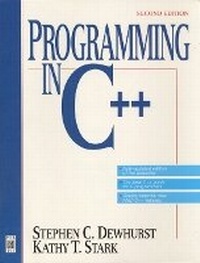
Programming in C++
2nd Edition
Published on 1. May 1995
Book
Paperback/Softback
320 pages
978-0-13-182718-9 (ISBN)
Description
For programmers familiar with C who are interested in programming in C++.
This is the long awaited second edition of the best-selling guide to Programming in C++. The authors discuss programming issues and develop topics of C++ programming paradigms and their supporting language features in parallel. Their goal is to foster understanding of C++ beyond simple syntax, so that it can be used as a flexible and effective programming tool. Interweaves a presentation of the C++ language features with discussion of the techniques and paradigms for which they were designed. Includes new information on key languages features, such as templates, exception handling, and wide characters.
This is the long awaited second edition of the best-selling guide to Programming in C++. The authors discuss programming issues and develop topics of C++ programming paradigms and their supporting language features in parallel. Their goal is to foster understanding of C++ beyond simple syntax, so that it can be used as a flexible and effective programming tool. Interweaves a presentation of the C++ language features with discussion of the techniques and paradigms for which they were designed. Includes new information on key languages features, such as templates, exception handling, and wide characters.
More details
Edition
2nd edition
Language
English
Place of publication
Upper Saddle River
United States
Publishing group
Pearson Education (US)
Target group
College/higher education
Dimensions
Height: 235 mm
Width: 180 mm
Thickness: 14 mm
Weight
504 gr
ISBN-13
978-0-13-182718-9 (9780131827189)
Copyright in bibliographic data and cover images is held by Nielsen Book Services Limited or by the publishers or by their respective licensors: all rights reserved.
Schweitzer Classification
Other editions
Previous edition

Stephen C. Dewhurst | Kathy T. Stark
Programming in C++
Book
12/1994
Prentice Hall PTR
€34.61
Article exhausted; check for reprint
Content
Preface.
Preface to the First Edition.
Introduction.
I. THE C++ LANGUAGE.
II. PROGRAMMING PARADIGMS.
III. BOOK ORGANIZATION.
1. Data Types and Operations.
1.1 Numeric Types. 1.2 Characters. 1.3 Scalar Types with Relational and Logical Operators. 1.4 Nonabstract Operations. 1.5 User- Defined Types. 1.6 Pointers and Arrays. 1.7 References. 1.8 Const Qualified Types. 1.9 Exercises.
2. Procedural Programming.
2.1 Functions as Modules. 2.2 Functional Decomposition. 2.3 File Organization. 2.4 Structured Programming. 2.5 Overloaded and Inline Functions. 2.6 Template Functions. 2.7 Arguments and Return Values. 2.8 Exercises.
3. Classes.
3.1 Class Types. 3.2 Data Members. 3.3 Function Members. 3.4 Operator Functions. 3.5 Static Members. 3.6 Access Protection and Friends. 3.7 Initialization and Conversions. 3.8 Pointers to Class Members. 3.9 Exercises.
4. Data Abstraction.
4.1 Abstraction and Interface. 4.2 Interface and Implementation. 4.3 Control Abstraction. 4.4 Genericity. 4.5 Exercises.
5. Inheritance.
5.1 Base and Derived Classes. 5.2 Augmentation and Specialization. 5.3 Class Hierarchies. 5.4 Virtual Functions. 5.5 Designing for Inheritance. 5.6 Inheritance as a Design Tool. 5.7 Inheritance for Interface Sharing. 5.8 Multiple Inheritance. 5.9 Virtual Base Classes. 5.10 Exercises.
6. Object-Oriented Programming.
6.1 Designing Objects. 6.2 Finding Objects. 6.3 Object Types as Modules. 6.4 Dynamic Object-Oriented Style. 6.5 Exercises.
7. Storage Management.
7.1 General-Purpose Storage Management. 7.2 Class-Specific Storage Management. 7.3 Copy Semantics. 7.4 Temporaries and Efficiency. 7.5 Operator. 7.6 Exercises.
8. Libraries.
8.1 Interface Encapsulation. 8.2 Error Interfaces and Exception. 8.3 Client Customizable Libraries. 8.4 Library Extensibility. 8.5 Exercises.
Appendix: Solved Exercises.
Index.
Preface to the First Edition.
Introduction.
I. THE C++ LANGUAGE.
II. PROGRAMMING PARADIGMS.
III. BOOK ORGANIZATION.
1. Data Types and Operations.
1.1 Numeric Types. 1.2 Characters. 1.3 Scalar Types with Relational and Logical Operators. 1.4 Nonabstract Operations. 1.5 User- Defined Types. 1.6 Pointers and Arrays. 1.7 References. 1.8 Const Qualified Types. 1.9 Exercises.
2. Procedural Programming.
2.1 Functions as Modules. 2.2 Functional Decomposition. 2.3 File Organization. 2.4 Structured Programming. 2.5 Overloaded and Inline Functions. 2.6 Template Functions. 2.7 Arguments and Return Values. 2.8 Exercises.
3. Classes.
3.1 Class Types. 3.2 Data Members. 3.3 Function Members. 3.4 Operator Functions. 3.5 Static Members. 3.6 Access Protection and Friends. 3.7 Initialization and Conversions. 3.8 Pointers to Class Members. 3.9 Exercises.
4. Data Abstraction.
4.1 Abstraction and Interface. 4.2 Interface and Implementation. 4.3 Control Abstraction. 4.4 Genericity. 4.5 Exercises.
5. Inheritance.
5.1 Base and Derived Classes. 5.2 Augmentation and Specialization. 5.3 Class Hierarchies. 5.4 Virtual Functions. 5.5 Designing for Inheritance. 5.6 Inheritance as a Design Tool. 5.7 Inheritance for Interface Sharing. 5.8 Multiple Inheritance. 5.9 Virtual Base Classes. 5.10 Exercises.
6. Object-Oriented Programming.
6.1 Designing Objects. 6.2 Finding Objects. 6.3 Object Types as Modules. 6.4 Dynamic Object-Oriented Style. 6.5 Exercises.
7. Storage Management.
7.1 General-Purpose Storage Management. 7.2 Class-Specific Storage Management. 7.3 Copy Semantics. 7.4 Temporaries and Efficiency. 7.5 Operator. 7.6 Exercises.
8. Libraries.
8.1 Interface Encapsulation. 8.2 Error Interfaces and Exception. 8.3 Client Customizable Libraries. 8.4 Library Extensibility. 8.5 Exercises.
Appendix: Solved Exercises.
Index.