

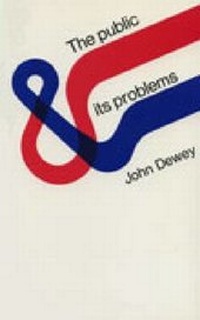
The Public and Its Problems
Published on 1. November 1991
Book
Paperback/Softback
242 pages
978-0-8040-0254-7 (ISBN)
Description
In The Public and Its Problems, a classic of social and political philosophy, John Dewey exhibits his strong faith in the potential of human intelligence to solve the public's problems. In his characteristic provocative style, Dewey clarifies the meaning and implications of such concepts as "the public," "the state," "government," and "political democracy." He distinguishes his a posterior reasoning from a priori reasoning, which, he argues permeates less meaningful discussion of basic concepts. Dewey repeatedly demonstrates the interrelationships between fact and theory.
More details
Language
English
Place of publication
Ohio
United States
Publishing group
Ohio University Press
Target group
College/higher education
Professional and scholarly
Dimensions
Height: 115 mm
Width: 140 mm
ISBN-13
978-0-8040-0254-7 (9780804002547)
Copyright in bibliographic data and cover images is held by Nielsen Book Services Limited or by the publishers or by their respective licensors: all rights reserved.
Schweitzer Classification
Other editions
New editions
Book
10/2016
Swallow Press
€22.50
Shipment within 10-20 days
Person
John Dewey (1859-1952) was an American philosopher, psychologist and educational reformer whose ideas have been influential in education and social reform. Dewey was an important early developer of the philosophy of pragmatism and one of the founders of functional psychology. He was a major representative of progressive education and liberalism. In 1894 Dewey joined the newly founded University of Chicago (1894-1904) where he developed his belief in an empirically based theory of knowledge, becoming associated with the newly emerging Pragmatic philosophy. His time at the University of Chicago resulted in four essays collectively entitled Thought and its Subject-Matter, which was published with collected works from his colleagues at Chicago under the collective title Studies in Logical Theory (1903). During that time Dewey also initiated the University of Chicago Laboratory Schools, where he was able to actualize the pedagogical beliefs that provided material for his first major work on education, The School and Social Progress (1899). In 1899, Dewey was elected president of the American Psychological Association. From 1904 until his retirement in 1930 he was professor of philosophy at both Columbia University and Columbia University's Teachers College. In 1905 he became president of the American Philosophical Association. He was a longtime member of the American Federation of Teachers.