

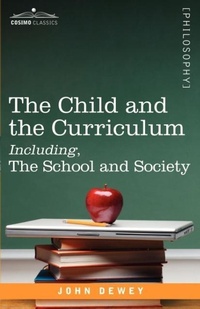
The Child and the Curriculum Including, the School and Society
Published on 1. November 2008
Book
Paperback/Softback
204 pages
978-1-60520-105-4 (ISBN)
Description
Abandon the notion of subject-matter as something fixed and ready-made in itself, outside the child's experience; cease thinking of the child's experience as also something hard and fast; see it as something fluent, embryonic, vital; and we realize that the child and the curriculum are simply two limits which define a single process.
-from The Child and the Curriculum
In this single volume, readers will find two of John Dewey's insightful essays on education in America. He considered proper education to be fundamental to a functioning democracy. The problem, according to Dewey in The School and Society, with the old education model was that elementary schools did not encourage exploration and curiosity in their students.
In The Child and the Curriculum, Dewey expands upon his definition of the ideal teaching method. A child's life, he says, is an integrated whole. A child will flow from one topic to another, taking a natural interest in subjects and dealing with a world of direct experience. School, on the other hand, addresses a world disconnected from a child's life. A more reasonable approach would be to strive to integrate their experience with the vast body of knowledge that society wishes them to know. By honoring the individual, both the student and the subject matter will come together in a process that produces a mature adult.
American educator and philosopher JOHN DEWEY (1859-1952) helped found the American Association of University Professors. He served as professor of philosophy at Columbia University from 1904 to 1930 and authored numerous books, including How We Think (1910), Experience and Nature (1925), Experience and Education (1938), and Freedom and Culture (1939).
-from The Child and the Curriculum
In this single volume, readers will find two of John Dewey's insightful essays on education in America. He considered proper education to be fundamental to a functioning democracy. The problem, according to Dewey in The School and Society, with the old education model was that elementary schools did not encourage exploration and curiosity in their students.
In The Child and the Curriculum, Dewey expands upon his definition of the ideal teaching method. A child's life, he says, is an integrated whole. A child will flow from one topic to another, taking a natural interest in subjects and dealing with a world of direct experience. School, on the other hand, addresses a world disconnected from a child's life. A more reasonable approach would be to strive to integrate their experience with the vast body of knowledge that society wishes them to know. By honoring the individual, both the student and the subject matter will come together in a process that produces a mature adult.
American educator and philosopher JOHN DEWEY (1859-1952) helped found the American Association of University Professors. He served as professor of philosophy at Columbia University from 1904 to 1930 and authored numerous books, including How We Think (1910), Experience and Nature (1925), Experience and Education (1938), and Freedom and Culture (1939).
More details
Series
Language
English
Place of publication
United States
Product notice
Paperback (trade)
Unsewn / adhesive bound
Illustrations
Illustrations, black and white
Dimensions
Height: 217 mm
Width: 139 mm
Thickness: 27 mm
Weight
266 gr
ISBN-13
978-1-60520-105-4 (9781605201054)
Copyright in bibliographic data and cover images is held by Nielsen Book Services Limited or by the publishers or by their respective licensors: all rights reserved.
Schweitzer Classification