

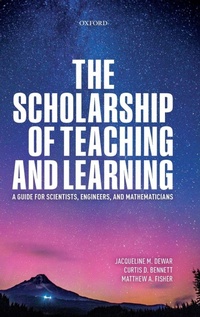
The Scholarship of Teaching and Learning
A Guide for Scientists, Engineers, and Mathematicians
Published on 3. May 2018
Book
Hardback
196 pages
978-0-19-882121-2 (ISBN)
Description
The Scholarship of Teaching and Learning: A Guide for Scientists, Engineers, and Mathematicians shows college and university faculty members how to draw on their disciplinary knowledge and teaching experience to investigate questions about student learning. It takes readers all the way through the inquiry process beginning with framing a research question and selecting a research design, moving on to gathering and analyzing evidence, and finally to making the results public. Numerous examples are provided at each stage, many from published studies of teaching and learning in science, engineering, or mathematics. At strategic points, short sets of questions prompt readers to pause and reflect, plan, or act. These questions are derived from the authors' experience leading many workshops in the United States and Canada on how to do the scholarship of teaching and learning (SoTL). The taxonomy of SoTL questions-What works? What is? What could be?-that emerged from the SoTL studies undertaken by scholars in the Carnegie Academic for the Scholarship of Teaching and Learning serves as a framework at many stages of the inquiry process. The book addresses the issue of evaluating and valuing this work, including implications for junior faculty who wish to engage in SoTL. The authors explain why SoTL should be of interest to STEM (science, technology, engineering, and mathematics) faculty at all types of higher education institutions, including faculty members active in traditional STEM research. They also give their perspective on the benefits of SoTL to faculty, to their institutions, to the academy, and to students.
Reviews / Votes
The authors have carefully organized their knowledge of the scholarship of teaching and learning (SoTL) in STEM contexts. This book could be highly useful as a text for a SoTL community involving and designed to benefit STEM faculty... and an important resource for students capstone projects. * Woong Lim, Mathematical Association of America Reviews *More details
Language
English
Place of publication
Oxford
United Kingdom
Target group
Professional and scholarly
Dimensions
Height: 240 mm
Width: 161 mm
Thickness: 15 mm
Weight
464 gr
ISBN-13
978-0-19-882121-2 (9780198821212)
Copyright in bibliographic data and cover images is held by Nielsen Book Services Limited or by the publishers or by their respective licensors: all rights reserved.
Schweitzer Classification
Other editions
Additional editions
Jacqueline Dewar | Curtis Bennett | Matthew A. Fisher
The Scholarship of Teaching and Learning
A Guide for Scientists, Engineers, and Mathematicians
E-Book
04/2018
1st Edition
OUP eBook
€73.99
Available for download
Jacqueline Dewar | Curtis Bennett | Matthew A. Fisher
The Scholarship of Teaching and Learning
A Guide for Scientists, Engineers, and Mathematicians
E-Book
04/2018
1st Edition
OUP eBook
€73.99
Available for download
Persons
Jacqueline M. Dewar, is Professor Emerita of Mathematics at Loyola Marymount University in Los Angeles. She received the Mathematical Association of America's Haimo award for Distinguished Teaching and the Association for Women in Mathematics Louise Hay award for contributions to mathematics education, was a Carnegie scholar, co-edited two books, co-authored several undergraduate mathematics textbooks, and has more than 15 publications related to faculty development or undergraduate teaching and learning.
Curtis D. Bennett is the Richard D. Green Dean of the College of Natural Sciences and Mathematics at California State University, Long Beach. He received the Haimo award for Distinguished Teaching from the Mathematical Association of America, was a two-time Carnegie Scholar with the Carnegie Foundation's Academy for the Scholarship of Teaching and Learning, and has over 30 publications in research and expository mathematics and the Scholarship of Teaching and Learning.
Matthew A. Fisher is an Associate Professor of Chemistry, Saint Vincent College, Latrobe PA. He received his Ph.D. in Biochemistry from the University of Wisconsin-Madison in 1990, was named a Fellow of the American Chemical Society in 2015, was a Carnegie Scholar with the Carnegie Foundation's Academy for the Scholarship of Teaching and Learning and has over 15 publications in the Scholarship of Teaching and Learning.
Curtis D. Bennett is the Richard D. Green Dean of the College of Natural Sciences and Mathematics at California State University, Long Beach. He received the Haimo award for Distinguished Teaching from the Mathematical Association of America, was a two-time Carnegie Scholar with the Carnegie Foundation's Academy for the Scholarship of Teaching and Learning, and has over 30 publications in research and expository mathematics and the Scholarship of Teaching and Learning.
Matthew A. Fisher is an Associate Professor of Chemistry, Saint Vincent College, Latrobe PA. He received his Ph.D. in Biochemistry from the University of Wisconsin-Madison in 1990, was named a Fellow of the American Chemical Society in 2015, was a Carnegie Scholar with the Carnegie Foundation's Academy for the Scholarship of Teaching and Learning and has over 15 publications in the Scholarship of Teaching and Learning.
Content
0: A Worthy Endeavor
1: Understanding the Scholarship of Teaching and Learning (SoTL)
2: Developing a Researchable Question
3: Designing a Research Study
4: Gathering Evidence: The Basics
5: Evidence: From Surveys
6: Evidence: From Interviews, Focus Groups, and Think-alouds
7: Analyzing Evidence
8: The Final Step: Going Public
9: Reflecting on the Benefits of SoTL
1: Understanding the Scholarship of Teaching and Learning (SoTL)
2: Developing a Researchable Question
3: Designing a Research Study
4: Gathering Evidence: The Basics
5: Evidence: From Surveys
6: Evidence: From Interviews, Focus Groups, and Think-alouds
7: Analyzing Evidence
8: The Final Step: Going Public
9: Reflecting on the Benefits of SoTL