

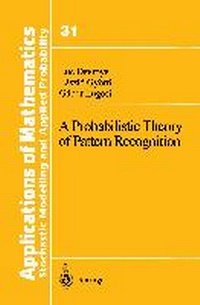
A Probabilistic Theory of Pattern Recognition
Published on 22. November 2013
Book
Paperback/Softback
XV, 638 pages
978-1-4612-6877-2 (ISBN)
Description
A self-contained and coherent account of probabilistic techniques, covering: distance measures, kernel rules, nearest neighbour rules, Vapnik-Chervonenkis theory, parametric classification, and feature extraction. Each chapter concludes with problems and exercises to further the readers understanding. Both research workers and graduate students will benefit from this wide-ranging and up-to-date account of a fast- moving field.
More details
Product info
Paperback
Series
Language
English
Place of publication
New York, NY
United States
Target group
Research
Illustrations
biography
Dimensions
Height: 236 mm
Width: 157 mm
Thickness: 38 mm
Weight
950 gr
ISBN-13
978-1-4612-6877-2 (9781461268772)
DOI
10.1007/978-1-4612-0711-5
Schweitzer Classification
Other editions
Additional editions
Luc Devroye | Laszlo Györfi | Gabor Lugosi
A Probabilistic Theory of Pattern Recognition
E-Book
11/2013
Springer
€106.99
Available for download
Luc Devroye | László Györfi | Gabor Lugosi
A Probabilistic Theory of Pattern Recognition
Book
02/1997
1st Edition
Springer
€149.79
Shipment within 5-7 days
Content
Preface * Introduction * The Bayes Error * Inequalities and alternate distance measures * Linear discrimination * Nearest neighbor rules * Consistency * Slow rates of convergence Error estimation * The regular histogram rule * Kernel rules Consistency of the k-nearest neighbor rule * Vapnik-Chervonenkis theory * Combinatorial aspects of Vapnik-Chervonenkis theory * Lower bounds for empirical classifier selection * The maximum likelihood principle * Parametric classification * Generalized linear discrimination * Complexity regularization * Condensed and edited nearest neighbor rules * Tree classifiers * Data-dependent partitioning * Splitting the data * The resubstitution estimate * Deleted estimates of the error probability * Automatic kernel rules * Automatic nearest neighbor rules * Hypercubes and discrete spaces * Epsilon entropy and totally bounded sets * Uniform laws of large numbers * Neural networks * Other error estimates * Feature extraction * Appendix * Notation * References * Index