

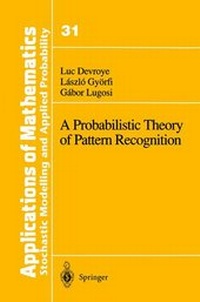
A Probabilistic Theory of Pattern Recognition
1st Edition
Published on 20. February 1997
Book
Hardback
XV, 638 pages
978-0-387-94618-4 (ISBN)
Description
A self-contained and coherent account of probabilistic techniques, covering: distance measures, kernel rules, nearest neighbour rules, Vapnik-Chervonenkis theory, parametric classification, and feature extraction. Each chapter concludes with problems and exercises to further the readers understanding. Both research workers and graduate students will benefit from this wide-ranging and up-to-date account of a fast- moving field.
More details
Product info
HC runder Rücken kaschiert
Series
Edition
1st ed. 1996. Corr. 2nd printing
Language
English
Place of publication
New York, NY
United States
Target group
Research
Edition type
Revised edition
Product notice
Laminated cover
Illustrations
biography
Dimensions
Height: 235 mm
Width: 155 mm
Thickness: 41 mm
Weight
1140 gr
ISBN-13
978-0-387-94618-4 (9780387946184)
DOI
10.1007/978-1-4612-0711-5
Schweitzer Classification
Other editions
Additional editions
Luc Devroye | Laszlo Györfi | Gabor Lugosi
A Probabilistic Theory of Pattern Recognition
E-Book
11/2013
Springer
€106.99
Available for download
Luc Devroye | László Györfi | Gabor Lugosi
A Probabilistic Theory of Pattern Recognition
Book
11/2013
Springer
€106.99
Shipment within 15-20 days
Content
Preface * Introduction * The Bayes Error * Inequalities and alternate distance measures * Linear discrimination * Nearest neighbor rules * Consistency * Slow rates of convergence Error estimation * The regular histogram rule * Kernel rules Consistency of the k-nearest neighbor rule * Vapnik-Chervonenkis theory * Combinatorial aspects of Vapnik-Chervonenkis theory * Lower bounds for empirical classifier selection * The maximum likelihood principle * Parametric classification * Generalized linear discrimination * Complexity regularization * Condensed and edited nearest neighbor rules * Tree classifiers * Data-dependent partitioning * Splitting the data * The resubstitution estimate * Deleted estimates of the error probability * Automatic kernel rules * Automatic nearest neighbor rules * Hypercubes and discrete spaces * Epsilon entropy and totally bounded sets * Uniform laws of large numbers * Neural networks * Other error estimates * Feature extraction * Appendix * Notation * References * Index