

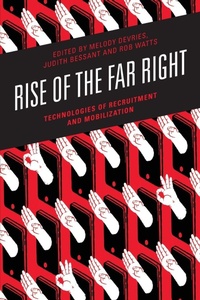
Rise of the Far Right
Technologies of Recruitment and Mobilization
Published on 11. March 2022
Book
Paperback/Softback
292 pages
978-1-5381-5890-6 (ISBN)
Description
After decades on the social and political margins, far-right groups and movements are enjoying increasing success, and even claiming a place in mainstream electoral politics in many Western political systems.
Research shows that new media like Twitter, YouTube, and community sites likes 4chan and Reddit are increasingly involved with the mobilization of popular support for far-right electoral campaigns, and even organized political violence. These technologies - including other social media, discussion websites, certain online games, chat servers, talk radio, cable news, and print media - are making contemporary far-right ideologies possible in diverse ways, altering methods of recruitment to the extent that they become unrecognizable from far-right movements of the past, and thus, more dangerous.
The results of these new technological processes can be seen in the increasing normalization of far-right values within mainstream culture, politics, and media ecosystems within countries from the United States, Britain, Australia, Germany, and Hungary.
This book brings together recent academic research exploring how far-right groups use new media to recruit followers to extremist beliefs and mobilize political action. In doing so, the book reveals the complex ways that evolving technologies are used both purposively, subtly, and in some cases incidentally, to recruit and mobilize far-right support.
Research shows that new media like Twitter, YouTube, and community sites likes 4chan and Reddit are increasingly involved with the mobilization of popular support for far-right electoral campaigns, and even organized political violence. These technologies - including other social media, discussion websites, certain online games, chat servers, talk radio, cable news, and print media - are making contemporary far-right ideologies possible in diverse ways, altering methods of recruitment to the extent that they become unrecognizable from far-right movements of the past, and thus, more dangerous.
The results of these new technological processes can be seen in the increasing normalization of far-right values within mainstream culture, politics, and media ecosystems within countries from the United States, Britain, Australia, Germany, and Hungary.
This book brings together recent academic research exploring how far-right groups use new media to recruit followers to extremist beliefs and mobilize political action. In doing so, the book reveals the complex ways that evolving technologies are used both purposively, subtly, and in some cases incidentally, to recruit and mobilize far-right support.
Reviews / Votes
This volume offers a timely, novel, and important contribution to current and emerging research on the nexus of the far right and digital technologies. -- Tanner Mirrlees, Assistant Professor in the Communication and Digital Media Studies Program at the University of Ontario Institute of Technology Analysing recruitment tactics, this volume provides significant information on how far right actors and their supporters become engaged in extremist politics, and how their contributions to and consumption of media artefacts on these platforms alters and influences their views and actions. -- Peter Lentini, Associate Professor of Politics and International Relations, Monash University Unraveling the connection between the radical right and technology is awkward, messy and dirty work, but work that the scientific community simply has to do, because its duty is to approach and explain existing social trends and events. At the same time, there is no intellectual sword with which one could cut the tangled knot of technology and the radical right - we need many a hands and eyes that will carefully, devotedly and meticulously untangle part by part the complex (internet) network, so that we can understand the fusion of technology and the contemporary digital radical right. If such a need is ignored and the process of analyzing the connection between technology and the contemporary radical right does not start, there is no doubt that the radical right will continue to further develop its use of digital technology - we will never be able to penetrate to the core of that relationship. At the same time, the authors of this book, in trying to expose this connection, had to come into contact with a multitude of invasive radical right-wing thoughts and content, leaving themselves exposed to the danger of experiencing permanent negative consequences for their political perception and worldview. Therefore, we must not allow their noble sacrifice to be in vain. * The Croatian Book Review *More details
Language
English
Place of publication
United States
Publishing group
Bloomsbury Publishing Plc
Target group
Professional and scholarly
US School Grade: From College Senior to College Graduate Student
Illustrations
58 b/w illustrations;4 tables;
Dimensions
Height: 229 mm
Width: 152 mm
Thickness: 16 mm
Weight
438 gr
ISBN-13
978-1-5381-5890-6 (9781538158906)
Copyright in bibliographic data and cover images is held by Nielsen Book Services Limited or by the publishers or by their respective licensors: all rights reserved.
Schweitzer Classification
Other editions
Additional editions

Melody Devries | Judith Bessant | Rob Watts
Rise of the Far Right
Technologies of Recruitment and Mobilization
E-Book
07/2021
1st Edition
Rowman & Littlefield Publishers
€35.49
Available for download
Persons
Melody Devries is a PhD Candidate in the Communication and Culture Department at Ryerson University, Canada.
Judith Bessant is Professor at RMIT University, Melbourne, Australia and an Adjunct Professor at the School of Justice, QUT, Australia.
Rob Watts is Professor of Social Policy at RMIT University, Melbourne.
Judith Bessant is Professor at RMIT University, Melbourne, Australia and an Adjunct Professor at the School of Justice, QUT, Australia.
Rob Watts is Professor of Social Policy at RMIT University, Melbourne.
Content
1. Introduction: The Uncanny Political Work of Technologies, Melody Devries, Judith Bessant, and Rob Watts
Part I: Electoral and Institutional Resurgence: Campaigns and Wins
2. Far-Right Recruitment and Mobilization on Facebook: The Case of Australia, Jordan McSwiney
3. Populist Myths and Ethno-Nationalist Fears in Hungary, Simon Bradford and Fin Cullen
4. Multi-Platform Social Capital Mobilization Strategies among Anti-LGBTQIA+ Groups in Taiwan, Kenneth C.C. Yang and Yowei Kang
Part II: Social Network, Social Movement and the Gendered Far-Right
5. Twitter as a Channel for Frame Diffusion: Hashtag Activism and the Virality of #HeterosexualPrideDay, JP Armstrong
6. The Online Manosphere and Misogyny in the Far-Right: The Case of the #thotaudit, Simon Copland
7. "A Positive Identity for Men": Pathways to Far-Right Participation through Reddit's /r/MensRights and /r/TheRedPill, Luc S. Cousineau
Part III: Platforms and Alt-Tech Collectivity
8. Soldiers of 4chan: The Role of Anonymous Online Spaces in
Part I: Electoral and Institutional Resurgence: Campaigns and Wins
2. Far-Right Recruitment and Mobilization on Facebook: The Case of Australia, Jordan McSwiney
3. Populist Myths and Ethno-Nationalist Fears in Hungary, Simon Bradford and Fin Cullen
4. Multi-Platform Social Capital Mobilization Strategies among Anti-LGBTQIA+ Groups in Taiwan, Kenneth C.C. Yang and Yowei Kang
Part II: Social Network, Social Movement and the Gendered Far-Right
5. Twitter as a Channel for Frame Diffusion: Hashtag Activism and the Virality of #HeterosexualPrideDay, JP Armstrong
6. The Online Manosphere and Misogyny in the Far-Right: The Case of the #thotaudit, Simon Copland
7. "A Positive Identity for Men": Pathways to Far-Right Participation through Reddit's /r/MensRights and /r/TheRedPill, Luc S. Cousineau
Part III: Platforms and Alt-Tech Collectivity
8. Soldiers of 4chan: The Role of Anonymous Online Spaces in