

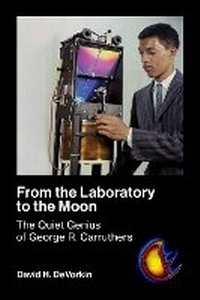
From the Laboratory to the Moon
The Quiet Genius of George R. Carruthers
Published on 20. May 2025
Book
Paperback/Softback
464 pages
978-0-262-55139-7 (ISBN)
Description
The reserved genius and celebrated Black scientist, who built the first astronomical observatory on the moon and worked to inspire underserved students to pursue science and engineering.
In April 1972, as George Carruthers closely monitored the operation from the Manned Spacecraft Center in Houston, astronauts conducting the Apollo 16 mission positioned a gold-plated far ultraviolet electrographic camera on the moon. The camera, Carruthers's invention, was the first astronomical observatory on the lunar surface, where it stands to this day. While Carruthers's achievements earned many accolades, including the President's Medal for Technology and Invention, surprisingly little is known about this remarkable man. In From the Laboratory to the Moon, David DeVorkin explores Carruthers's life and work, for the first time telling the full story of how a deeply reserved African American farm boy rose to become one of our most celebrated aerospace scientists.
DeVorkin follows Carruthers from his childhood in Ohio and then Chicago to his career at the US Naval Research Laboratory in Washington, DC. In the highly competitive world of space science in the 1960s and 1970s, Carruthers's genius for experimentation and exploration transcended the racial stereotyping and discrimination of his day, and he achieved world-class recognition for his studies of the Earth and deep space. A leading expert in the history of astronomy and space science, DeVorkin gives a deft account of these achievements and of how Carruthers used the fame they brought him, along with his notoriety as a Black man in science, to become a tireless advocate for underserved young people in science and engineering.
In April 1972, as George Carruthers closely monitored the operation from the Manned Spacecraft Center in Houston, astronauts conducting the Apollo 16 mission positioned a gold-plated far ultraviolet electrographic camera on the moon. The camera, Carruthers's invention, was the first astronomical observatory on the lunar surface, where it stands to this day. While Carruthers's achievements earned many accolades, including the President's Medal for Technology and Invention, surprisingly little is known about this remarkable man. In From the Laboratory to the Moon, David DeVorkin explores Carruthers's life and work, for the first time telling the full story of how a deeply reserved African American farm boy rose to become one of our most celebrated aerospace scientists.
DeVorkin follows Carruthers from his childhood in Ohio and then Chicago to his career at the US Naval Research Laboratory in Washington, DC. In the highly competitive world of space science in the 1960s and 1970s, Carruthers's genius for experimentation and exploration transcended the racial stereotyping and discrimination of his day, and he achieved world-class recognition for his studies of the Earth and deep space. A leading expert in the history of astronomy and space science, DeVorkin gives a deft account of these achievements and of how Carruthers used the fame they brought him, along with his notoriety as a Black man in science, to become a tireless advocate for underserved young people in science and engineering.
More details
Language
English
Place of publication
Cambridge (Massachusetts)
United States
Publishing group
MIT Press Ltd
Illustrations
43 BLACK AND WHITE ILLUS.
Dimensions
Height: 229 mm
Width: 152 mm
ISBN-13
978-0-262-55139-7 (9780262551397)
Copyright in bibliographic data and cover images is held by Nielsen Book Services Limited or by the publishers or by their respective licensors: all rights reserved.
Schweitzer Classification
Other editions
Additional editions
E-Book
05/2025
MIT Press
€73.49
Available for download
Person
David DeVorkin is Senior Curator Emeritus of the History of Astronomy at the National Air and Space Museum, Smithsonian Institution.
Content
Series Foreword
Author's Affinity
Acknowledgments
Acronyms
Glossary
1 Introduction and Overview
2 Family History and Early Life
3 College Years
4 Postdoctoral Years at NRL
5 Improving His Camera
6 Proposals to NASA Post Apollo
7 Living in Washington, DC and Aiming for the Moon
8 On the Moon, and After the Moon
9 Attention: Public and Private
10 Human Spaceflight Post Apollo
11 Preparing for the Space Shuttle
12 Changes in Management and Technology
13 Reaching Out and Giving Back
14 Family Life and Recognition in Later Years
Oral History Interviews
Archival Resources
Appendix 1: Testimony from Mentees
Appendix 2: Conserving and Displaying Carruthers' Camera
Oral History Interviews
Archival Resources
Notes
Bibliography
Index
Author's Affinity
Acknowledgments
Acronyms
Glossary
1 Introduction and Overview
2 Family History and Early Life
3 College Years
4 Postdoctoral Years at NRL
5 Improving His Camera
6 Proposals to NASA Post Apollo
7 Living in Washington, DC and Aiming for the Moon
8 On the Moon, and After the Moon
9 Attention: Public and Private
10 Human Spaceflight Post Apollo
11 Preparing for the Space Shuttle
12 Changes in Management and Technology
13 Reaching Out and Giving Back
14 Family Life and Recognition in Later Years
Oral History Interviews
Archival Resources
Appendix 1: Testimony from Mentees
Appendix 2: Conserving and Displaying Carruthers' Camera
Oral History Interviews
Archival Resources
Notes
Bibliography
Index