

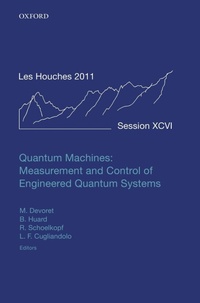
Quantum Machines: Measurement and Control of Engineered Quantum Systems
Lecture Notes of the Les Houches Summer School: Volume 96, July 2011
Published on 12. June 2014
Book
Hardback
602 pages
978-0-19-968118-1 (ISBN)
Description
This book gathers the lecture notes of courses given at the 2011 summer school in theoretical physics in Les Houches, France, Session XCVI.
What is a quantum machine? Can we say that lasers and transistors are quantum machines? After all, physicists advertise these devices as the two main spin-offs of the understanding of quantum mechanical phenomena. However, while quantum mechanics must be used to predict the wavelength of a laser and the operation voltage of a transistor, it does not intervene at the level of the signals processed by these systems. Signals involve macroscopic collective variables like voltages and currents in a circuit or the amplitude of the oscillating electric field in an electromagnetic cavity resonator. In a true quantum machine, the signal collective variables, which both inform the outside on the state of the machine and receive controlling instructions, must themselves be treated as quantum operators, just as the position of the electron in a hydrogen atom. Quantum superconducting circuits, quantum dots, and quantum nanomechanical resonators satisfy the definition of quantum machines. These mesoscopic systems exhibit a few collective dynamical variables, whose fluctuations are well in the quantum regime and whose measurement is essentially limited in precision by the Heisenberg uncertainty principle. Other engineered quantum systems based on natural, rather than artificial degrees of freedom can also qualify as quantum machines: trapped ions, single Rydberg atoms in superconducting cavities, and lattices of ultracold atoms. This book provides the basic knowledge needed to understand and investigate the physics of these novel systems.
What is a quantum machine? Can we say that lasers and transistors are quantum machines? After all, physicists advertise these devices as the two main spin-offs of the understanding of quantum mechanical phenomena. However, while quantum mechanics must be used to predict the wavelength of a laser and the operation voltage of a transistor, it does not intervene at the level of the signals processed by these systems. Signals involve macroscopic collective variables like voltages and currents in a circuit or the amplitude of the oscillating electric field in an electromagnetic cavity resonator. In a true quantum machine, the signal collective variables, which both inform the outside on the state of the machine and receive controlling instructions, must themselves be treated as quantum operators, just as the position of the electron in a hydrogen atom. Quantum superconducting circuits, quantum dots, and quantum nanomechanical resonators satisfy the definition of quantum machines. These mesoscopic systems exhibit a few collective dynamical variables, whose fluctuations are well in the quantum regime and whose measurement is essentially limited in precision by the Heisenberg uncertainty principle. Other engineered quantum systems based on natural, rather than artificial degrees of freedom can also qualify as quantum machines: trapped ions, single Rydberg atoms in superconducting cavities, and lattices of ultracold atoms. This book provides the basic knowledge needed to understand and investigate the physics of these novel systems.
More details
Series
Language
English
Place of publication
Oxford
United Kingdom
Target group
College/higher education
Illustrations
202 b/w illustrations
Dimensions
Height: 250 mm
Width: 175 mm
Thickness: 37 mm
Weight
1203 gr
ISBN-13
978-0-19-968118-1 (9780199681181)
Copyright in bibliographic data and cover images is held by Nielsen Book Services Limited or by the publishers or by their respective licensors: all rights reserved.
Schweitzer Classification
Other editions
Additional editions
Michel Devoret | Benjamin Huard | Robert Schoelkopf
Quantum Machines: Measurement and Control of Engineered Quantum Systems
Lecture Notes of the Les Houches Summer School: Volume 96, July 2011
E-Book
06/2014
1st Edition
OUP eBook
€64.49
Available for download
Persons
Michel H. Devoret:
Department of Applied Physics, Yale University, New Haven, CT, USA
College de France, 11 Place Marcelin Berthelot, Paris, France
; Benjamin Huard:
Laboratoire Pierre Aigrain, CNRS, Ecole Normale Superieure, Paris, France
; Robert Schoelkopf:
Department of Applied Physics, Yale University, New Haven, CT, USA
; Leticia F. Cugliandolo:
Laboratoire de Physique Theorique et Hautes Energies
Universite Pierre et Marie Curie - Paris 6, Paris, France
Department of Applied Physics, Yale University, New Haven, CT, USA
College de France, 11 Place Marcelin Berthelot, Paris, France
; Benjamin Huard:
Laboratoire Pierre Aigrain, CNRS, Ecole Normale Superieure, Paris, France
; Robert Schoelkopf:
Department of Applied Physics, Yale University, New Haven, CT, USA
; Leticia F. Cugliandolo:
Laboratoire de Physique Theorique et Hautes Energies
Universite Pierre et Marie Curie - Paris 6, Paris, France
Editor
, Department of Applied Physics, Yale University, USA; College de France, Paris, France
, Laboratoire Pierre Aigrain, CNRS, Ecole Normale Superieure, Paris, France
, Department of Applied Physics, Yale University, USA
, Laboratoire de Physique Theorique et Hautes Energies, Universite Pierre et Marie Curie - Paris 6, Paris, France
Content
PART I: LECTURES; PART II: SEMINARS