

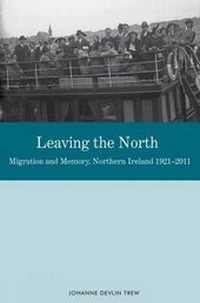
Leaving the North
Migration and Memory, Northern Ireland 1921-2011
Published on 11. October 2013
Book
Hardback
348 pages
978-1-84631-940-2 (ISBN)
Description
Leaving the North is the first book that provides a comprehensive survey of Northern Ireland migration since 1921. Based largely on the personal memories of emigrants who left Northern Ireland from the 1920s to the 2000s, approximately half of whom eventually returned, the book traces their multigenerational experiences of leaving Northern Ireland and adapting to life abroad, with some later returning to a society still mired in conflict. Contextualised by a review of the statistical and policy record, the emigrants' stories reveal that contrary to its well-worn image as an inward-looking place - 'such narrow ground' - Northern Ireland has a rather dynamic migration history, demonstrating that its people have long been looking outward as well as inward, well connected with the wider world. But how many departed and where did they go? And what of the Northern Ireland Diaspora? How has the view of the 'troubled' homeland from abroad, especially among expatriates, contributed to progress along the road to peace? In addressing these questions, the book treats the relationship between migration, sectarianism and conflict, immigration and racism, repatriation and the Peace Process, with particular attention to the experience of Northern Ireland migrants in the two principal receiving societies - Britain and Canada. With the emigration of young people once again on the increase due to the economic downturn, it is perhaps timely to learn from the experiences of the people who have been 'leaving the North' over many decades; not only to acknowledge their departure but in the hope that we might better understand the challenges and opportunities that migration and Diaspora can present.
Reviews / Votes
Reviews'Johanne Devlin Trew's recent book on migration from Northern Ireland is that increasingly rare thing in Irish diaspora studies: research that addresses a genuinely glaring gap in the literature. Leaving the North could hardly be more timely. While it is quickly attaining the status of a core text in Irish migration studies, it is to be hoped that it reaches the wider audience it deserves.'
Marc Scully, Irish Studies Review 'This book by Johanne Devlin Trew is an important contribution to our knowledge and understanding of this particular aspect of migration from the island of Ireland...This relatively untold aspect of the story of movement from Ireland to Britain reveals the complex spatial and temporal dynamics of identifications.'
Louise Ryan, Oral History 'In her engrossing account of Northern Irish emigration since 1921, Leaving the North: Migration and Memory, Northern Ireland 1921-2011, Professor Johanne Devlin Trew combines a mastery of the quantitative and the qualitative approaches to her subject as she endeavors to put "migration back into history". Trew addresses a gap in the Irish migration historiography that has allowed the specific experience of Northern Irish migrants within the overall Irish migration story to fall between the cracks. ... One of the unique features of this book is that the emigrant interviews are conducted both in Northern Ireland and abroad, showing a more complete picture of the subject. ... this book is a worthy read, filling in a historiographical gap for experts while offering some thoughtful insights into the psyche of emigrants for the broader public.'
Peter Moloney, Journal of World History
More details
Language
English
Place of publication
Liverpool
United Kingdom
Target group
Professional and scholarly
Dimensions
Height: 239 mm
Width: 163 mm
ISBN-13
978-1-84631-940-2 (9781846319402)
Copyright in bibliographic data and cover images is held by Nielsen Book Services Limited or by the publishers or by their respective licensors: all rights reserved.
Schweitzer Classification
Person
Johanne Devlin Trew is Lecturer in the School of Criminology, Politics and Social Policy at the University of Ulster.
Content
Introduction
'The truth about stories': Personal perspectives on Ulster migration
Arthur and me
The politics of demography
Chapter summary
Part I: Theory, History and Demography
1: History, memory, migration
Diaspora, migration and identity
Life Stories and migration research
Oral history and Irish migration
Oral narrative research in the context of societal conflict
Migration, time and generation
Memory and emotion in migration research
History, memory and postmemory
Mechanisms of autobiographical memory
Reminiscence bump
Structure of life stories
2: Northern Ireland: Migration history and demography
Demographic summary
Migration and the British Empire
Assisted emigration schemes
Northern Ireland, migration and Empire
Interwar migration, 1920s-1930s
Post-war migration, 1940s-1960s
Characteristics of migrants, 1920s-1960s
Migration, 1970s-2000
Migration since 2001
Refugees and asylum seekers
Conclusion: An all-Ulster perspective
Part II: Voices of Migration and Return
3: 'They were always missed, they were always mentioned': Migration, generation and family history
Memory, migration and generation: Rosina's story
Understanding migration and generation
Families, histories, emotions
'She grieved him all her life': Narrating migration and loss
'It was all just land and trees': Narrating settlement and return
'It was a culture shock': Narrating immigration and generation
Conclusion
4: 'Are you Catholic or Protestant?' Migration, religion and identity
Majorities and minorities: 'Reality very often is not what you would wish it to be'
Majorities and minorities in Northern Ireland
The demography of migration and religion
Religion, migration and conflict
Religion, migration and 'brain drain'
'A big black cloud lifted': Leaving the North
'Are you Catholic or Protestant?' Religion and identity abroad
'They don't see Northerners as Irish': Encounters in 'diaspora space'
'There's nothing wrong with being British and Irish': Migration and identity
Conclusion
5: 'Doubly invisible?' Being Northern Irish in Britain
'Northern Ireland's my soul': Home and identity in Britain
The Irish in Britain: Demography and visibility
'No different than the nineteenth century': Being a Presbyterian navvy
'Pagan England': Family migration to and from Britain
'Flying the flag': Doing business in Britain
'The people with hair left': Social exclusion in Northern Ireland and Britain
'Traumatised by being an Irish person in England': Suffering, silence and victimhood
Conclusion
6: 'A very tolerant country': Immigration to Canada
Brave new world
Canada, British and Irish migration
'Is this what I came to Canada for?' Interwar immigration
'The horizons go on forever': Post-war immigration
'Second class Canadian': 1970s immigration
'Amazing credentials and they don't get work': Immigration since the 1980s
'A very tolerant country': Life in the 'peaceable kingdom'
'The secret of Canada': Conclusion
7: 'I'm back where I belong': Return migration
Returning home: 'I'm back where I belong'
Return migration: Definitions
Dream of return: 'Nobody knows me there'
Failed return: 'Take your political views and shut up'
No return: 'Not in my name'
After return: 'We found we were in trouble with both sides'
Transnational returning: 'A dream that I would have'
Ultimate return: 'I don't want to go home to live, I want to go home to die'
Epilogue: 'I can't see myself leaving and I can't see myself going back'
Postscript
The lost generation
Notes
Bibliography & List of interviews
Index
'The truth about stories': Personal perspectives on Ulster migration
Arthur and me
The politics of demography
Chapter summary
Part I: Theory, History and Demography
1: History, memory, migration
Diaspora, migration and identity
Life Stories and migration research
Oral history and Irish migration
Oral narrative research in the context of societal conflict
Migration, time and generation
Memory and emotion in migration research
History, memory and postmemory
Mechanisms of autobiographical memory
Reminiscence bump
Structure of life stories
2: Northern Ireland: Migration history and demography
Demographic summary
Migration and the British Empire
Assisted emigration schemes
Northern Ireland, migration and Empire
Interwar migration, 1920s-1930s
Post-war migration, 1940s-1960s
Characteristics of migrants, 1920s-1960s
Migration, 1970s-2000
Migration since 2001
Refugees and asylum seekers
Conclusion: An all-Ulster perspective
Part II: Voices of Migration and Return
3: 'They were always missed, they were always mentioned': Migration, generation and family history
Memory, migration and generation: Rosina's story
Understanding migration and generation
Families, histories, emotions
'She grieved him all her life': Narrating migration and loss
'It was all just land and trees': Narrating settlement and return
'It was a culture shock': Narrating immigration and generation
Conclusion
4: 'Are you Catholic or Protestant?' Migration, religion and identity
Majorities and minorities: 'Reality very often is not what you would wish it to be'
Majorities and minorities in Northern Ireland
The demography of migration and religion
Religion, migration and conflict
Religion, migration and 'brain drain'
'A big black cloud lifted': Leaving the North
'Are you Catholic or Protestant?' Religion and identity abroad
'They don't see Northerners as Irish': Encounters in 'diaspora space'
'There's nothing wrong with being British and Irish': Migration and identity
Conclusion
5: 'Doubly invisible?' Being Northern Irish in Britain
'Northern Ireland's my soul': Home and identity in Britain
The Irish in Britain: Demography and visibility
'No different than the nineteenth century': Being a Presbyterian navvy
'Pagan England': Family migration to and from Britain
'Flying the flag': Doing business in Britain
'The people with hair left': Social exclusion in Northern Ireland and Britain
'Traumatised by being an Irish person in England': Suffering, silence and victimhood
Conclusion
6: 'A very tolerant country': Immigration to Canada
Brave new world
Canada, British and Irish migration
'Is this what I came to Canada for?' Interwar immigration
'The horizons go on forever': Post-war immigration
'Second class Canadian': 1970s immigration
'Amazing credentials and they don't get work': Immigration since the 1980s
'A very tolerant country': Life in the 'peaceable kingdom'
'The secret of Canada': Conclusion
7: 'I'm back where I belong': Return migration
Returning home: 'I'm back where I belong'
Return migration: Definitions
Dream of return: 'Nobody knows me there'
Failed return: 'Take your political views and shut up'
No return: 'Not in my name'
After return: 'We found we were in trouble with both sides'
Transnational returning: 'A dream that I would have'
Ultimate return: 'I don't want to go home to live, I want to go home to die'
Epilogue: 'I can't see myself leaving and I can't see myself going back'
Postscript
The lost generation
Notes
Bibliography & List of interviews
Index