

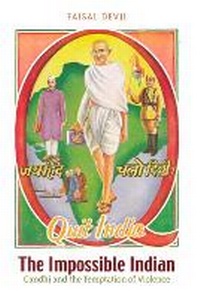
The Impossible Indian
Gandhi and the Temptations of Violence
Will be published approx. on 1. June 2012
Book
Hardback
176 pages
978-1-84904-115-7 (ISBN)
Description
While in his own time Gandhi was recognised by friends and enemies alike as a major political force, not only in India but the world at large, in our own day the Mahatma has been reduced to an idealist by his supporters as much as by his detractors. Whether this idealism is regarded as sincere or hypocritical, Gandhi has also become a resolutely Indian figure today, capable only of inspiring others in the most general way. Yet the Mahatma always considered his practices as being realistic and even mundane in the ease of their application, while at the same time holding them to possess universal potential. India for him was only the site of an experiment in non-violence. Given that Gandhi had become during his own lifetime one of the world's most famous and admired men, indeed one of the earliest figures who enjoyed such global celebrity, these grandiose impressions of his mission were not out of place. This book is about the Mahatma as a political thinker, one who recognised how the quotidian reality of modern life could be radicalised to produce the most extraordinary effects. In this sense he belongs with Lenin, Hitler and Mao as one of the great revolutionary figures of our times, though his politics was of course directed along paths other than state-building. Focussing on his unsentimental engagement with the hard facts of imperial domination, fascism and civil war, this study places Gandhi at the centre of modern history, exploring the new political reality he claimed to have discovered. This was a politics the Mahatma mobilised in practices that required as much sacrifice, and even death, as those propagated by his revolutionary peers, if for very different reasons. The Impossible Indian reveals Gandhi as the hard-hitting political thinker he was and confirms the contemporary relevance of his legacy to the world at large.
Reviews / Votes
Refreshingly, Faisal Devji, an expert on South Asian history at Oxford, is not interested in bashing Gandhi's burnished halo: his highly original new work on Gandhi's thought is a powerful defence of the Mahatma and his relevance to us today. But he does ask whether we have beatified him for the wrong reasons. His Gandhi is far from the uncomplicated advocate of non-violence we think we know. ... Devji's analysis provides not only an original interpretation of Indian nationalist history, but raises a range of important questions about globalisation that are rarely addressed by our thinkers today. * History Today * According to some, Gandhi single-handedly and non-violently brought down the British Raj. Faisal Devji has taken it on himself to correct this image. 'The Impossible Indian' constitutes intriguing reading material about a still widely admired but often misunderstood figure. * European Review of History * This remarkable book will secure Faisal Devji's reputation as the boldest historian of twentieth-century political ideas of liberation and humanity. Freeing himself from both the hagiographic cant and the cynical cliches about Gandhi, Devji has presented us with a Gandhian book about the Mahatma, embracing contradiction, forsaking easy friends and embracing obvious enemies. Devji is able to show that Gandhi sought nothing less than to erect a new sort of moral subject in India during British rule, a subject who can, even at great cost, make history as she pleases, placing the exigencies of justice, freedom and truth securely within the search for a sovereign self, free of the tyrannies of various seductive images of the inevitability of political modernity. Neither Gandhi nor political theory will be the same again. -- Arjun Appadurai, Goddard Professor of Media, Culture and Communication, New York University True to form, Faisal Devji has developed a novel interpretation of a well-studied historical issue, in this case M. K. Gandhi's commitment to non-violence. Here Gandhi emerges neither as a neo-Christian figure 'turning the other cheek', nor as a liberal concerned with human rights, but rather as a thinker who sees self-sacrifice and death as the embodiment of human duty. -- Sir Christopher Bayly, Vere Harmsworth Professor of Imperial and Naval History, University of Cambridge This subtle yet polemical study presents M.K. Gandhi as the genius behind an anti-majoritarian type of mass politics which emerged in the twentieth-century but still awaits proper elaboration. Devji's highly original portrait is not always salubrious but it makes Gandhi look all the more radical, and sometimes almost like a postcolonial heir to Friedrich Nietzsche. -- Leela Gandhi, University of Chicago Devji is a creative and distinctive thinker who has now developed a style of exposition that is all his own. He manages to tease gently out of Gandhi's writings intellectual-political positions that both surprise and enlighten the reader. -- Professor Dipesh Chakrabarty, Lawrence A. Kimpton Distinguished Service Professor, Department of History, University of Chicago [It is rare that] someone manages to decipher Gandhi and make a value addition to the existing body of knowledge. 'The Impossible Indian' presents one such rare work and should be celebrated as a collectors' item. There is something strikingly distinct about Devji's style. He invokes, then whets the intellectual taste-buds of his readers and then takes them on a roller-coaster ride in a richly sourced complex of abstract ideas. -- Swaran Singh, The Hindu A fresh and insightful view of the Mahatma and his ideas. Devji effectively situates Gandhi, not as an outmoded, sentimental idealist, adrift in an anachronistic rural utopia, but as a remarkably original thinker who speaks to many of the most pressing issues of modernity and present-day politics - not least the abiding problem of violence and the place of minorities within contemporary societies. ... This book does not claim to be a complete history of Gandhi. What it offers instead is a remarkably fresh and original look at the meaning and significance of Gandhi's thought and practice, bringing together a well-nuanced sense of Gandhi's historical and cultural context with a sharp present-day concern for his abiding relevance and profound challenge to the world today. It is an important book; some will find it provocative. Either way, it will stimulate fresh debate among scholars, students and a wider public readership. -- David Arnold, Professor of Asian and Global History, Warwick University Faisal Devji's 'The Impossible Indian' is an audacious book. He approaches Gandhi counter-intuitively: instead of foregrounding Gandhi's non-violence, Devji explores what he calls 'the temptation to violence'. His earlier work on jihad and terror gives him insights into the fascination with violence as a legitimate means of politics. He wishes to recast the genealogy of Gandhi's ahimsa, which he traces not to Gandhi's childhood and the eclectic belief systems with which Gandhi was raised, but to the violence of the war of 1857. He shows Gandhi engaged with the question of violence inherent in Empire and fascism. Gandhi is concerned about the civil war in South Africa and possibility of such a war starting in India. Devji convincingly argues that, for Gandhi, sovereignty and its validation lies not in the State but within the ethical self -- a self rooted in dharma and engaged in moral negotiations with real and potential violence.In the course of this argument, Devji also provides a departure from Gandhi's reading of the Bhagvad Gita as a discourse on detached action. Gandhi saw the Gita as a spiritual guidebook, in the sense that it enlightened him in his quest for the moral agency that lay within. This search for a solitary moral agent committed to ethical action and duty, willing to grapple with modernity as also with violence both of the traditional structures and that of modern civilisation, makes Devji's Gandhi a political philosopher whose revolutionary potential is yet to be grasped. -- Tridip Suhrud, The Caravan, A Journal of Culture and Politics, New Delhi
More details
Language
English
Place of publication
London
United Kingdom
Dimensions
Height: 216 mm
Width: 138 mm
ISBN-13
978-1-84904-115-7 (9781849041157)
Copyright in bibliographic data and cover images is held by Nielsen Book Services Limited or by the publishers or by their respective licensors: all rights reserved.
Schweitzer Classification
Person
Faisal Devji is Reader in History at St Antony's College, Oxford University. He is the author of two acclaimed books, Landscapes of the Jihad and The Terrorist in Search of Humanity, both of which are published by Hurst.