

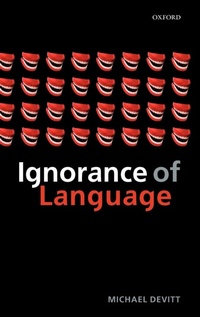
Ignorance of Language
Published on 27. April 2006
Book
Hardback
320 pages
978-0-19-925096-7 (ISBN)
Description
The Chomskian revolution in linguistics gave rise to a new orthodoxy about mind and language. Michael Devitt throws down a provocative challenge to that orthodoxy. What is linguistics about? What role should linguistic intuitions play in constructing grammars? What is innate about language? Is there a 'language faculty'? These questions are crucial to our developing understanding of ourselves; Michael Devitt offers refreshingly original answers. He argues that linguistics is about linguistic reality and is not part of psychology; that linguistic rules are not represented in the mind; that speakers are largely ignorant of their language; that speakers' intuitions do not reflect information supplied by the language faculty and are not the main evidence for grammars; that the rules of 'Universal Grammar' are largely, if not entirely, innate structure rules of thought; indeed, that there is little or nothing to the language faculty. Devitt's controversial theses will prove highly stimulating to anyone working on language and the mind.
Reviews / Votes
A wealth of careful distinctions and detailed arguments...an example of how serious philosophy of a very technical area may be conducted with thoroughness, lucidity, and elegance. * John Collins, Mind Journal *More details
Language
English
Place of publication
Oxford
United Kingdom
Target group
College/higher education
Professional and scholarly
Dimensions
Height: 240 mm
Width: 161 mm
Thickness: 22 mm
Weight
646 gr
ISBN-13
978-0-19-925096-7 (9780199250967)
Copyright in bibliographic data and cover images is held by Nielsen Book Services Limited or by the publishers or by their respective licensors: all rights reserved.
Schweitzer Classification
Other editions
Additional editions
Michael Devitt
Ignorance of Language
Book
04/2008
Oxford University Press
€71.50
Shipment within 15-20 days
Person
Content
I. LINGUISTICS IS NOT PSYCHOLOGY ; II. POSITIONS ON PSYCHOLOGICAL REALITY ; III. 'PHILOSOPHICAL' ARGUMENTS FOR THE REPRESENTATIONAL THESIS ; IV. THE RELATION OF LANGUAGE TO THOUGHT ; V. LANGUAGE USE AND ACQUISITION