

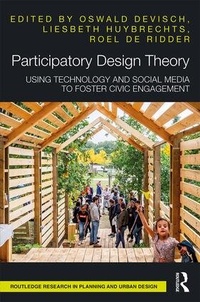
Participatory Design Theory
Using Technology and Social Media to Foster Civic Engagement
1st Edition
Published on 2. October 2018
Book
Hardback
270 pages
978-1-138-08768-2 (ISBN)
Description
In recent years, many countries all over Europe have witnessed a demand for a more direct form of democracy, ranging from improved clarity of information to being directly involved in decision-making procedures. Increasingly, governments are putting citizen participation at the centre of their policy objectives, striving for more transparency, to engage and empower local individuals and communities to collaborate on public projects and to encourage self-organization.
This book explores the role of participatory design in keeping these participatory processes public. It addresses four specific lines of enquiry: how can the use and/or development of technologies and social media help to diversify, to coproduce, to interrupt and to document democratic design experiments? Aimed at researchers and academics in the fields of urban planning and participatory design, this book includes contributions from a range of experts across Europe including the UK, Belgium, the Netherlands, Italy, Denmark, Austria, Spain, France, Romania, Hungary and Finland.
This book explores the role of participatory design in keeping these participatory processes public. It addresses four specific lines of enquiry: how can the use and/or development of technologies and social media help to diversify, to coproduce, to interrupt and to document democratic design experiments? Aimed at researchers and academics in the fields of urban planning and participatory design, this book includes contributions from a range of experts across Europe including the UK, Belgium, the Netherlands, Italy, Denmark, Austria, Spain, France, Romania, Hungary and Finland.
More details
Series
Language
English
Place of publication
London
United Kingdom
Publishing group
Taylor & Francis Ltd
Target group
College/higher education
Illustrations
24 s/w Abbildungen, 14 s/w Photographien bzw. Rasterbilder, 10 s/w Zeichnungen, 24 s/w Tabellen
24 Tables, black and white; 10 Line drawings, black and white; 14 Halftones, black and white; 24 Illustrations, black and white
Dimensions
Height: 234 mm
Width: 156 mm
Weight
680 gr
ISBN-13
978-1-138-08768-2 (9781138087682)
Copyright in bibliographic data and cover images is held by Nielsen Book Services Limited or by the publishers or by their respective licensors: all rights reserved.
Schweitzer Classification
Other editions
Additional editions

Oswald Devisch | Liesbeth Huybrechts | Roel De Ridder
Participatory Design Theory
Using Technology and Social Media to Foster Civic Engagement
Book
09/2020
1st Edition
Routledge
€54.46
Shipment within 15-20 days
Oswald Devisch | Liesbeth Huybrechts | Roel De Ridder
Participatory Design Theory
Using Technology and Social Media to Foster Civic Engagement
E-Book
10/2018
1st Edition
Routledge
€61.99
Available for download
Oswald Devisch | Liesbeth Huybrechts | Roel De Ridder
Participatory Design Theory
Using Technology and Social Media to Foster Civic Engagement
E-Book
10/2018
1st Edition
Routledge
€61.99
Available for download
Persons
Oswald Devisch is Associate Professor in Urban Design at Hasselt University, Belgium. He is coordinator of the research cluster Spatial Capacity Building and explores themes such as collective learning, casual participation, autonomous urbanization and the gamification of participation.
Liesbeth Huybrechts is Associate Professor at Hasselt University, Belgium. She works in the areas of participatory design, spatial transformation processes and human-computer interaction. She is part of the research projects Traders and Critical Heritage. She designed the participatory mapping tool MAP-it (www.map-it.be) and is co-founder of Social Spaces (www.socialspaces.be).
Roel De Ridder is a researcher and a tutor at the Faculty of Architecture and Arts, Hasselt University, Belgium. He is also a lecturer in architectural theory and a tutor at the Faculty of Architecture at KU Leuven (in Brussels and Ghent). He attained a doctoral degree, on The Public Performance of the Parish Church, at Hasselt University (2013). His research focuses on supporting municipalities and church boards in developing and implementing policies and new architectural schemes regarding the future of church buildings. Since 2012, De Ridder has been artistic director of the architecture organisation Architectuurwijzer vzw (Hasselt, Belgium).
Liesbeth Huybrechts is Associate Professor at Hasselt University, Belgium. She works in the areas of participatory design, spatial transformation processes and human-computer interaction. She is part of the research projects Traders and Critical Heritage. She designed the participatory mapping tool MAP-it (www.map-it.be) and is co-founder of Social Spaces (www.socialspaces.be).
Roel De Ridder is a researcher and a tutor at the Faculty of Architecture and Arts, Hasselt University, Belgium. He is also a lecturer in architectural theory and a tutor at the Faculty of Architecture at KU Leuven (in Brussels and Ghent). He attained a doctoral degree, on The Public Performance of the Parish Church, at Hasselt University (2013). His research focuses on supporting municipalities and church boards in developing and implementing policies and new architectural schemes regarding the future of church buildings. Since 2012, De Ridder has been artistic director of the architecture organisation Architectuurwijzer vzw (Hasselt, Belgium).
Content
Introduction Part I: To diversify 1. Valuating narrative accounts in participatory planning processes: A case of co-creative storytelling in Antwerp, Belgium 2. Using a complex sound world for a participative dismantling and redefinition of the collective appropriation of industrial landscapes 3. Reflections on the counter-mapping of urban 'arrival neighborhoods' through Geoweb 2.0 in Brussels and Ghent 4. Data-driven design for civic participation: Introducing digital methods for on-going civic engagement for design in public space 5. Design initiatives in public spaces: eight interpretative lenses Part II: To co-produce 6. Sharing authorship and measuring influence in architectural training in neighbourhood communities 7. Digitally networked action: Developing self-organisation in 'weak-tie' residential communities through a 'Facebook group' 8. Communal garden and the liminal city 9. BIMBY: modeling, civic empowerment and the invention of a new profession Part III: To interrupt 10. Design, technology and social innovation: the serious game of TrafficO2 11. Daredevil or socializer? Exploring the relations between intrinsic motivation, game experience and player types in serious games with environmental narratives 12. Fabricam: Participatory urban interventions in a post-communist context 13. Rethinking the designer's role in the collective re-imagination of societies: A necessary reinterpretation of design for social innovation Part IV: To document 14. Participation within and beyond museums with the help of digital technologies 15. (Challenges and opportunities of) documentation practices of self-organised urban initiatives 16. Documentation games: A comparison between three games to support participatory design teams to document their design process