

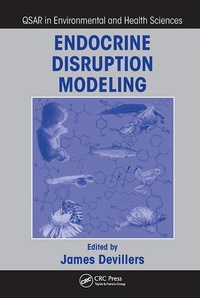
Endocrine Disruption Modeling
1st Edition
Published on 12. September 2017
Book
Paperback/Softback
424 pages
978-1-138-11191-2 (ISBN)
Description
Uses Computational Tools to Simulate Endocrine Disruption Phenomena
Endocrine Disruption Modeling provides a practical overview of the current approaches for modeling endocrine activity and the related potential adverse effects they may induce on environmental and human health. Based on the extensive research of an international panel of contributors from industry, academia, and regulatory agencies, this is the first book devoted to using computer tools to better understand and simulate the multifaceted aspects of endocrine disruption in humans and wildlife.
Explores Diverse Modeling Techniques and Applications
This up-to-date resource focuses on xenobiotics that are accidentally released into the environment with the potential to disturb the normal functioning of the endocrine system of invertebrates and vertebrates but also on the specific agro-chemistry design of chemicals that take control of insect endocrine systems. A comprehensive research reference, Endocrine Disruption Modeling provides a collection of computational strategies to model these structurally diverse chemicals. It concludes with a review of the available e-resources in the field, rounding out the book's task-oriented approach to future EDC discovery.
Endocrine Disruption Modeling is the first book in the QSAR in Environmental and Health Sciences series (James Devillers, j.devillers@ctis.fr).
Endocrine Disruption Modeling provides a practical overview of the current approaches for modeling endocrine activity and the related potential adverse effects they may induce on environmental and human health. Based on the extensive research of an international panel of contributors from industry, academia, and regulatory agencies, this is the first book devoted to using computer tools to better understand and simulate the multifaceted aspects of endocrine disruption in humans and wildlife.
Explores Diverse Modeling Techniques and Applications
This up-to-date resource focuses on xenobiotics that are accidentally released into the environment with the potential to disturb the normal functioning of the endocrine system of invertebrates and vertebrates but also on the specific agro-chemistry design of chemicals that take control of insect endocrine systems. A comprehensive research reference, Endocrine Disruption Modeling provides a collection of computational strategies to model these structurally diverse chemicals. It concludes with a review of the available e-resources in the field, rounding out the book's task-oriented approach to future EDC discovery.
Endocrine Disruption Modeling is the first book in the QSAR in Environmental and Health Sciences series (James Devillers, j.devillers@ctis.fr).
More details
Series
Language
English
Place of publication
London
United Kingdom
Publishing group
Taylor & Francis Ltd
Target group
Professional and scholarly
Illustrations
100 s/w Abbildungen
100 Illustrations, black and white
Dimensions
Height: 234 mm
Width: 156 mm
Weight
780 gr
ISBN-13
978-1-138-11191-2 (9781138111912)
Copyright in bibliographic data and cover images is held by Nielsen Book Services Limited or by the publishers or by their respective licensors: all rights reserved.
Schweitzer Classification
Other editions
Additional editions
James Devillers
Endocrine Disruption Modeling
Book
04/2009
1st Edition
CRC Press
€326.83
Shipment within 15-20 days
James Devillers
Endocrine Disruption Modeling
E-Book
04/2009
1st Edition
CRC Press
€104.99
Available for download
Person
Content
In Silico Methods for Modeling Endocrine Disruption. Mechanisms of Endocrine Disruptions, A Tentative Overview. Population Dynamics Modeling: A Tool For Environmental Risk Assessment of Endocrine Disrupting Chemicals. Application of Pharmacokinetic Modeling to Understand the Mechanism of Action of Endocrine Disrupting Chemicals. Comparative Modeling Review of Nuclear Hormone Receptor Superfamily. The FDA's Endocrine Disruptor Knowledge Base (EDKB): Lessons Learned in QSAR Modeling and Applications. A Structure-Activity Relationship (SAR) Analysis for the Identification of Environmental Estrogens: The Categorical-SAR (cat-SAR) Approach. Kohonen and Counterpropagation Neural Networks Employed for Modeling Endocrine Disruptors. Quantitative Spectrometric Data-Activity Relationships (QSDAR) Models of Endocrine Disruptor Binding Activities. Mechanism-Based Modeling of Estrogen Receptor Binding Affinity: A COREPA Implementation. Molecular Field Analysis Methods for Modeling Endocrine Disruptors. Structure-Activity Modeling of a Diverse Set of Endrogen Receptor Ligands. SAR and QSAR Analyses of Substituted Dibenzoylhydrazines for Their Mode of Action as Ecdysone Agonists. e-Endocrine Disrupting Chemical Databases for Deriving SAR and QSAR Models.