

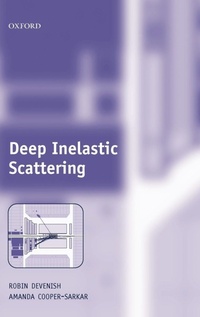
Deep Inelastic Scattering
Published on 20. November 2003
Book
Hardback
418 pages
978-0-19-850671-3 (ISBN)
Description
The book is an up-to-date, self-contained account of deep inelastic scattering in high-energy physics. Intended for graduate students and physicists new to the subject, it covers the classic results which led to the quark-parton model of hadrons and the establishment of quantum chromodynamics as the theory of the strong nuclear force, in addition to new vistas in the subject opened up by the electron-proton collider HERA. The extraction of parton momentum distribution functions, a key input for physics at hadron colliders such as the Tevatron at Fermi Lab and the Large Hadron Collider at CERN, is described in detail. The challenges of the HERA data at 'low x' are described and possible explanations in terms of gluon dynamics and other models outlined. Other chapters cover: jet production at large momentum transfer and the determination of the strong coupling constant, electroweak interactions at very high momentum transfers, the extension of deep inelastic techniques to include hadronic probes, a summary of fully polarised inelastic scattering and the spin structure of the nucleon, and finally a brief account of methods in searching for signals 'beyond the standard model'.
Reviews / Votes
[Devenish and Cooper-Sarkar] have written a book whose distinction reflects this pedigree and which is a landmark ... The authors thus deserve our congratulations. * Contemporary Physics *More details
Language
English
Place of publication
Oxford
United Kingdom
Target group
College/higher education
Professional and scholarly
Illustrations
numerous line drawings
Dimensions
Height: 240 mm
Width: 161 mm
Thickness: 27 mm
Weight
790 gr
ISBN-13
978-0-19-850671-3 (9780198506713)
Copyright in bibliographic data and cover images is held by Nielsen Book Services Limited or by the publishers or by their respective licensors: all rights reserved.
Schweitzer Classification
Other editions
Additional editions
Robin Devenish | Amanda Cooper-Sarkar
Deep Inelastic Scattering
Book
04/2011
Oxford University Press
€80.47
Shipment within 15-20 days
Robin Devenish | Amanda Cooper-Sarkar
Deep Inelastic Scattering
E-Book
04/2011
OUP eBook
€37.99
Available for download
Robin Devenish | Amanda Cooper-Sarkar
Deep Inelastic Scattering
E-Book
04/2011
OUP eBook
€37.99
Available for download
Persons
Robin Devenish joined the Department of Physics and Hertford College at the University of Oxford in 1979 and was awarded the title of Professor in 1996. He has worked on particle physics phenomenology and experimental high-energy physics, particularly electron-positron annihilation at DORIS and PETRA and with the ZEUS collaboration at the electron-proton collider HERA since its inception.
Amanda Cooper-Sarkar joined the Rutherford Laboratory in 1979 and held a CERN Senior Fellowship 1983-85. In 1990, she joined the Department of Physics and St. Hilda's College at the University of Oxford, and St. John's College in 1995. She has worked on deep inelastic scattering experiments and phenomenology for more than 20 years, starting with the early neutrino induced experiments at the BEBC detector at CERN in the 1980s and moving on to join the ZEUS collaboration at the electron-proton collider HERA.
Amanda Cooper-Sarkar joined the Rutherford Laboratory in 1979 and held a CERN Senior Fellowship 1983-85. In 1990, she joined the Department of Physics and St. Hilda's College at the University of Oxford, and St. John's College in 1995. She has worked on deep inelastic scattering experiments and phenomenology for more than 20 years, starting with the early neutrino induced experiments at the BEBC detector at CERN in the 1980s and moving on to join the ZEUS collaboration at the electron-proton collider HERA.
Content
1. Introduction ; 2. The quark-parton model ; 3. Quantum chromodynamics (QCD) and formal methods ; 4. QCD improved parton model ; 5. Deep inelastic scattering (DIS) experiments and data ; 6. Extraction of parton densities ; 7. Alpha s from scaling violations and jets at high Q squared ; 8. DIS at high Q squared ; 9. DIS at low x ; 10. Hadron induced DIS ; 11. Polarized DIS ; 12. Beyond the standard model ; A. Dirac equations and some other conventions ; B. Phase space and cross-sections ; C. DIS cross-sections ; D. Feynman rules ; E. Monte Carlo codes ; F. Data sources ; G. Parton parameterizations