

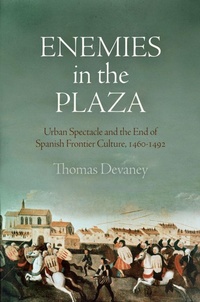
Enemies in the Plaza
Urban Spectacle and the End of Spanish Frontier Culture, 146-1492
Published on 22. May 2015
Book
Hardback
256 pages
978-0-8122-4713-8 (ISBN)
Description
Toward the end of the fifteenth century, Spanish Christians near the border of Castile and Muslim-ruled Granada held complex views about religious tolerance. People living in frontier cities bore much of the cost of war against Granada and faced the greatest risk of retaliation, but had to reconcile an ideology of holy war with the genuine admiration many felt for individual members of other religious groups. After a century of near-continuous truces, a series of political transformations in Castile-including those brought about by the civil wars of Enrique IV's reign, the final war with Granada, and Fernando and Isabel's efforts to reestablish royal authority-incited a broad reaction against religious minorities. As Thomas Devaney shows, this active hostility was triggered by public spectacles that emphasized the foreignness of Muslims, Jews, and recent converts to Christianity.
Enemies in the Plaza traces the changing attitudes toward religious minorities as manifested in public spectacles ranging from knightly tournaments, to religious processions, to popular festivals. Drawing on contemporary chronicles and municipal records as well as literary and architectural evidence, Devaney explores how public pageantry originally served to dissipate the anxieties fostered by the give-and-take of frontier culture and how this tradition of pageantry ultimately contributed to the rejection of these compromises. Through vivid depictions of frontier personalities, cities, and performances, Enemies in the Plaza provides an account of how public spectacle served to negotiate and articulate the boundaries between communities as well as to help Castilian nobles transform the frontier's religious ambivalence into holy war.
Enemies in the Plaza traces the changing attitudes toward religious minorities as manifested in public spectacles ranging from knightly tournaments, to religious processions, to popular festivals. Drawing on contemporary chronicles and municipal records as well as literary and architectural evidence, Devaney explores how public pageantry originally served to dissipate the anxieties fostered by the give-and-take of frontier culture and how this tradition of pageantry ultimately contributed to the rejection of these compromises. Through vivid depictions of frontier personalities, cities, and performances, Enemies in the Plaza provides an account of how public spectacle served to negotiate and articulate the boundaries between communities as well as to help Castilian nobles transform the frontier's religious ambivalence into holy war.
Reviews / Votes
"Thomas Devaney offers an engaging and accomplished analysis of public theater and spectacle on the frontier of fifteenth-century Castile, with richly textured descriptions of individual theatrical performances and judicious discussions of medieval culture wars." (Simon Doubleday, Hofstra University)More details
Series
Language
English
Place of publication
Pennsylvania
United States
Target group
College/higher education
Professional and scholarly
Product notice
Paper over boards
Illustrations
8 illus.
Dimensions
Height: 231 mm
Width: 157 mm
Thickness: 25 mm
Weight
544 gr
ISBN-13
978-0-8122-4713-8 (9780812247138)
Copyright in bibliographic data and cover images is held by Nielsen Book Services Limited or by the publishers or by their respective licensors: all rights reserved.
Schweitzer Classification
Other editions
Additional editions
Thomas Devaney
Enemies in the Plaza
Urban Spectacle and the End of Spanish Frontier Culture, 146-1492
E-Book
04/2015
1st Edition
University of Pennsylvania Press
€78.49
Available for download
Person
Thomas Devaney teaches history at the University of Rochester.
Content
List of Abbreviations
Introduction
PART I
Chapter 1. The Anatomy of a Spectacle: Participants, Critics, and Onlookers
Chapter 2. The Meanings of Civic Space
PART II
Chapter 3. Knights, Magi, and Muslims: Miguel Lucas de Iranzo and the People of JaEn
Chapter 4. A "Chance Act": COrdoba in 1473
Chapter 5. Murcia and the Body of Christ Triumphant
Conclusion
Notes
Glossary of Spanish Terms
Bibliography
Index
Acknowledgments
Introduction
PART I
Chapter 1. The Anatomy of a Spectacle: Participants, Critics, and Onlookers
Chapter 2. The Meanings of Civic Space
PART II
Chapter 3. Knights, Magi, and Muslims: Miguel Lucas de Iranzo and the People of JaEn
Chapter 4. A "Chance Act": COrdoba in 1473
Chapter 5. Murcia and the Body of Christ Triumphant
Conclusion
Notes
Glossary of Spanish Terms
Bibliography
Index
Acknowledgments