

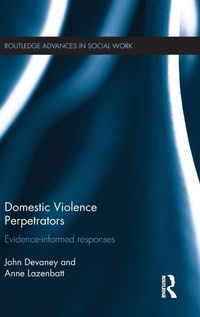
Domestic Violence Perpetrators
Evidence-Informed Responses
1st Edition
Published on 4. July 2016
Book
Hardback
168 pages
978-1-138-01626-2 (ISBN)
Description
Domestic violence is a serious, widespread public, social and health problem that affects the lives of many women, children and men. There is also evidence to suggest it has one of the highest rates of recidivism. This comprehensive book provides an overview of what the research tells us about the perpetrators of domestic violence and what works, and what doesn't, in promoting positive change.
Collecting together the most up-to-date evidence from the international literature and bringing psychological, sociological, gendered and socio-political theoretical perspectives to bear on the issue, the authors explore:
- what domestic violence is, why it happens and how it can be measured
- who the perpetrators of domestic violence are, including discussion of non-stereotypical patterns such as male victims, female perpetrators, couples where the abuse is mutual, and couples with abusive relationships who want the abuse to end but the relationship to be sustained
- strategies for engaging perpetrators in interventions and for promoting behaviour change
- evidence-informed interventions, programmes and policies for working with perpetrators
- where robust evidence is lacking and more research needs to be undertaken.
Domestic violence is a significant problem for those individuals and families whose life is affected by this issue, the social, health and criminal justice agencies that respond to it, and wider society which must bear the costs and its devastating effects. This volume is an important reference for all those researching and working with the victims, survivors and perpetrators of domestic violence, including academics and students from fields such as social work, sociology, criminology, psychology and social policy.
Collecting together the most up-to-date evidence from the international literature and bringing psychological, sociological, gendered and socio-political theoretical perspectives to bear on the issue, the authors explore:
- what domestic violence is, why it happens and how it can be measured
- who the perpetrators of domestic violence are, including discussion of non-stereotypical patterns such as male victims, female perpetrators, couples where the abuse is mutual, and couples with abusive relationships who want the abuse to end but the relationship to be sustained
- strategies for engaging perpetrators in interventions and for promoting behaviour change
- evidence-informed interventions, programmes and policies for working with perpetrators
- where robust evidence is lacking and more research needs to be undertaken.
Domestic violence is a significant problem for those individuals and families whose life is affected by this issue, the social, health and criminal justice agencies that respond to it, and wider society which must bear the costs and its devastating effects. This volume is an important reference for all those researching and working with the victims, survivors and perpetrators of domestic violence, including academics and students from fields such as social work, sociology, criminology, psychology and social policy.
More details
Series
Language
English
Place of publication
London
United Kingdom
Publishing group
Taylor & Francis Ltd
Target group
College/higher education
Illustrations
2 s/w Abbildungen, 2 s/w Tabellen
2 Tables, black and white; 2 Illustrations, black and white
Dimensions
Height: 240 mm
Width: 161 mm
Thickness: 14 mm
Weight
426 gr
ISBN-13
978-1-138-01626-2 (9781138016262)
Copyright in bibliographic data and cover images is held by Nielsen Book Services Limited or by the publishers or by their respective licensors: all rights reserved.
Schweitzer Classification
Other editions
Additional editions
Book
01/2018
1st Edition
Routledge
€73.90
Shipment within 10-20 days
E-Book
07/2016
Routledge
€68.49
Available for download
E-Book
07/2016
Routledge
€68.49
Available for download
Persons
John Devaney, PhD, is a Senior Lecturer at Queen's University Belfast, UK. He was a member of the governmental policy group which developed Northern Ireland's first domestic violence strategy, and has researched and published widely on familial violence. He is a former chair of the British Association for the Study and Prevention of Child Abuse and Neglect.
Anne Lazenbatt, PhD, is a former Reader in Childhood Studies at Queen's University Belfast, UK. She is a psychologist with extensive experience of researching issues related to domestic violence and child maltreatment.
Anne Lazenbatt, PhD, is a former Reader in Childhood Studies at Queen's University Belfast, UK. She is a psychologist with extensive experience of researching issues related to domestic violence and child maltreatment.
Content
1. Introduction
2. Defining and Measuring Domestic Violence
3. Explanations for Domestic Violence
4. Typologies of Domestic Violence Perpetrators
5. Changing Perpetrator Behaviour
6. Evidence Informed Interventions
7. Conclusions
2. Defining and Measuring Domestic Violence
3. Explanations for Domestic Violence
4. Typologies of Domestic Violence Perpetrators
5. Changing Perpetrator Behaviour
6. Evidence Informed Interventions
7. Conclusions