

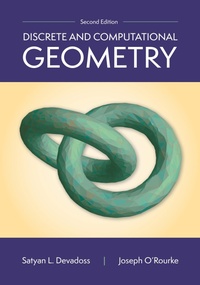
Discrete and Computational Geometry, 2nd Edition
Published on 8. July 2025
Book
Hardback
280 pages
978-0-691-26620-6 (ISBN)
Description
The essential introduction to discrete and computational geometry-now fully updated and expanded
Discrete and Computational Geometry bridges the theoretical world of discrete geometry with the applications-driven realm of computational geometry, offering a comprehensive yet accessible introduction to this cutting-edge frontier of mathematics and computer science. Beginning with polygons and ending with polyhedra, it explains how to capture the shape of data given by a set of points, from convex hulls and triangulations to Voronoi diagrams, geometric duality, chains, linkages, and alpha complexes. Connections to real-world applications are made throughout, and algorithms are presented independent of any programming language. Now fully updated and expanded, this richly illustrated textbook is an invaluable learning tool for students in mathematics, computer science, engineering, and physics.
Now with new sections on duality and on computational topology
Project suggestions at the end of every chapter
Covers traditional topics as well as new and advanced material
Features numerous full-color illustrations, exercises, and fully updated unsolved problems
Uniquely designed for a one-semester class
Accessible to college sophomores with minimal background
Also suitable for more advanced students
Online solutions manual (available to instructors)
Discrete and Computational Geometry bridges the theoretical world of discrete geometry with the applications-driven realm of computational geometry, offering a comprehensive yet accessible introduction to this cutting-edge frontier of mathematics and computer science. Beginning with polygons and ending with polyhedra, it explains how to capture the shape of data given by a set of points, from convex hulls and triangulations to Voronoi diagrams, geometric duality, chains, linkages, and alpha complexes. Connections to real-world applications are made throughout, and algorithms are presented independent of any programming language. Now fully updated and expanded, this richly illustrated textbook is an invaluable learning tool for students in mathematics, computer science, engineering, and physics.
Now with new sections on duality and on computational topology
Project suggestions at the end of every chapter
Covers traditional topics as well as new and advanced material
Features numerous full-color illustrations, exercises, and fully updated unsolved problems
Uniquely designed for a one-semester class
Accessible to college sophomores with minimal background
Also suitable for more advanced students
Online solutions manual (available to instructors)
More details
Language
English
Place of publication
New Jersey
United States
Target group
College/higher education
Professional and scholarly
Product notice
Trade binding
Illustrations
186 color illus. 4 tables.
Dimensions
Height: 259 mm
Width: 181 mm
Thickness: 22 mm
Weight
760 gr
ISBN-13
978-0-691-26620-6 (9780691266206)
Copyright in bibliographic data and cover images is held by Nielsen Book Services Limited or by the publishers or by their respective licensors: all rights reserved.
Schweitzer Classification
Other editions
Additional editions
Satyan L. Devadoss | Joseph O'Rourke
Discrete and Computational Geometry, 2nd Edition
E-Book
07/2025
Princeton University Press
€83.49
Available for download
Persons
Satyan L. Devadoss is the Fletcher Jones Professor of Applied Mathematics and Professor of Computer Science at the University of San Diego. He is the author (with Matthew Harvey) of Mage Merlin's Unsolved Mathematical Mysteries. He is a Fellow of the American Mathematical Society and recipient of two national teaching awards from the Mathematical Association of America. Joseph O'Rourke is the Olin Professor of Computer Science and Professor of Mathematics (Emeritus) at Smith College. His books include How to Fold It: The Mathematics of Linkages, Origami, and Polyhedra. He was the chair of the first Symposium on Computational Geometry, the premier conference in the field.