

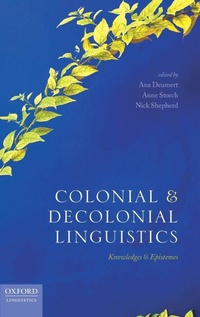
Colonial and Decolonial Linguistics
Knowledges and Epistemes
Published on 10. December 2020
Book
Hardback
400 pages
978-0-19-879320-5 (ISBN)
Description
This wide-ranging volume offers a detailed exploration of coloniality in the discipline of linguistics, with case studies drawn from Africa, Southeast Asia, Europe, and the Caribbean. Colonial meanings and legacies have returned to the forefront of many academic fields in recent years and linguistics, like several other disciplines, has had an ambivalent relationship with its own histories of practice in colonial and postcolonial worlds. The implications of these histories are still felt today, as colonial paradigms of knowledge production continue to shape both academic linguistic practices and non-specialist discussion of language and culture. The chapters in this volume adopt a range of different conceptual frameworks - including postcolonial theory, southern theory, and decolonial thinking - to provide a nuanced account of the coloniality of linguistics at the level of knowledge and disciplinary practice; crucially, the contributors also expand their investigations beyond this ambivalent inheritance to imagine a decolonial linguistics. The volume will be of interest to all linguists looking to critically assess their own practices and to engage with debates at the cutting-edge of their discipline, particularly in the areas of sociolinguistics, field linguistics, typology, and linguistic anthropology, as well as to those outside the discipline engaging with questions of coloniality.
More details
Edition
1
Language
English
Place of publication
Oxford
United Kingdom
Target group
Professional and scholarly
Dimensions
Height: 240 mm
Width: 161 mm
Thickness: 26 mm
Weight
754 gr
ISBN-13
978-0-19-879320-5 (9780198793205)
Copyright in bibliographic data and cover images is held by Nielsen Book Services Limited or by the publishers or by their respective licensors: all rights reserved.
Schweitzer Classification
Other editions
Additional editions
Ana Deumert | Anne Storch | Nick Shepherd
Colonial and Decolonial Linguistics
Knowledges and Epistemes
E-Book
11/2020
1st Edition
OUP eBook
€64.49
Available for download
Persons
Ana Deumert is Professor of Linguistics at the University of Cape Town. She works within the broad field of sociocultural linguistics, with a strong transdisciplinary focus. Her current work explores the use of language in global political movements as well as the contributions that de-/anti-colonial thought can make to (socio)linguistic theory. Her many publications include Introducing Sociolinguistics (with Rajend Mesthrie, Joan Swann, and William Leap; Benjamins, 2009) and Sociolinguistics and Mobile Communication (Edinburgh University Press, 2014). She is a recipient of the Neville Alexander Award for the Promotion of Multilingualism (2014) and the Humboldt Research Award (2016).
Anne Storch is Professor of African Linguistics at the University of Cologne. Her work combines contributions on cultural and social contexts of languages, the semiotics of linguistic practices, colonial linguistics, epistemic language and metalinguistics, and linguistic description. Her publications include Secret Manipulations (OUP, 2011), A Grammar of Luwo (Benjamins, 2014), and Language and Tourism in Postcolonial Settings (with Angelika Mietzner; Channel View, 2019), She is co-editor of the journal The Mouth and a recipient of the Leibniz Prize (2017).
Nick Shepherd is Associate Professor of Archaeology and Heritage Studies at Aarhus University and Extraordinary Professor at the University of Pretoria. His current projects are focused on walking as a form of embodied research practice, and on the politics and poetics of water in the Anthropocene. He has held visiting positions at Harvard University, Brown University, the University of Basel, and Colgate University. His recent publications include After Ethics: Ancestral Voices and Post-Disciplinary Worlds in Archaeology (with Alejandro Haber; Springer, 2014) and The Mirror in the Ground: Archaeology, Photography and the Making of a Disciplinary Archive (Jonathan Ball, 2015).
Anne Storch is Professor of African Linguistics at the University of Cologne. Her work combines contributions on cultural and social contexts of languages, the semiotics of linguistic practices, colonial linguistics, epistemic language and metalinguistics, and linguistic description. Her publications include Secret Manipulations (OUP, 2011), A Grammar of Luwo (Benjamins, 2014), and Language and Tourism in Postcolonial Settings (with Angelika Mietzner; Channel View, 2019), She is co-editor of the journal The Mouth and a recipient of the Leibniz Prize (2017).
Nick Shepherd is Associate Professor of Archaeology and Heritage Studies at Aarhus University and Extraordinary Professor at the University of Pretoria. His current projects are focused on walking as a form of embodied research practice, and on the politics and poetics of water in the Anthropocene. He has held visiting positions at Harvard University, Brown University, the University of Basel, and Colgate University. His recent publications include After Ethics: Ancestral Voices and Post-Disciplinary Worlds in Archaeology (with Alejandro Haber; Springer, 2014) and The Mirror in the Ground: Archaeology, Photography and the Making of a Disciplinary Archive (Jonathan Ball, 2015).
Editor
Professor, School of African and Gender Studies, Anthropology and LinguisticsProfessor, School of African and Gender Studies, Anthropology and Linguistics, University of Cape Town
Professor, Institut fuer Afrikanistik und AEgyptologieProfessor, Institut fuer Afrikanistik und AEgyptologie, University of Cologne
Associate Professor, Department of Archaeology and Heritage StudiesAssociate Professor, Department of Archaeology and Heritage Studies, Aarhus University
Content
1: Ana Deumert and Anne Storch: Introduction: Colonial linguistics then and now
Part I: In the Midst
2: Sonal Kulkarni-Joshi and S. Imtiaz Hasnain: Northern perspectives on language and society in India
3: Rajend Mesthrie: Transcending the colonial? Colonial linguistics and George Grierson's Linguistic Survey of India
4: Christine Severo and Sinfree Makoni: Using lusitanization and creolization as frameworks to analyze historical and contemporary Cape Verde language policy and planning
5: Nick Faraclas: On colonization and 'awesome materiality'. A commentary
Part II: Echoes, Traces
6: Ingo H. Warnke: Tracing de-/colonial options in German Philology around 1900: The two faces of Hermann Paul (1846-1921)
7: Anette Hoffmann: War and grammar: Acoustic recordings with African prisoners of the First World War (1915-18)
8: Anne Storch: Accomplished works and facts. The family tree project of Africanistics
9: Raewyn Connell: Linguistics and language in the global economy of knowledge. A commentary
Part III: On the Poetics of Iconoclasm
10: Bettina Migge: Researching lesser-used endangered languages: Exploring field and documentary linguistics' perspectives on language research
11: Ana Deumert: The missionary in the theatre of linguistics: Or, is a decolonial linguistics possible?
12: Reem Bassiouney: Language ideology and policy in a colonial and postcolonial context: The case of Egypt
13: Ricardo Roque: The decolonizer iconoclast. A commentary
Part IV: Sounds of Resistance
14: Andrea Hollington: Jamaican postcolonial writing practices and metalinguistic discourses as a challenge to established norms and standards
15: Pegah Faghiri: Language ideologies and attitudes towards Arabic in contemporary Iran
16: Katharina Monz: Decolonizing decolonization? Desiring pure language in Mali
17: Christopher Stroud: Colonial creep
18: Salikoko S. Mufwene: Decolonial linguistics as paradigm shift. A commentary
Part V: On Decoloniality
19: Nick Shepherd: A grammar of decoloniality
20: Walter Mignolo: Walking decolonially with Nick Shepherd
Part I: In the Midst
2: Sonal Kulkarni-Joshi and S. Imtiaz Hasnain: Northern perspectives on language and society in India
3: Rajend Mesthrie: Transcending the colonial? Colonial linguistics and George Grierson's Linguistic Survey of India
4: Christine Severo and Sinfree Makoni: Using lusitanization and creolization as frameworks to analyze historical and contemporary Cape Verde language policy and planning
5: Nick Faraclas: On colonization and 'awesome materiality'. A commentary
Part II: Echoes, Traces
6: Ingo H. Warnke: Tracing de-/colonial options in German Philology around 1900: The two faces of Hermann Paul (1846-1921)
7: Anette Hoffmann: War and grammar: Acoustic recordings with African prisoners of the First World War (1915-18)
8: Anne Storch: Accomplished works and facts. The family tree project of Africanistics
9: Raewyn Connell: Linguistics and language in the global economy of knowledge. A commentary
Part III: On the Poetics of Iconoclasm
10: Bettina Migge: Researching lesser-used endangered languages: Exploring field and documentary linguistics' perspectives on language research
11: Ana Deumert: The missionary in the theatre of linguistics: Or, is a decolonial linguistics possible?
12: Reem Bassiouney: Language ideology and policy in a colonial and postcolonial context: The case of Egypt
13: Ricardo Roque: The decolonizer iconoclast. A commentary
Part IV: Sounds of Resistance
14: Andrea Hollington: Jamaican postcolonial writing practices and metalinguistic discourses as a challenge to established norms and standards
15: Pegah Faghiri: Language ideologies and attitudes towards Arabic in contemporary Iran
16: Katharina Monz: Decolonizing decolonization? Desiring pure language in Mali
17: Christopher Stroud: Colonial creep
18: Salikoko S. Mufwene: Decolonial linguistics as paradigm shift. A commentary
Part V: On Decoloniality
19: Nick Shepherd: A grammar of decoloniality
20: Walter Mignolo: Walking decolonially with Nick Shepherd