

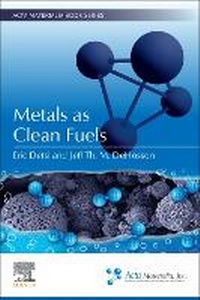
Metals as Clean Fuels
Preparation and Stabilization by One-Spot Alloying and Dealloying
Published on 25. June 2025
Book
Paperback/Softback
260 pages
978-0-443-13537-8 (ISBN)
Description
Metals as Clean Fuels explores the innovative use of metals as a sustainable energy source. It presents a scalable selective leaching method to activate metal fuels by increasing their surface-to-volume ratio, significantly enhancing their reactivity with water for hydrogen and heat generation. This approach positions metal fuels as a superior alternative to fossil fuels, offering higher energy density and the crucial benefit of generating energy without CO2 emissions. Additionally, the book addresses key questions and working principles in its initial chapters before delving into the energy densities of various metals, from zinc to aluminum.
Chapters 8 and 9 focus on novel sustainable fabrication methods for metal/metal nanocomposites, while Chapter 10 introduces an advanced methodology for analyzing porous material systems. This monograph is a pioneering work in discussing nanostructured metals as clean fuels, with the potential to drive significant advancements in energy applications and material science research.
Chapters 8 and 9 focus on novel sustainable fabrication methods for metal/metal nanocomposites, while Chapter 10 introduces an advanced methodology for analyzing porous material systems. This monograph is a pioneering work in discussing nanostructured metals as clean fuels, with the potential to drive significant advancements in energy applications and material science research.
More details
Series
Language
English
Place of publication
Philadelphia
United States
Target group
Professional and scholarly
Product notice
Paperback (trade)
Dimensions
Height: 229 mm
Width: 152 mm
Thickness: 14 mm
Weight
356 gr
ISBN-13
978-0-443-13537-8 (9780443135378)
Copyright in bibliographic data and cover images is held by Nielsen Book Services Limited or by the publishers or by their respective licensors: all rights reserved.
Schweitzer Classification
Other editions
Additional editions
Eric Detsi | Jeff Th. M. DeHosson
Metals as Clean Fuels
E-Book
06/2025
Elsevier
€209.99
Available for download
Persons
Eric Detsi is currently an Associate Professor in Materials Science and Engineering at the University of Pennsylvania. He received his BSc (2006), MSc (2008), and PhD (with honors and highest distinction, 2012) degrees in Applied Physics at the University of Groningen in the Netherlands; afterward, he carried out his postdoctoral research in the Department of Chemistry at the University of California in Los Angeles (2013-2016) as a Netherlands Science Foundation Rubicon Fellow.
He joined the University of Pennsylvania in 2016 as an Assistant Professor in Materials Science and Engineering. His current research involves electrochemical energy conversion and storage using nonconventional materials, such as liquid metals, nonprecious nanoporous metals, and disordered three-dimensional metal scaffolds. For details, see: https://directory.seas.upenn.edu/eric-detsi/.
Jeff Th. M. DeHosson received a PhD in Physics from the University of Groningen, the Netherlands (with honors and highest distinction), and after his postdoctoral years in the USA (Northwestern University and UC Berkeley), he was appointed Professor in 1977 by the Crown (H.M. Queen Juliana). His passion is to carry out innovative and (pre-)competitive research in the field of materials sciences, with a particular emphasis on advances in (in situ) electron microscopy, lasers, and nanostructured materials, e.g., highly nanoporous materials, as started with Eric Detsi in 2008.
He is the Elected Member of the Royal Netherlands Academy of Sciences (division physics), the Royal Holland Society for Sciences and Humanities, and Academia Europaea; the Editor of Acta Materialia journals; and a Fellow of various scientific societies, including TMS-USA-and FASM-USA. He acts as the Honorary Professor of Tsinghua University, Beijing; UST, Beijing; and the University of Port Elizabeth, SA. For his scientific research, he was honored with several international awards, including the European Materials Gold Medal, and he became Knighted by the Crown in 2019 (Knighthood, Netherlands Lion). For details, see https://www.rug.nl/staff/j.t.m.de.hosson/cv.
He joined the University of Pennsylvania in 2016 as an Assistant Professor in Materials Science and Engineering. His current research involves electrochemical energy conversion and storage using nonconventional materials, such as liquid metals, nonprecious nanoporous metals, and disordered three-dimensional metal scaffolds. For details, see: https://directory.seas.upenn.edu/eric-detsi/.
Jeff Th. M. DeHosson received a PhD in Physics from the University of Groningen, the Netherlands (with honors and highest distinction), and after his postdoctoral years in the USA (Northwestern University and UC Berkeley), he was appointed Professor in 1977 by the Crown (H.M. Queen Juliana). His passion is to carry out innovative and (pre-)competitive research in the field of materials sciences, with a particular emphasis on advances in (in situ) electron microscopy, lasers, and nanostructured materials, e.g., highly nanoporous materials, as started with Eric Detsi in 2008.
He is the Elected Member of the Royal Netherlands Academy of Sciences (division physics), the Royal Holland Society for Sciences and Humanities, and Academia Europaea; the Editor of Acta Materialia journals; and a Fellow of various scientific societies, including TMS-USA-and FASM-USA. He acts as the Honorary Professor of Tsinghua University, Beijing; UST, Beijing; and the University of Port Elizabeth, SA. For his scientific research, he was honored with several international awards, including the European Materials Gold Medal, and he became Knighted by the Crown in 2019 (Knighthood, Netherlands Lion). For details, see https://www.rug.nl/staff/j.t.m.de.hosson/cv.
Content
1. How Metal Fuels Work
2. Activation of Metal Fuels
3. Fundamentals of Dealloying
4. Monolithic Bulk Nanoporous Zinc by Free Corrosion Dealloying
5. Rapid Synthesis of Nanoporous Zinc in Powder Form by Free Corrosion Dealloying
6. Monolithic Bulk Nanoporous Aluminum by Air-Free Electrolytic Dealloying with Recovery of Sacrificial Materials
7. Rapid Synthesis of Nanoporous Aluminum Powder by Air-Free Electrolytic Dealloying with Recovery of Sacrificial Materials
8. Nanoporous tri-layer of similar elements by etching without sacrificing materials through the Kirkendall effect
9. Nanoporous tri-layer of dissimilar elements by etching without sacrificing materials through the Kirkendall effect
10. Porous structures and their geometric and topological characteristics
2. Activation of Metal Fuels
3. Fundamentals of Dealloying
4. Monolithic Bulk Nanoporous Zinc by Free Corrosion Dealloying
5. Rapid Synthesis of Nanoporous Zinc in Powder Form by Free Corrosion Dealloying
6. Monolithic Bulk Nanoporous Aluminum by Air-Free Electrolytic Dealloying with Recovery of Sacrificial Materials
7. Rapid Synthesis of Nanoporous Aluminum Powder by Air-Free Electrolytic Dealloying with Recovery of Sacrificial Materials
8. Nanoporous tri-layer of similar elements by etching without sacrificing materials through the Kirkendall effect
9. Nanoporous tri-layer of dissimilar elements by etching without sacrificing materials through the Kirkendall effect
10. Porous structures and their geometric and topological characteristics