

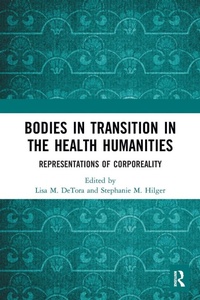
Bodies in Transition in the Health Humanities
Representations of Corporeality
1st Edition
Published on 30. June 2021
Book
Paperback/Softback
192 pages
978-1-032-09140-2 (ISBN)
Description
In recent years, the transitioning body has become the subject of increasing scholarly, medical, and political interest. This interdisciplinary collection seeks to enable productive dialogue about bodily transformation and its many potential meanings and possibilities.
Recent high-profile sex transitions, such as Bruce Jenner's transformation into Caitlyn, have contributed to a proliferation of public and private debates about the boundaries of personal identity and the politics of gender. Sexual transition is only one possible type of bodily transformation, and bodies that change forms vex many binaries that underpin daily life such as male/female, gay/straight, well/unhealthy, able/disabled, beautiful/ugly, or adult/child. When transformations and transitions involve trauma, illness, injury, surgery or death, bodies can become culturally and socially illegible and enter the realm of abjection or even horror. Health humanities, a recent revision of medical humanities that includes patients and other nonphysicians, provides an interdisciplinary lens through which to read such bodily transformation and its representation in public culture. The authors of the essays in the present volume situate their work in this interdisciplinary space to enable productive dialogue about bodily transformation and its meanings in artistic, literary, visual, and health discourses. The essays in this volume discuss non-normative bodies from eighteenth-century France to present-day Iran and investigate narratives of cancer, aging, anorexia, AIDS, intersexuality, transsexuality, viruses, bacteria, and vaccinations.
This collection will be of key interest to faculty and students in women' studies/gender studies, cultural studies, studies of visual and material culture, medical/health humanities, disability studies, and rhetorics of science, health and medicine, and will be a useful resource for scholars across interdisciplinary fields of study.
Recent high-profile sex transitions, such as Bruce Jenner's transformation into Caitlyn, have contributed to a proliferation of public and private debates about the boundaries of personal identity and the politics of gender. Sexual transition is only one possible type of bodily transformation, and bodies that change forms vex many binaries that underpin daily life such as male/female, gay/straight, well/unhealthy, able/disabled, beautiful/ugly, or adult/child. When transformations and transitions involve trauma, illness, injury, surgery or death, bodies can become culturally and socially illegible and enter the realm of abjection or even horror. Health humanities, a recent revision of medical humanities that includes patients and other nonphysicians, provides an interdisciplinary lens through which to read such bodily transformation and its representation in public culture. The authors of the essays in the present volume situate their work in this interdisciplinary space to enable productive dialogue about bodily transformation and its meanings in artistic, literary, visual, and health discourses. The essays in this volume discuss non-normative bodies from eighteenth-century France to present-day Iran and investigate narratives of cancer, aging, anorexia, AIDS, intersexuality, transsexuality, viruses, bacteria, and vaccinations.
This collection will be of key interest to faculty and students in women' studies/gender studies, cultural studies, studies of visual and material culture, medical/health humanities, disability studies, and rhetorics of science, health and medicine, and will be a useful resource for scholars across interdisciplinary fields of study.
Reviews / Votes
"The collection conveys a keen purview of the representation of health and illness through sociological, clinical, cultural, and historical lenses of understanding and interpretation. Teachers, scholars, and clinicians, as well as anyone working in the health sciences seeking to understand how humanistic inquiry contributes to understanding health writ large, will find this volume enormously valuable."--L. H. Taylor Jr., American College of Healthcare Sciences, CHOICE February 2021
More details
Language
English
Place of publication
London
United Kingdom
Publishing group
Taylor & Francis Ltd
Target group
College/higher education
Dimensions
Height: 234 mm
Width: 156 mm
Thickness: 11 mm
Weight
304 gr
ISBN-13
978-1-032-09140-2 (9781032091402)
Copyright in bibliographic data and cover images is held by Nielsen Book Services Limited or by the publishers or by their respective licensors: all rights reserved.
Schweitzer Classification
Other editions
Additional editions
Lisa M. Detora | Stephanie Mathilde Hilger
Bodies in Transition in the Health Humanities
Representations of Corporeality
E-Book
07/2019
1st Edition
Routledge
€60.49
Available for download
Lisa M. Detora | Stephanie Mathilde Hilger
Bodies in Transition in the Health Humanities
Representations of Corporeality
E-Book
07/2019
1st Edition
Routledge
€60.49
Available for download
Lisa M. Detora | Stephanie Mathilde Hilger
Bodies in Transition in the Health Humanities
Representations of Corporeality
Book
07/2019
1st Edition
Routledge
€206.00
Shipment within 15-20 days
Persons
Stephanie Hilger is Professor of Comparative Literature and German at the University of Illinois at Urbana-Champaign. She is the author of Women Write Back (2009) and Gender and Genre (2015). She is also the (co)-editor of New Directions in Literature and Medicine Studies (2017) and The Early History of Embodied Cognition (2015).
Lisa M. DeTora is Associate Professor of Writing Studies and Rhetoric and Director of STEM Writing at Hofstra University. She has published widely on scientific and medical affairs and the medical humanities. In addition, she is the editor of Heroes of Film, Comics, and American Culture (2009) and Regulatory Writing: An Overview (2017).
Lisa M. DeTora is Associate Professor of Writing Studies and Rhetoric and Director of STEM Writing at Hofstra University. She has published widely on scientific and medical affairs and the medical humanities. In addition, she is the editor of Heroes of Film, Comics, and American Culture (2009) and Regulatory Writing: An Overview (2017).
Content
1 Acknowledgments 2 Foreword Rebecca Garden 3 Introduction: Bodies and Transitions in the Health Humanities Lisa M. DeTora and Stephanie M. Hilger Part I: Medical Models, Charts, and Institutional Narratives 4 Enlightened Wax Works:
Viewing the Anatomical Woman in the Viennese Josephinum Angelika Vybiral 5 Epistemological Anxiety: The Case of Michel-Anne Drouart Stephanie M. Hilger 6 Charting Intersex: Intersex Life-Writing and the Medical Record Katelyn Dykstra 7 Narrating Sex Change in Iran: Transsexuality and the Politics of Documentary Film Najmeh Moradiyan-Rizi 8 Isolated Bodies, Isolated Spaces: Anorexia and Bulimia in Women's Autobiographical Narratives Barbara Gruening Part II: Invasive Influences and Corporeal Integrity 9Unseen Enemies: Neisseria, Desire, and Bodily Discourse Lisa M. DeTora 10The Human Papillomavirus Vaccination: Gendering the Rhetorics of Immunization in Public Health Discourses Jennifer A. Malkowski 11 Bacteriology and Modernity: Phenomenology, Bio-Politics, Ontology Jens Lohfert Jorgensen 12 Being-in-Alien: The Trinity of Bodies in Prometheus (2012) and Alien: Covenant (2017) Adnan Mahmutovic and Denise Ask Nunes Part III: Aging, Decline, and Death 13 Embodied Transitions in Michel de Montaigne Nora Martin Peterson and Peter Martin 14 Witnessing Illness: Phenomenology of Photographic Self Portraiture Elizabeth Lanphier 15 Disjunction and Relationality in Terminal Illness Writing Yianna Liatsos 16 Afterword Representation as a Lens: Teaching and Researching in the Health Humanities Carl Fisher
Viewing the Anatomical Woman in the Viennese Josephinum Angelika Vybiral 5 Epistemological Anxiety: The Case of Michel-Anne Drouart Stephanie M. Hilger 6 Charting Intersex: Intersex Life-Writing and the Medical Record Katelyn Dykstra 7 Narrating Sex Change in Iran: Transsexuality and the Politics of Documentary Film Najmeh Moradiyan-Rizi 8 Isolated Bodies, Isolated Spaces: Anorexia and Bulimia in Women's Autobiographical Narratives Barbara Gruening Part II: Invasive Influences and Corporeal Integrity 9Unseen Enemies: Neisseria, Desire, and Bodily Discourse Lisa M. DeTora 10The Human Papillomavirus Vaccination: Gendering the Rhetorics of Immunization in Public Health Discourses Jennifer A. Malkowski 11 Bacteriology and Modernity: Phenomenology, Bio-Politics, Ontology Jens Lohfert Jorgensen 12 Being-in-Alien: The Trinity of Bodies in Prometheus (2012) and Alien: Covenant (2017) Adnan Mahmutovic and Denise Ask Nunes Part III: Aging, Decline, and Death 13 Embodied Transitions in Michel de Montaigne Nora Martin Peterson and Peter Martin 14 Witnessing Illness: Phenomenology of Photographic Self Portraiture Elizabeth Lanphier 15 Disjunction and Relationality in Terminal Illness Writing Yianna Liatsos 16 Afterword Representation as a Lens: Teaching and Researching in the Health Humanities Carl Fisher