

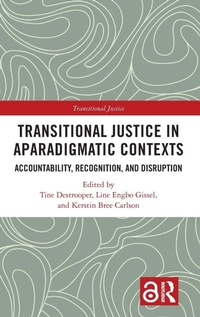
Transitional Justice in Aparadigmatic Contexts
Accountability, Recognition, and Disruption
1st Edition
Published on 23. March 2023
Book
Hardback
238 pages
978-1-032-26617-6 (ISBN)
Description
This book explores the practical and theoretical opportunities as well as the challenges raised by the expansion of transitional justice into new and 'aparadigmatic' cases.
The book defines transitional justice as the pursuit of accountability, recognition and/or disruption and applies an actor-centric analysis focusing on justice actors' intentions of and responses to transitional justice. It offers a typology of different transitional justice contexts ranging from societies experiencing ongoing conflict to consolidated democracies, and includes chapters from all types of aparadigmatic contexts. This covers transitional justice in states with contested political authority, shared political authority, and consolidated political authority. The transitional justice initiatives explored by the wide range of contributors are those of Afghanistan, Belgium, France, Greenland/Denmark, Libya, Syria, Turkey/Kurdistan, UK/Iraq, US, and Yemen. Through these aparadigmatic case studies, the book develops a new framework that, appropriate to its expanding reach, allows us to understand the practice of transitional justice in a more context-sensitive, bottom-up, and actor-oriented way, which leaves room for the complexity and messiness of interventions on the ground.
The book will appeal to scholars and practitioners in the broad field of transitional justice, as represented in law, criminology, politics, conflict studies and human rights.
The Introduction, Chapter 8 and the Concluding Remarks of this book are freely available as a downloadable Open Access PDF at http://www.taylorfrancis.com under a Creative Commons Attribution-Non Commercial-No Derivatives (CC-BY-NC-ND) 4.0 license.
The book defines transitional justice as the pursuit of accountability, recognition and/or disruption and applies an actor-centric analysis focusing on justice actors' intentions of and responses to transitional justice. It offers a typology of different transitional justice contexts ranging from societies experiencing ongoing conflict to consolidated democracies, and includes chapters from all types of aparadigmatic contexts. This covers transitional justice in states with contested political authority, shared political authority, and consolidated political authority. The transitional justice initiatives explored by the wide range of contributors are those of Afghanistan, Belgium, France, Greenland/Denmark, Libya, Syria, Turkey/Kurdistan, UK/Iraq, US, and Yemen. Through these aparadigmatic case studies, the book develops a new framework that, appropriate to its expanding reach, allows us to understand the practice of transitional justice in a more context-sensitive, bottom-up, and actor-oriented way, which leaves room for the complexity and messiness of interventions on the ground.
The book will appeal to scholars and practitioners in the broad field of transitional justice, as represented in law, criminology, politics, conflict studies and human rights.
The Introduction, Chapter 8 and the Concluding Remarks of this book are freely available as a downloadable Open Access PDF at http://www.taylorfrancis.com under a Creative Commons Attribution-Non Commercial-No Derivatives (CC-BY-NC-ND) 4.0 license.
More details
Series
Language
English
Place of publication
London
United Kingdom
Publishing group
Taylor & Francis Ltd
Target group
College/higher education
Professional and scholarly
Academic, Postgraduate, and Undergraduate
Illustrations
2 s/w Abbildungen, 2 s/w Zeichnungen, 2 s/w Tabellen
2 Tables, black and white; 2 Line drawings, black and white; 2 Illustrations, black and white
Dimensions
Height: 240 mm
Width: 161 mm
Thickness: 18 mm
Weight
546 gr
ISBN-13
978-1-032-26617-6 (9781032266176)
Copyright in bibliographic data and cover images is held by Nielsen Book Services Limited or by the publishers or by their respective licensors: all rights reserved.
Schweitzer Classification
Other editions
Additional editions
Tine Destrooper | Line Engbo Gissel | Kerstin Bree Carlson
Transitional Justice in Aparadigmatic Contexts
Accountability, Recognition, and Disruption
Book
10/2024
1st Edition
Routledge
€63.30
Shipment within 10-20 days
Tine Destrooper | Line Engbo Gissel | Kerstin Bree Carlson
Transitional Justice in Aparadigmatic Contexts
Accountability, Recognition, and Disruption
E-Book
03/2023
1st Edition
Routledge
€52.49
Available for download
Tine Destrooper | Line Engbo Gissel | Kerstin Bree Carlson
Transitional Justice in Aparadigmatic Contexts
Accountability, Recognition, and Disruption
E-Book
03/2023
1st Edition
Routledge
€52.49
Available for download
Persons
Tine Destrooper is Associate Professor at the Human Rights Centre, Ghent University, Belgium.
Line Engbo Gissel is Associate Professor at Roskilde University, Denmark.
Kerstin Bree Carlson is Associate Professor at Roskilde University and The American University of Paris.
Line Engbo Gissel is Associate Professor at Roskilde University, Denmark.
Kerstin Bree Carlson is Associate Professor at Roskilde University and The American University of Paris.
Content
Introduction: Transitional Justice in Aparadigmatic Contexts Tine Destrooper, Line Engbo Gissel and Kerstin Bree Carlson 1. Diasporic and Domestic: Leveraging Criminal Accountability for Transitional Justice in the Middle East Noha Aboueldahab 2. Overcoming the Justice Impasse in Syria Brigitte Herremans and Veronica Bellintani 3. Imagining Transitional Justice in Turkey's Ongoing Kurdish Conflict Nisan Alici 4. Transitional Justice in Afghanistan: A Hegemonic Power Discourse Huma Saeed 5. Unable to See the Forest for the Trees: Transitional Justice and the United States of America Brianne McGonigle Leyh 6. Transitional Justice in the North Atlantic: The Greenland Reconciliation Commission and the Role of Political Authority Line Engbo Gissel 7. Transitional Justice and the British Military in Iraq Thomas Obel Hanssen 8. Divergent Ambitions: Bracketing the Disruptive Potential of Transitional Justice in Belgium Tine Destrooper 9. Transitional Justice for European Terror Actors: Disrupting Europe's Security/Rights Terror Law Impasse Kerstin Bree Carlson 10. Addressing the Legacies of the Past: Historical Commissions in Consolidated Democracies Cira Palli-Aspero 11. Theorising Transitional Justice in Ongoing Conflict Stephen Winter Concluding Remarks Tine Destrooper and Par Engstrom