

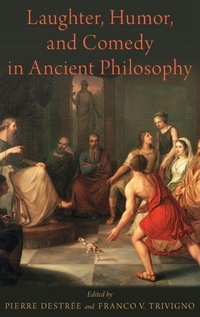
Laughter, Humor, and Comedy in Ancient Philosophy
Published on 16. October 2019
Book
Hardback
304 pages
978-0-19-046054-9 (ISBN)
Description
Ancient philosophers considered question about laughter, humor, and comedy to be both philosophically interesting and important. They theorized about laughter and its causes, moralized about the appropriate uses of humor and what it is appropriate to laugh at, and wrote treaties on comedic composition. They were often merciless in ridiculing their opponents' positions, borrowing comedic devices and techniques from comic poetry and drama to do so.
This volume is organized around three sets of questions that illuminate the philosophical concerns and corresponding range of answers found in ancient philosophy. The first set investigates the psychology of laughter. What is going on in our minds when we laugh? What background conditions must be in place for laughter to occur? Is laughter necessarily hostile or derisive? The second set of questions concerns the ethical and social norms governing laughter and humor. When is it appropriate or inappropriate to laugh? Does laughter have a positive social function? Is there a virtue, or excellence, connected to laugher and humor? The third set of questions concerns the philosophical uses of humor and comedic technique. Do philosophers use humor exclusively in criticizing rivals, or can it play a positive educational role as well? If it can, how does philosophical humor communicate its philosophical content? This volume does not aim to settle these fascinating questions but more importantly to start a conversation about them, and serve as a reference point for discussions of laughter, humor, and comedy in ancient philosophy.
This volume is organized around three sets of questions that illuminate the philosophical concerns and corresponding range of answers found in ancient philosophy. The first set investigates the psychology of laughter. What is going on in our minds when we laugh? What background conditions must be in place for laughter to occur? Is laughter necessarily hostile or derisive? The second set of questions concerns the ethical and social norms governing laughter and humor. When is it appropriate or inappropriate to laugh? Does laughter have a positive social function? Is there a virtue, or excellence, connected to laugher and humor? The third set of questions concerns the philosophical uses of humor and comedic technique. Do philosophers use humor exclusively in criticizing rivals, or can it play a positive educational role as well? If it can, how does philosophical humor communicate its philosophical content? This volume does not aim to settle these fascinating questions but more importantly to start a conversation about them, and serve as a reference point for discussions of laughter, humor, and comedy in ancient philosophy.
Reviews / Votes
... this is a valuable collection on an important and largely neglected topic. It avoids needless invective and polemic, and it is inclusive in the variety of approaches that are discussed. Modern theories come in for mention, but the primary focus is on the ancient texts and the complex engagement with wit, both cutting and convivial, that they exhibit. * Notre Dame Philosophical Reviews *More details
Language
English
Place of publication
New York
United States
Dimensions
Height: 240 mm
Width: 161 mm
Thickness: 21 mm
Weight
619 gr
ISBN-13
978-0-19-046054-9 (9780190460549)
Copyright in bibliographic data and cover images is held by Nielsen Book Services Limited or by the publishers or by their respective licensors: all rights reserved.
Schweitzer Classification
Other editions
Additional editions
Pierre Destrée | Franco V. Trivigno
Laughter, Humor, and Comedy in Ancient Philosophy
E-Book
08/2019
OUP eBook
€57.49
Available for download
Pierre Destrée | Franco V. Trivigno
Laughter, Humor, and Comedy in Ancient Philosophy
E-Book
08/2019
OUP eBook
€57.49
Available for download
Persons
Franco V. Trivigno is Professor of Philosophy in the Department of Philosophy, Classics, History of Art and Ideas at the University of Oslo. He is the co-editor (with Nancy Snow) of The Philosophy and Psychology of Character and Happiness (Routledge, 2014).
Pierre Destree is an Associate Research Professor at the FRS (Fonds de la Recherche Scientifique), and teaches ancient philosophy at the University of Louvain (Louvain-la-Neuve). He has edited numerous volumes with Brill, Wiley-Blackwell, Peeters Publishers, and Cambridge University Press.
Pierre Destree is an Associate Research Professor at the FRS (Fonds de la Recherche Scientifique), and teaches ancient philosophy at the University of Louvain (Louvain-la-Neuve). He has edited numerous volumes with Brill, Wiley-Blackwell, Peeters Publishers, and Cambridge University Press.
Editor
Associate Research ProfessorAssociate Research Professor, Department of Philosophy, Universite Catholique de Louvain, Belgium
Associate Professor, Department of Philosophy, Classics, History of Art and IdeasAssociate Professor, Department of Philosophy, Classics, History of Art and Ideas, University of Oslo
Content
- Introduction, Pierre Destrée and Franco V. Trivigno
- Part I. The Psychology of Laughter
- 1. Plato on Laughter and Moral Harm, Franco V. Trivigno
- 2. Aristotle on Why We Laugh at Jokes, Pierre Destrée
- 3. The Laughing Philosopher and the Physician: Laughter, Diagnosis and Therapy in Greek Medicine, R.J. Hankinson
- 4. Divine and Human Laughter in later Platonism, Malcolm Heath
- Part II. The Ethical and Social Significance of Laugher and Humor
- 5. Aristotle on Wittiness, Matthew D. Walker
- 6. Laughter, Social Norms and Ethics in Cicero's Works, Charles Guérin
- 7. Laughter and the Moral Guide: Dio Chrysostom and Plutarch, Michael Trapp
- Part III. The Use of Humor and Comedy in Philosophical Discourse
- 8. Self-Ridicule: Socratic Wisdom, Paul Woodruff
- 9. Ridicule and Protreptic: Plato, His Reader and the Role of Comedy in Inquiry, Mary Margaret McCabe
- 10. Humor as Philosophical Subversion, Especially in the Skeptics, Richard Bett
- 11. Philosophy is Great Fun! Laughter in Epicureanism, Geert Roskam
- 12. The Mouse, the Moneybox, and the Six-Footed Scurrying Solecism: Satire and Riddles in Seneca's Philosophy, Margaret Graver
- 13. Diogenes vs. Demonax: Laughter as Philosophy in Lucian, Inger N.I. Kuin