

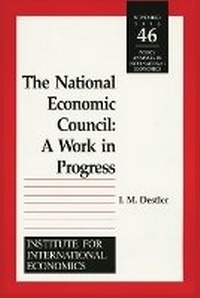
The National Economic Council - A Work in Progress
A Work in Progress
Published on 1. November 1996
Book
Paperback/Softback
94 pages
978-0-88132-239-2 (ISBN)
Description
In January 1993, President Bill Clinton established in his Executive Office the National Economic Council, parallel to the National Security Council born 45 years before. Its official purpose was to "coordinate the economic policymaking process with respect to domestic and international economic issues." The NEC was the President's staff instrument for fulfilling his campaign promise to give top priority to the American economy. Under its first director, Robert E. Rubin, the NEC orchestrated the development of Clinton's comprehensive deficit reduction plan. Then and since, it has sought to coordinate policy on a range of issues, particularly in the area of international trade. Now, as the NEC nears its fourth anniversary, it is appropriate to assess its record. How effectively has it played the role the president assigned it? Has its role been institutionalized, so the NEC can endure as the NSC has endured? Destler reviews its performance across a range of issues, from its two years under Rubin to its role under his successor, Laura Tyson. The analysis concludes with recommendations for strengthening the NEC in 1997 and beyond.
More details
Language
English
Place of publication
Washington
United States
Target group
College/higher education
Professional and scholarly
Product notice
Paperback (trade)
Dimensions
Height: 229 mm
Width: 152 mm
Thickness: 8 mm
Weight
170 gr
ISBN-13
978-0-88132-239-2 (9780881322392)
Copyright in bibliographic data and cover images is held by Nielsen Book Services Limited or by the publishers or by their respective licensors: all rights reserved.
Schweitzer Classification
Person
I. M. Destler was a Visiting Fellow and Professor and Acting Dean (1994-1995) at the School of Public Affairs and Director of its Center for International and Security Studies. He was Senior Associate at the Carnegie Endowment for International Peace (1977-83) and the Brookings Institution (1972-1977); and Visiting Lecturer at Princeton University (1971-1972) and at the International University of Japan (1986).