

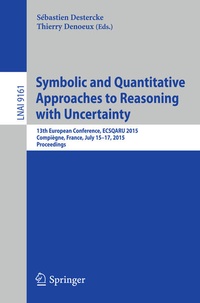
Symbolic and Quantitative Approaches to Reasoning with Uncertainty
13th European Conference, ECSQARU 2015, Compiègne, France, July 15-17, 2015. Proceedings
Published on 29. June 2015
Book
Paperback/Softback
XIII, 554 pages
978-3-319-20806-0 (ISBN)
Description
This book constitutes the refereed proceedings of the 13th European Conference on Symbolic and Quantitative Approaches to Reasoning with Uncertainty, ECSQARU 2015, held in Compiègne, France, in July 2015. The 49 revised full papers presented were carefully reviewed and selected from 69 submissions and cover topics on decision theory and preferences; argumentation; conditionals; game theory; belief update; classification; inconsistency; graphical models; Bayesian networks; belief functions; logic; and probabilistic graphical models for scalable data analytics. Papers come from researchers interested in advancing the technology and from practitioners using uncertainty techniques in real-world applications. The scope of the ECSQARU conferences encompasses fundamental issues, representation, inference, learning, and decision making in qualitative and numeric uncertainty paradigms.
More details
Series
Edition
2015 ed.
Language
English
Place of publication
Cham
Switzerland
Publishing group
Springer International Publishing
Target group
Professional and scholarly
Research
Illustrations
107 s/w Abbildungen
XIII, 554 p. 107 illus.
Dimensions
Height: 235 mm
Width: 155 mm
Thickness: 31 mm
Weight
850 gr
ISBN-13
978-3-319-20806-0 (9783319208060)
DOI
10.1007/978-3-319-20807-7
Schweitzer Classification
Other editions
Additional editions
Sébastien Destercke | Thierry Denoeux
Symbolic and Quantitative Approaches to Reasoning with Uncertainty
13th European Conference, ECSQARU 2015, Compiègne, France, July 15-17, 2015. Proceedings
E-Book
07/2015
Springer
€53.49
Available for download
Content
Decision theory and preferences.- Argumentation.-Conditionals.- Game theory.- Belief update.- Classification.- Inconsistency.- Graphical models.- Bayesian Networks.- Belief functions.- Logic.-Probabilistic graphical models for scalable data analytics.