

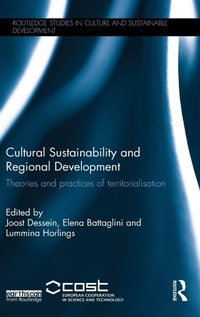
Cultural Sustainability and Regional Development
Theories and practices of territorialisation
1st Edition
Published on 13. August 2015
Book
Hardback
268 pages
978-1-138-83008-0 (ISBN)
Description
Meeting the aims of sustainability is becoming increasingly difficult; at the same time, the call for culture is becoming more powerful. This book explores the relationships between culture, sustainability and regional change through the concept of 'territorialisation'. This new concept describes the dynamics and processes in the context of regional development, driven by collective human agency that stretches beyond localities and marked-off regional boundaries.
This book launches the concept of 'territorialisation' by exploring how the natural environment and culture are constitutive of each other. This concept allows us to study the characterisation of the natural assets of a place, the means by which the natural environment and culture interact, and how communities assign meaning to local assets, add functions and ascribe rules of how to use space. By highlighting the time-space dimension in the use and consumption of resources, territorialisation helps to frame the concept and grasp the meaning of sustainable regional development. Drawing on an international range of case studies, the book addresses both conceptual issues and practical applications of 'territorialisation' in a range of contexts, forms, and scales.
The book will be of great interest to researchers and postgraduates in sustainable development, environmental studies, and regional development and planning.
This book launches the concept of 'territorialisation' by exploring how the natural environment and culture are constitutive of each other. This concept allows us to study the characterisation of the natural assets of a place, the means by which the natural environment and culture interact, and how communities assign meaning to local assets, add functions and ascribe rules of how to use space. By highlighting the time-space dimension in the use and consumption of resources, territorialisation helps to frame the concept and grasp the meaning of sustainable regional development. Drawing on an international range of case studies, the book addresses both conceptual issues and practical applications of 'territorialisation' in a range of contexts, forms, and scales.
The book will be of great interest to researchers and postgraduates in sustainable development, environmental studies, and regional development and planning.
Reviews / Votes
"Sustainability is a complex notion that has rapidly turned into a keyword in politics and also academic research. This topical and important book pushes this debate further by introducing a novel idea of cultural sustainability and how it is related to the complicated processes of regional development. An experienced interdisciplinary group of authors examines this themes from a number of exciting perspectives. The book explores thoroughly, through the concept of territorialisation, how the natural environment and culture are constitutive to each other."-Anssi Paasi, Professor of Geography, University of Oulu, Finland"Territorialisation becomes the focus of regional development in this path-breaking book. We are shown how this concept re-grounds development in place, in culture, in co-production with 'nature' within dynamic socio-technical assemblages. The approaches to territorialisation elaborated by the range of contributors shift attention away from the economism of mainstream regional development, giving value to the contingent but always present cultures of place. With empirical elaborations from all over the world we are given adequate illustration of the productivity of this line of thinking. The editors are to be congratulated for steering a well-trodden field in a direction that highlights new pathways towards sustainability."-J.K. Gibson-Graham, Institute for Culture and Society, Western Sydney University
More details
Series
Language
English
Place of publication
London
United Kingdom
Publishing group
Taylor & Francis Ltd
Target group
College/higher education
Illustrations
9 s/w Tabellen, 52 s/w Abbildungen, 34 s/w Photographien bzw. Rasterbilder, 9 s/w Zeichnungen
9 Tables, black and white; 9 Line drawings, black and white; 34 Halftones, black and white; 52 Illustrations, black and white
Dimensions
Height: 240 mm
Width: 161 mm
Thickness: 20 mm
Weight
596 gr
ISBN-13
978-1-138-83008-0 (9781138830080)
Copyright in bibliographic data and cover images is held by Nielsen Book Services Limited or by the publishers or by their respective licensors: all rights reserved.
Schweitzer Classification
Other editions
Additional editions
Joost Dessein | Elena Battaglini | Lummina Horlings
Cultural Sustainability and Regional Development
Theories and practices of territorialisation
Book
02/2017
1st Edition
Routledge
€76.80
Shipment within 10-20 days
Joost Dessein | Elena Battaglini | Lummina Horlings
Cultural Sustainability and Regional Development
Theories and practices of territorialisation
E-Book
08/2015
Routledge
€69.99
Available for download
Joost Dessein | Elena Battaglini | Lummina Horlings
Cultural Sustainability and Regional Development
Theories and practices of territorialisation
E-Book
08/2015
Routledge
€69.99
Available for download
Persons
Joost Dessein is Scientific Coordinator of the Social Sciences Unit of the Institute for Agricultural and Fisheries Research (ILVO), Belgium and Visiting Professor at the Department of Agricultural Economics,Ghent University, Belgium.
Elena Battaglini, Senior Researcher, manages the Research Area on Environment & Regional Development of Istituto di Ricerche Economiche e Sociali (IRES), Italy. Member of the Scientific Board of the Italian Sociology Association (AIS), Section Environment and Territory.
Lummina Horlings is Assistant Professor at the Rural Sociology Group, Wageningen University and Research Centre, The Netherlands.
Elena Battaglini, Senior Researcher, manages the Research Area on Environment & Regional Development of Istituto di Ricerche Economiche e Sociali (IRES), Italy. Member of the Scientific Board of the Italian Sociology Association (AIS), Section Environment and Territory.
Lummina Horlings is Assistant Professor at the Rural Sociology Group, Wageningen University and Research Centre, The Netherlands.
Content
1. Introduction: The role of culture in territorialisation 2. 'Sustainable Places': Place as a Vector of Culture. Two cases from Mexico 3. Territorialisation and the Assemblage of Rural Place: Examples from Canada and New Zealand 4. The Worldview and Symbolic Dimension in Territorialisation: How Human Values Play a Role in a Dutch Neighbourhood 5. Nature and Culture in Territorialisation Processes: Challenges and Insights from a Case-study in Serbia 6. Territoriality as Appropriation of Space: How 'Engaging with Space' Frames Sociality 7. Exploring Culture and Sustainability in Rural Finland 8. Territorialisation in Practice: The Case of Saffron Cultivation in Morocco 9. Is There a Place for Place? How Spaces and Places are Included in the Measures of Sustainable Development and Wellbeing 10. Making Territory through Cultural Mapping and Co-Design. How Community Practices Promote Territorialisation 11. How to Scale a Territory? Experiences from the U.S. 12. Culture matters. Planning Processes and Approaches towards Urban Resilience in European Cities and Urban Regions: Two Examples from Brussels and Ljubljana 13. Re-Creating and Celebrating Place(s) in Designated Space(s): The Case of Wales 14. Local Maize Practices and the Culture of Seed in Luoland, West Kenya 15. Les Jardins Partages in Paris: Cultivating Space, Community and Sustainable Way of Life 16. A 'European Valley' in South America: Regionalisation, colonisation, and environmental inequalities in Santa Catarina, Brazil 17. Conclusions: Territorialisation, a Challenging Concept for Framing Regional Development