

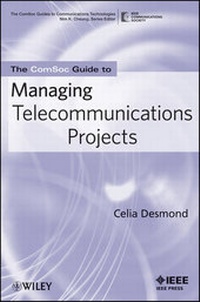
The ComSoc Guide to Managing Telecommunications Projects
Published on 15. October 2010
Book
Paperback/Softback
190 pages
978-0-470-28475-9 (ISBN)
Description
This pocket guide provides an overview of the telecommunications environment as it has evolved over the past few years, illustrating the need for project management, the significance of project success to the companies, and the application of key project management processes within the telecom environment. Topics covered include: scope management, time management, cost management, procurement management, risk management, communications, quality, human resources, and Integration. It offers professionals a brief and accessible guide to managing telecommunication projects in the 21st century.
Reviews / Votes
"This book is for those involved in line and staff functions at telecommunications companies who manage projects of any size. It will also be of interest to manufacturers and suppliers who serve the telecommunications industry, Internet providers, and companies that make products for the datacom industry. The book begins with an overview of the role of project management in the telecommunications industry, then gives advice on how to define the project scope. It outlines the procurement cycle, reviews issues of project risk, and addresses core aspects of project management such as building a schedule and budgeting." (Reference and Research Book News, February 2011)More details
Product info
Paperback
Series
Edition
1. Auflage
Language
English
Place of publication
United States
Publishing group
John Wiley & Sons Inc
Target group
Professional and scholarly
Product notice
Paperback (trade)
Unsewn / adhesive bound
Illustrations
Charts: 75 B&W, 0 Color; Drawings: 75 B&W, 0 Color; Graphs: 50 B&W, 0 Color
Dimensions
Height: 234 mm
Width: 156 mm
Thickness: 11 mm
Weight
322 gr
ISBN-13
978-0-470-28475-9 (9780470284759)
Schweitzer Classification
Other editions
Additional editions
Celia Desmond
The ComSoc Guide to Managing Telecommunications Projects
E-Book
06/2011
Wiley-IEEE Press
€61.99
Available for download
Celia Desmond
The ComSoc Guide to Managing Telecommunications Projects
E-Book
02/2011
Wiley-IEEE Press
€62.99
Available for download
Person
Celia Desmond is President of World Class Telecommunications, which provides training in management skills in business and telecommunications engineering environments. She is the project manager for the IEEE Communications Society Certification in Wireless Communications Engineering Technologies. Desmond has taught project management at four universities. A past president of IEEE Communications Society and past vice president of IEEE Engineering Management Society, Desmond has lectured internationally on programs for success. She is a Senior Member of IEEE.
Content
Preface.
Acronyms.
CHAPTER 1 Evolution of The Telecommunications Industry.
Monopoly Status.
Competition for Long Distance Services.
Competition for Local Services.
Competition Starts to Spread.
Internet and Multimedia Disrupt the Basic Networks.
A New Telecom Environment.
What About the Future?
CHAPTER 2 Why is PM Important, Especially in Telecommunications?
Team Diversity.
Resource Limitations.
Time Constraints and Limitations.
Risk Management.
Ensuring Quality.
Scope Definition.
Project Objectives.
What About Telecom Projects?
Tehnologies.
Services.
Companies in the Business.
Regulatory Environment.
Successful Business Model.
Internal Corporate Structures.
Customers.
The Best Way to Market.
Service Models.
Network Architecture.
Conclusion.
CHAPTER 3 Project Management Basics.
Integration.
Project Scope Management.
Time Management.
Cost Management.
Procurement Management.
Risk Management.
Communications Management.
Human Resources Management.
Quality Management.
CHAPTER 4 Getting Started on Your Project.
Why Do Projects?
The Requirements.
What Happens Before the Team Arrives?
Setting Project Objectives.
General Description, Skills Analysis, and Stakeholders, and Risk Analysis.
CHAPTER 5 Who Is Involved?
Project Sponsor.
Stakeholders.
Management.
Functional Managers.
The Type of Company Hosting the Project.
CHAPTER 6 Setting Business and Project Objectives.
SMART Objectives.
Specific.
Measurable.
Achievable.
Realistic.
Time-Bound.
CHAPTER 7 What Is to be Included?
Building the Charter.
Scope Description.
Scope Management Plan.
Where Will the Resources Come From?
The Work Breakdown Structure.
CHAPTER 8 Going Outside the Company for Products and Services.
Definition of Requirements.
Solicitation.
RFI.
RFP.
RFQ.
Vendor Selection.
Contract Management.
CHAPTER 9 Managing Risk in Telecom Projects.
Risk Management.
Contingency is Expected to be Spent.
CHAPTER 10 Who Tells What to Whom?
Communications Management.
General Communications.
CHAPTER 11 Creating the Timelines.
Task Duration.
Dependencies.
Finish-Start Dependency.
Start-Start Dependency.
Finish-Finish Dependency.
Start-Finish Dependency.
Mandatory and Discretionary Dependencies.
Lags and Leads.
Project Logic Diagram.
Critical Path.
Forward Pass.
Backward Pass.
Float.
Showing the Schedule.
Including Contingency.
Collapsing the Schedule.
Effort-Driven and Duration-Driven Tasks.
And then . . . .
CHAPTER 12 Managing the Costs.
Types of Costs.
Profitability Measures.
Estimating the Costs.
Project Budgets and Planning the Project Cost.
Managing the Costs.
Project Communications Planning and the Communications Matrix.
Status Reporting.
Meetings.
Preparing the Agenda.
Inviting the Right People.
Informing the People of Their Roles at the Meeting.
Using the Meeting Time Effectively.
Motivating People to Communicate Properly.
Electronic Tools for Communications.
Monitor and Control.
Some Suggestions.
CHAPTER 13 Managing the Developments.
CHAPTER 14 Managing the People.
Organization Structures for Projects.
Management Styles.
Autocratic.
Paternalistic.
Democratic.
Laissez-faire.
Leadership.
Team Building.
Motivation.
Conflict.
Learning Organization.
Managing the Workloads of the Team Members.
Some Suggestions for Good Participation and Good Management.
CHAPTER 15 What Is the Gain?
Good People.
Understanding the Value of the Product.
Clear Project Objectives.
Clearly Defined Scope.
Good Planning.
Strong Change Control.
Well-Connected Team.
Effective Communication.
References.
Index.