

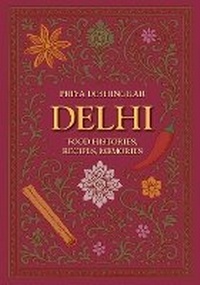
Delhi
Food Histories, Recipes, Memories
Will be published approx. on 1. September 2026
Book
Hardback
224 pages
978-1-80050-784-5 (ISBN)
Description
This book is about the food of Delhi, one of the world's great gastronomic capitals and a city where food is a living archive of migration, empire, social hierarchies and everyday neighbourliness.
The author frames her narrative around four intertwined communities-Baniyas, Muslims, Kayasthas, and Punjabis-whose kitchens, rituals, and street foods map onto Delhi's colonial and social histories. A core thread is that culinary knowledge is embodied and transmitted informally: through market errands, pickle making, festivals, religious practices. The more than 90 recipes in the book are thus more than instructions; they are windows into moral philosophies (Ayurveda, Jain ahimsa, Islamic halal and Unani Tibb), sensory aesthetics (perfume, texture, layered spices), and techniques (bhunai, dum, dhungar) that define tastes in the city.
Starting with a regional-historical backdrop, the author then provides a granular evocation of her own mohalla (neighbourhood) and a taxonomy of shared culinary techniques, ingredients and condiments. This is followed by chapters devoted to the cuisines of the four communities. In each the author deconstructs and explains hallmark methods, provides recipes and historical context while also debunking myths-for instance, that all vegetarianisms are alike or that Kayasthas eat meat only due to Mughal proximity.
The book also sketches constraints that affected each of these cuisines and generated creativity: limited seafood in a land-locked city; the elite glamour of hunting's and its legal end; and municipal pressures on informal vendors who nonetheless ensure that affordable snacks dot every market and lane. The result is a multicultural grammar that allows Delhiites to appreciate difference within a comforting sense of amicable coexistence.
Readers will appreciate that the city's genius is not a handful of signature dishes but its capacity to seat opposites at the same table and to keep absorbing new migrations without losing its own voice. That is the Dehli promise this book invites readers to taste and keep alive.
The author frames her narrative around four intertwined communities-Baniyas, Muslims, Kayasthas, and Punjabis-whose kitchens, rituals, and street foods map onto Delhi's colonial and social histories. A core thread is that culinary knowledge is embodied and transmitted informally: through market errands, pickle making, festivals, religious practices. The more than 90 recipes in the book are thus more than instructions; they are windows into moral philosophies (Ayurveda, Jain ahimsa, Islamic halal and Unani Tibb), sensory aesthetics (perfume, texture, layered spices), and techniques (bhunai, dum, dhungar) that define tastes in the city.
Starting with a regional-historical backdrop, the author then provides a granular evocation of her own mohalla (neighbourhood) and a taxonomy of shared culinary techniques, ingredients and condiments. This is followed by chapters devoted to the cuisines of the four communities. In each the author deconstructs and explains hallmark methods, provides recipes and historical context while also debunking myths-for instance, that all vegetarianisms are alike or that Kayasthas eat meat only due to Mughal proximity.
The book also sketches constraints that affected each of these cuisines and generated creativity: limited seafood in a land-locked city; the elite glamour of hunting's and its legal end; and municipal pressures on informal vendors who nonetheless ensure that affordable snacks dot every market and lane. The result is a multicultural grammar that allows Delhiites to appreciate difference within a comforting sense of amicable coexistence.
Readers will appreciate that the city's genius is not a handful of signature dishes but its capacity to seat opposites at the same table and to keep absorbing new migrations without losing its own voice. That is the Dehli promise this book invites readers to taste and keep alive.
More details
Language
English
Place of publication
London
United Kingdom
Product notice
sewn/stitched
Cloth over boards
Weight
390 gr
ISBN-13
978-1-80050-784-5 (9781800507845)
Copyright in bibliographic data and cover images is held by Nielsen Book Services Limited or by the publishers or by their respective licensors: all rights reserved.
Schweitzer Classification
Person
Priya Deshingkar was born in London and lived in Delhi from the age of 7 to 24. She moved to the UK in her 20s and travels back frequently to reconnect with the city. Priya established her company Deccan Tiffin in 2013 to showcase Indian food cultures including her Maharani Supper Club in Hove. Academically, she is a renowned expert on migration and refugee studies and is currently Professor of Migration and Development at the University of Sussex.
Content
PrefaceAcknowledgements
Notes
Glossary of Terms
Time Line
Maps
1. Introduction
2. Regional History: Situating the Food of Delhi
3. Ancient Delhi and Ganga-Jamuni Tehzeeb
4. My Mohalla
5. Shared Foods and Cultures
6. Baniya Food
7. Muslim Food
8. Kayastha Food
9. Punjabi Food
10. Epilogue
End Matter
Bibliography
Index
Notes
Glossary of Terms
Time Line
Maps
1. Introduction
2. Regional History: Situating the Food of Delhi
3. Ancient Delhi and Ganga-Jamuni Tehzeeb
4. My Mohalla
5. Shared Foods and Cultures
6. Baniya Food
7. Muslim Food
8. Kayastha Food
9. Punjabi Food
10. Epilogue
End Matter
Bibliography
Index