

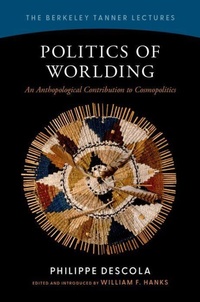
Politics of Worlding
An Anthropological Contribution to Cosmopolitics
Will be published approx. on 18. April 2026
Book
Hardback
240 pages
978-0-19-780165-9 (ISBN)
Description
The Politics of Worldling presents Philippe Descola's Tanner Lectures on Human Values, delivered in 2023 at the University of California, Berkeley. It offers a highly readable precis of some of the central ideas that animate Descola's work, and an excellent gateway into a new vision of anthropology developed by one of its most distinguished practitioners. The lectures draw heavily on Descola's research among Achuar peoples (formerly known as Jivaro) of the Upper Amazon, and on his erudite knowledge of the comparative literature in anthropology. He presents evidence that people in different societies construe the relation between nature and culture in fundamentally different ways, according to how they view human beings versus other-than-human beings.
Modern Euro-American naturalism holds that the laws of nature are universal and apply continuously across life forms, whereas human mental processes, self-consciousness and "inner lives" are unlike, and hence discontinous with the inner lives of non-human beings. Descola critiques this schema as anchronistic and destructive in the way it has led us to construct our world. He proposes alternative ways of thinking about "worldling" that might lead to less destructive outcomes, and provides a four-part typology of alternative relationships between the human and non-human, employing fascinating examples from the field. The commentators-political theorist Adom Getachew, environmental historian Timothy J. LeCain and comparative archaeologist David Wengrew-respond to the lectures and emphasize the importance of history, hybridity and the need for new, multidisciplinary approaches, to which Descola responds in a final chapter.
Intellectually compelling, politically critical, and forward looking, and including an introduction by the volume editor William F. Hanks, The Politics of Worldling will be valuable for scholars and students alike interested in a concise presentation of the views of one of its most visionary theorists.
Modern Euro-American naturalism holds that the laws of nature are universal and apply continuously across life forms, whereas human mental processes, self-consciousness and "inner lives" are unlike, and hence discontinous with the inner lives of non-human beings. Descola critiques this schema as anchronistic and destructive in the way it has led us to construct our world. He proposes alternative ways of thinking about "worldling" that might lead to less destructive outcomes, and provides a four-part typology of alternative relationships between the human and non-human, employing fascinating examples from the field. The commentators-political theorist Adom Getachew, environmental historian Timothy J. LeCain and comparative archaeologist David Wengrew-respond to the lectures and emphasize the importance of history, hybridity and the need for new, multidisciplinary approaches, to which Descola responds in a final chapter.
Intellectually compelling, politically critical, and forward looking, and including an introduction by the volume editor William F. Hanks, The Politics of Worldling will be valuable for scholars and students alike interested in a concise presentation of the views of one of its most visionary theorists.
More details
Series
Language
English
Place of publication
New York
United States
Target group
College/higher education
Professional and scholarly
Dimensions
Height: 150 mm
Width: 218 mm
Thickness: 23 mm
Weight
406 gr
ISBN-13
978-0-19-780165-9 (9780197801659)
Copyright in bibliographic data and cover images is held by Nielsen Book Services Limited or by the publishers or by their respective licensors: all rights reserved.
Schweitzer Classification
Persons
Philippe Descola is Emeritus Professor of Anthropology at the College de France and Director of studies at the Ecole des Hautes Etudes en Sciences Sociales (EHESS), Paris. His research has focused on the ethnology of Amerindian societies, Cognitive Anthropology, and on the cross-cultural examination of the relations between humans and non-humans. He has written or edited over twenty books translated into a dozen languages and has been a visiting professor in several prestigious institutions. His book Beyond Nature and Culture has been a major influence on anthropologists and intellectuals worldwide. Among many awards, Descola was the Recipient of the CNRS Gold Medal in 2012, and is a foreign member of the British Academy and of the American Academy of Arts and Sciences.
William F. Hanks is Professor of Anthropology at the University of California, Berkeley and Berkeley Distinguished Chair in Linguistic Anthropology. His work has focused on the study of communicative practices through
sustained fieldwork in Yucatan, Mexico. He has written extensively on spatial orientation and deixis, the language of religious conversion in the colonial history of Yucatan, Mexico, and contemporary shamanism. Former Guggenheim fellow (1996), his books include Referential Practice: Language and Lived Space among the Maya, Intertexts: Writings on Language, Utterance and Context, and Converting Words: Maya in the Age of the Cross, which won the 2015 Staley Book Prize and the 2010 Edward Sapir Book Prize. He received the John Gumperz Award for Lifetime Achievement, IPrA.
William F. Hanks is Professor of Anthropology at the University of California, Berkeley and Berkeley Distinguished Chair in Linguistic Anthropology. His work has focused on the study of communicative practices through
sustained fieldwork in Yucatan, Mexico. He has written extensively on spatial orientation and deixis, the language of religious conversion in the colonial history of Yucatan, Mexico, and contemporary shamanism. Former Guggenheim fellow (1996), his books include Referential Practice: Language and Lived Space among the Maya, Intertexts: Writings on Language, Utterance and Context, and Converting Words: Maya in the Age of the Cross, which won the 2015 Staley Book Prize and the 2010 Edward Sapir Book Prize. He received the John Gumperz Award for Lifetime Achievement, IPrA.
Author
Emeritus Professor of AnthropologyEmeritus Professor of Anthropology, College de France, Paris
Editor
Professor of Anthropology, Berkeley Distinguished Chair in Linguistic AnthropologyProfessor of Anthropology, Berkeley Distinguished Chair in Linguistic Anthropology, University of California Berkeley
Content
Acknowledgements, Philippe Descola
Contributors
Introduction, William F. Hanks
Politics of worlding: An anthropological contribution to cosmopolitans
Philippe Descola
Anthropology: a revolutionary science?
Anthropology as a comparative endeavor
I. Alter-politics
Ways of worlding
Cosmopolities
II. Animist worlds and their denizens
Patterns of relation
Can an animist territory be circumscribed?
III. Coping with hierarchy
Sacred kings, despots, rainmakers, powerless chiefs, and Andean churches
Conclusion
Commentaries
Strategies for a Decolonized Social Science
Adom Getachew
Ecology, Ethology, and Evolution: Towards a Post-Anthropocentric Collective Humanism
Timothy J. LeCain
Weapon of choice: Some archaeological reflections on cosmopolitics, and Indigenous critiques of European culture
David Wengrow
Response
Comments on Comments: Hybridization and Symmetrization
Philippe Descola
Index
Contributors
Introduction, William F. Hanks
Politics of worlding: An anthropological contribution to cosmopolitans
Philippe Descola
Anthropology: a revolutionary science?
Anthropology as a comparative endeavor
I. Alter-politics
Ways of worlding
Cosmopolities
II. Animist worlds and their denizens
Patterns of relation
Can an animist territory be circumscribed?
III. Coping with hierarchy
Sacred kings, despots, rainmakers, powerless chiefs, and Andean churches
Conclusion
Commentaries
Strategies for a Decolonized Social Science
Adom Getachew
Ecology, Ethology, and Evolution: Towards a Post-Anthropocentric Collective Humanism
Timothy J. LeCain
Weapon of choice: Some archaeological reflections on cosmopolitics, and Indigenous critiques of European culture
David Wengrow
Response
Comments on Comments: Hybridization and Symmetrization
Philippe Descola
Index