

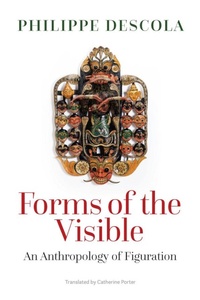
Forms of the Visible
An Anthropology of Figuration
1st Edition
Published on 26. September 2025
Book
Hardback
656 pages
978-1-5095-6196-4 (ISBN)
Description
Imagery and figuration are not just figments of an artist's imagination. Perception and imagination are always shaped by what habit has taught us to discern. The visual path we spontaneously trace through the world depends on where we are situated in the four regions of the ontological archipelago: animism, naturalism, totemism or analogism. Each of these four regions corresponds to a way of conceiving the objects that make up the world, of perceiving the continuities and discontinuities in the folds of the world and of drawing the dividing lines between humans and nonhumans.
From Alaskan Yup'ik masks and Aboriginal bark paintings to miniature landscapes from the Song dynasty and Dutch Golden Age interior scenes: each image reveals, through what it shows or fails to show, a certain figurative regime, identifiable by the formal means it uses and by the device through which it can unleash its power to act. The figurative regime enables us to grasp - sometimes better than words can - the contrasting ways of living that characterize the human condition and its relation to the nonhuman. By comparing a great diversity of visual images and artworks, Descola masterfully lays the theoretical foundations for an anthropology of figuration.
One of the world's leading anthropologists, Philippe Descola has developed a comparative anthropology of relations between humans and nonhumans that has revolutionized both the human sciences and our ways of thinking about the great ecological issues of our time. His new book will be of great value to students and scholars of anthropology, visual art and art history and to anyone interested in art, culture and the relations between the human and nonhuman worlds.
From Alaskan Yup'ik masks and Aboriginal bark paintings to miniature landscapes from the Song dynasty and Dutch Golden Age interior scenes: each image reveals, through what it shows or fails to show, a certain figurative regime, identifiable by the formal means it uses and by the device through which it can unleash its power to act. The figurative regime enables us to grasp - sometimes better than words can - the contrasting ways of living that characterize the human condition and its relation to the nonhuman. By comparing a great diversity of visual images and artworks, Descola masterfully lays the theoretical foundations for an anthropology of figuration.
One of the world's leading anthropologists, Philippe Descola has developed a comparative anthropology of relations between humans and nonhumans that has revolutionized both the human sciences and our ways of thinking about the great ecological issues of our time. His new book will be of great value to students and scholars of anthropology, visual art and art history and to anyone interested in art, culture and the relations between the human and nonhuman worlds.
Reviews / Votes
?Vast, magisterial, and unsettling, Forms of the Visible offers powerful tools for a more precise and more relevant global history of art. No one thinks about images more expansively and urgently than Philippe Descola.?Joseph Leo Koerner, Harvard University
?In putting his ontological framework to the test of images, Philippe Descola opens a wholly original way of looking at figuration across the entire ethnographic and historical spectrum. With its incisive thinking, breadth of scholarship, and multitude of insights, Forms of the Visible is a veritable tour de force. Neither the discipline of art history nor the anthropology of art will ever be the same.?
Michael Lambek, University of Toronto Scarborough
?Philippe Descola occupies a unique position in the field of social anthropology. Building on the long periods of fieldwork he has spent in Amazonia, the Northwest Coast of America, and Malaysia, he has developed a truly global anthropology of the image. Using a dazzling variety of case studies from Amazonian body painting to Florentine Renaissance painting, and from Dutch seventeenth-century interiors to Yup'ik masks, this book redefines the parameters for any truly global study of image-making for the coming decades.?
Caroline van Eck, University of Cambridge
More details
Language
English
Place of publication
Oxford
United Kingdom
Publishing group
John Wiley and Sons Ltd
Target group
Professional and scholarly
College/higher education
Dimensions
Height: 232 mm
Width: 154 mm
Thickness: 31 mm
Weight
1102 gr
ISBN-13
978-1-5095-6196-4 (9781509561964)
Copyright in bibliographic data and cover images is held by Nielsen Book Services Limited or by the publishers or by their respective licensors: all rights reserved.
Schweitzer Classification
Other editions
Additional editions
E-Book
09/2025
1st Edition
Wiley
€32.99
Available for download
Persons
Philippe Descola is Emeritus Professor of Anthropology at the College de France and Director of Studies at EHESS, Paris.
Content
Preface
1. The Folds of the World
Layers of invisibility
The embodied sign
Ontologies of images
Geometries of figuration
Forms of ostension and powers to act
PART ONE: PRESENCES
2. Embodied Spirits
Animal persons
Think animals
Who's there?
Distinguishing resemblances
Ontological camouflage
3. Multiplying Viewpoints
4. Relational Identities
PART TWO. INDICES
5. Types of Beings and Courses of Life
Figuring the ordering
Figuring the organizer
Figuring the traces of the organizing
6. A Heraldry of Qualities
7. The Power of Traces
Variation 1. Repertoire-Image and Person-Image
PART THREE. CORRESPONDENCES
8. Exercises in Composition Hybrids and chimeras
Pictured bonds
The great world and the small one
9. Conjunctive Spaces
10. Role Playing
PART FOUR: SIMULACRA
11. Facing the World
The conquest of the visible
Painting the soul
Instituting nature
Toward immanence
Impossible objectivity
12. Objectivizing the Subjective
13. Detecting Resemblance
Variation 2. Playing on All Fronts
Conclusion. Image-Making
Ontologies
Forms
Agencies Incarnations
Postscript. Scaffoldings
The quarrel over resemblance
Animating images
Imaged languages
Acknowledgements
Notes
Bibliography
Index
List of Illustrations
List of Tables
1. The Folds of the World
Layers of invisibility
The embodied sign
Ontologies of images
Geometries of figuration
Forms of ostension and powers to act
PART ONE: PRESENCES
2. Embodied Spirits
Animal persons
Think animals
Who's there?
Distinguishing resemblances
Ontological camouflage
3. Multiplying Viewpoints
4. Relational Identities
PART TWO. INDICES
5. Types of Beings and Courses of Life
Figuring the ordering
Figuring the organizer
Figuring the traces of the organizing
6. A Heraldry of Qualities
7. The Power of Traces
Variation 1. Repertoire-Image and Person-Image
PART THREE. CORRESPONDENCES
8. Exercises in Composition Hybrids and chimeras
Pictured bonds
The great world and the small one
9. Conjunctive Spaces
10. Role Playing
PART FOUR: SIMULACRA
11. Facing the World
The conquest of the visible
Painting the soul
Instituting nature
Toward immanence
Impossible objectivity
12. Objectivizing the Subjective
13. Detecting Resemblance
Variation 2. Playing on All Fronts
Conclusion. Image-Making
Ontologies
Forms
Agencies Incarnations
Postscript. Scaffoldings
The quarrel over resemblance
Animating images
Imaged languages
Acknowledgements
Notes
Bibliography
Index
List of Illustrations
List of Tables