

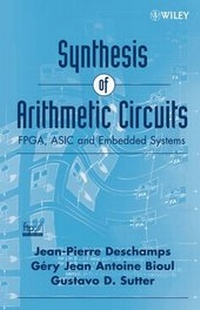
Synthesis of Arithmetic Circuits
FPGA, ASIC and Embedded Systems
Published on 31. March 2006
Book
Hardback
576 pages
978-0-471-68783-2 (ISBN)
Description
A new approach to the study of arithmetic circuits
In Synthesis of Arithmetic Circuits: FPGA, ASIC and Embedded Systems, the authors take a novel approach of presenting methods and examples for the synthesis of arithmetic circuits that better reflects the needs of today's computer system designers and engineers. Unlike other publications that limit discussion to arithmetic units for general-purpose computers, this text features a practical focus on embedded systems.
Following an introductory chapter, the publication is divided into two parts. The first part, Mathematical Aspects and Algorithms, includes mathematical background, number representation, addition and subtraction, multiplication, division, other arithmetic operations, and operations in finite fields. The second part, Synthesis of Arithmetic Circuits, includes hardware platforms, general principles of synthesis, adders and subtractors, multipliers, dividers, and other arithmetic primitives. In addition, the publication distinguishes itself with:
* A separate treatment of algorithms and circuits-a more useful presentation for both software and hardware implementations
* Complete executable and synthesizable VHDL models available on the book's companion Web site, allowing readers to generate synthesizable descriptions
* Proposed FPGA implementation examples, namely synthesizable low-level VHDL models for the Spartan II and Virtex families
* Two chapters dedicated to finite field operations
This publication is a must-have resource for students in computer science and embedded system designers, engineers, and researchers in the field of hardware and software computer system design and development.
Reviews / Votes
"...useful both in the academia and industry...suited for students taking specialist courses...[and] a valuable reference for practicing engineers." (IEEE Circuits & Devices Magazine, November/December 2006) "This book is warmly recommended to anyone having to design or understand how computer arithmetic operates at almost every conceivable level of detail." (Computing Reviews.com, June 8, 2006)More details
Edition
1. Auflage
Language
English
Place of publication
United States
Publishing group
John Wiley & Sons Inc
Target group
Professional and scholarly
Product notice
sewn/stitched
Paper over boards
Illustrations
Drawings: 300 B&W, 0 Color
Dimensions
Height: 240 mm
Width: 161 mm
Thickness: 35 mm
Weight
1026 gr
ISBN-13
978-0-471-68783-2 (9780471687832)
Schweitzer Classification
Other editions
Additional editions
Jean-Pierre Deschamps | Gery J. A. Bioul | Gustavo D. Sutter
Synthesis of Arithmetic Circuits
FPGA, ASIC and Embedded Systems
E-Book
03/2006
Wiley
€170.99
Available for download
Persons
JEAN-PIERRE DESCHAMPS, PhD, is Professor, University Rovira, Tarragona, Spain. He is the author of six books and over 100 research papers. His research interests include FPGA and ASIC design, digital arithmetic, and cryptography.
GERY Jean Antoine BIOUL, MSc, is Professor, National University of the Center of the Province of Buenos Aires, Argentina. His research interests include logic design and computer arithmetic algorithms, and implementations.
GUSTAVO D. SUTTER, PhD, is Professor, University Autonoma of Madrid, Spain. His research interests include FPGA and ASIC design, digital arithmetic, and development of embedded systems.
Content
Preface.
About the Authors.
1. Introduction.
1.1 Number Representation.
1.2 Algorithms.
1.3 Hardware Platforms.
1.4 Hardware-Software Partitioning.
1.5 Software Generation.
1.6 Synthesis.
1.7 A First Example.
1.8 Bibliography.
2. Mathematical Background.
2.1 Number Theory.
2.2 Algebra.
2.3 Function Approximation.
2.4 Bibliography.
3. Number Representation.
3.1 Natural Numbers.
3.2 Integers.
3.3 Real Numbers.
3.4 Bibliography.
4. Arithmetic Operations: Addition and Subtraction.
4.1 Addition of Natural Numbers.
4.2 Subtraction of Natural Numbers.
4.3 Integers.
4.4 Bibliography.
5. Arithmetic Operations: Multiplication.
5.1 Natural Numbers Multiplication.
5.2 Integers.
5.3 Squaring.
5.4 Bibliography.
6 Arithmetic Operations: Division.
6.1 Natural Numbers.
6.2 Integers.
6.3 Convergence (Functional Iteration) Algorithms.
6.4 Bibliography.
7. Other Arithmetic Operations.
7.1 Base Conversion.
7.2 Residue Number System Conversion.
7.3 Logarithmic, Exponential, and Trigonometric Functions.
7.4 Square Rooting.
7.5 Bibliography.
8. Finite Field Operations.
8.1 Operations in Zm.
8.2 Operations in GF(p).
8.3 Operations in Zp[x]/f (x).
8.4 Operations in GF(pn).
8.5 Bibliography.
Appendix 8.1 Computation of fki.
9 Hardware Platforms.
9.1 Design Methods for Electronic Systems.
9.2 Instruction Set Processors.
9.3 ASIC Designs.
9.4 Programmable Logic.
9.5 Hardware Description Languages (HDLs).
9.6 Further Readings.
9.7 Bibliography.
10. Circuit Synthesis: General Principles.
10.1 Resources.
10.2 Precedence Relation and Scheduling.
10.3 Pipeline.
10.4 Self-Timed Circuits.
10.5 Bibliography.
11 Adders and Subtractors.
11.1 Natural Numbers.
11.2 Integers.
11.3 Bibliography.
12 Multipliers.
12.1 Natural Numbers.
12.2 Integers.
12.3 Bibliography.
13. Dividers.
13.1 Natural Numbers.
13.2 Integers.
13.3 Bibliography.
14 Other Arithmetic Operators.
14.1 Base Conversion.
14.2 Polynomial Computation Circuits.
14.3 Logarithm Operator.
14.4 Exponential Operator.
14.5 Sine and Cosine Operators.
14.6 Square Rooters.
14.7 Bibliography.
15. Circuits for Finite Field Operations.
15.1 Operations in Zm.
15.2 Inversion in GF(p).
15.3 Operations in Zp[x]/f (x).
15.4 Inversion in GF(pn).
15.5 Bibliography.
16. Floating-Point Unit.
16.1 Floating-Point System Definition.
16.2 Arithmetic Operations.
16.3 Rounding Schemes.
16.4 Guard Digits.
16.5 Adder-Subtractor.
16.6 Multiplier.
16.7 Divider.
16.8 Square Root.
16.9 Comments.
16.10 Bibliography.
Index.