

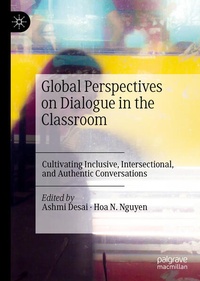
Global Perspectives on Dialogue in the Classroom
Description
This book explores globally-informed, culturally-rooted approaches to dialogue in the classroom. It seeks to fill gaps in communication and education literature related to decolonizing dialogue and breaking binaries by decentering Eurocentric perspectives and providing space for dialogic practices grounded in cultural wealth of students and teachers. We first describe the book's genesis, contextualize dialogue within the global impact of the COVID-19 pandemic, and share guiding concepts of inclusion, intersectionality, and authenticity in dialogue and pedagogy. We also distinguish dialogue from other practices and times in which dialogue may not be possible. The book brings fresh and urgent perspectives from authors across different disciplines, including ceramics, religious studies, cultural studies, communication, family therapy, and conflict resolution. The chapters distill the idea of dialogue within contexts like a bible circle, university sculpture studio, trauma and peacebuilding program, and connect dialogue to teaching, learning, and emerging ideas of power disruption, in-betweenness, and relationality.
Reviews / Votes
A book that takes seriously the moment we are in and the global nature of the imperatives for dialogue. For those interested in expanding the work of dialogue, social change and social justice, this will become required reading. An essential guide for change makers who seek to delve deeply into the new ways we have now come to understand the varieties of human experience and expression.-Kazi Joshua, Vice President for Student Affairs and Dean of Students, Whitman College, USA A wonderful text that expands understanding of dialogue to include categories of people often given less attention, with chapters focusing on people who hail from multiple national communities as they pursue diverse goals. This collection offers readers fresh ways to understand and appreciate others whose lives are different from their own. -Karen Tracy, Professor Emeritus, Department of Communication, University of Colorado Boulder, USA Ashmi Desai and Hoa Nguyen have called together a room full of scholar-activist-educators who openly and vulnerably share both their discontents with a perspective of dialogue rooted in colonial, oppressive structures and their efforts to reconcile their training in dialogue with a more culturally resonant practice. Reading this edited volume is an invitation into that room -- a unique opportunity to listen to nuanced conversations about dialogue, conversations that question how foundational practices in dialogue might actually exclude and further marginalize cultural ways that have liberatory potential. The authors in this volume speak and write from communities often unseen, unacknowledged or silenced in discussions about dialogue; ironically, white, European men are often centered in dialogic origin stories. Global Perspectives on Dialogue in the Classroom rectifies this and, in doing so, challenges readers to rethink how we came to learn about dialogue, what we believe constitutes dialogue and, most importantly, the purposes of dialogue. The authors included in this volume provide a vision for dialogue as community engagement, as organizing, as protest and as activism. This book was born from a wondering about a standard practice in dialogue, one I've used many times myself, and blossomed into this lovely, challenging, insightful text that unseats assumptions in the field and challenges practitioners to see the potential of dialogue for social change. -Colette Cann, Associate Dean and Professor in International and Multicultural Education School of Education, University of San Francisco, USA This important text about intergroup dialogue decenters U.S. and eurocentric epistemologies of race and decolonization to focus on perspectives from the global south that are often marginal and underrepresented. To center healing and non-western ways of knowing as part of intergroup dialogue pedagogy is to move beyond how we have come to know each other racially and spatially. This text creates space for other ways of knowing and learning about race, racism and the functions of whiteness globally from which we can begin to create new pathways for dialoguing across differences. It is a must read! -Kimberly N. Williams Brown, Assistant Professor of Education, Vassar College, USA This book answers the urgent call to apply dialogue aligned to social justice in our polarized communities. It not only advocates but also shows how to interrupt conflict with dialogue, in the voices of grounded practitioners drawing on Reflective Structured Dialogue, Intergroup Dialogue and other approaches. Through well told stories from classrooms to conflict zones, and across various identities, including Chicanx and Indigenous, this book invites readers to interrogate their own notions of power and privilege in a globalized world. -John Sarrouf, Co-executive Director andDirector of Program Development, Essential Partners, USAMore details
Other editions
Additional editions
Persons
Ashmi Desai (she/her), Ph.D., is an Assistant Professor in Public Dialogue and Conflict Management at San Francisco State University Department of Communication Studies and also directs the Conflict Resolution Certificate there. Desai completed her Ph.D. in Communication from University of Colorado Boulder and finished her Master's degree in Development Communication from Gujarat University, India. As a community-based researcher, her teaching and research interests involve dialogic pedagogy, international and intercultural communication, conflict management tools and approaches, and representations of culture, home and belonging. Desai's classes on dialogue and conflict resolution engage students in the discovery of self and the other through analysis of global and local struggles, story circles, relational leadership, and examination of systemic power and privilege. Desai is certified to facilitate dialogue from Public Conversations Project, Intercultural Development Institute and Community Boards. By centering community cultural wealth and dialogic approach in conversations, Desai aims to cultivate critical and transformative connections across divides.
Hoa Nguyen (she.her), Ph.D., is an Assistant Professor in the Family Therapy Program at Valdosta State University. She graduated with her Ph.D. in Marriage and Family Therapy from Virginia Tech. Currently, she teaches courses on postmodernism, ethics, and diversity, inclusion, and social justice in family therapy. She is trained in dialogical approaches to therapy as well as dialogue models of teaching. Her research interest focuses on the intersection of cultural and sexual identity, international LGBTQ+ lived experiences, and cultural humility in family therapy and education. Hoa largely focuses on teaching and working with graduate family therapy students on how to facilitate and engage in transformative dialogues. In her classrooms, students are self-reflexive of their own levelsof openness, resistance, and ways of approaching different ideas, perspectives, and people. Her hope is to cultivate critically conscious conversations that are globally aware, inclusive, and decolonizing.
Content
Chapter 1. Introduction: Beyond Borders, Labels, and Divides.- Chapter 2. Decolonizing the Classroom: Settler Colonialism, Knowledge Production, and Antiracism.- Chapter 3. Interfaith Dialogue: Managing Paradoxes.- Chapter 4. Harmony: Essence and Applications to Dialogue.- Chapter 5. Not Transition, But Translation: A Dialogic Approach to 'Differences' in a Korean Diasporic Evangelical Church.- Chapter 6. Los Seis de Boulder Sculpture Project: A Reflection on Dialogue and Community Building Through Art-Making.- Chapter 7. Writing Black Queers into Existence: A South African Model for Dialogue Among Oppressed Groups.- Chapter 8. Intergroup Dialogue for Social Healing: Creating Spaces of Collective Hope and Transformation.- Chapter 9. Experiential Ecological and Art-Based Practices for Reconnecting with Mother Earth and with Each Other.- Chapter 10. Dialogic Learning in the Time of a Global Pandemic and Beyond.- Chapter 11. Relationality as a Way of Being: A Pedagogy of Classroom Conversations.- Chapter 12. Dialogue and Systems Theory: Teaching Public Conversations in Family Therapy.- Chapter 13. Honoring Culture, Holding Complexity: Synthesis and Emerging Possibilities in Dialogue.