

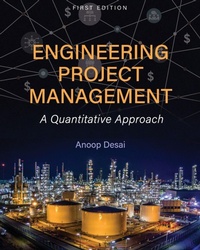
Engineering Project Management
A Quantitative Approach
Published on 30. May 2022
Book
Paperback/Softback
188 pages
978-1-7935-1230-7 (ISBN)
Description
Engineering Project Management: A Quantitative Approach introduces students to an assortment of quantitative analysis techniques with emphasis on three key attributes for effective project management: cost analysis, product quality, and time management. The techniques provide individuals with the ability to ensure appropriate quality control by meeting and exceeding customer expectations; complete a project within a given timeframe; and complete a project within given cost constraints.
The book is organized into three units. Unit I focuses on cost management and features chapters that cover breakeven analysis, the time value of money, benefit cost analysis, and depreciation. Unit II underscores the importance of quality control and familiarizes students with two approaches to ensuring quality: the reactive method and the proactive method. Relevant tools such as control charts, FMEA, QFD, and Ishikawa analysis are presented. In Unit III, students become familiar with the twin methods of the project evaluation review technique (PERT) and the critical path method (CPM), which are essential for effective time management. Both deterministic and probabilistic approaches to CPM are presented. Appendices provide students with a collection of interest rate tables and a normal distribution table.
A concise yet enlightening guide, Engineering Project Management is an exemplary resource for courses and programs in engineering.
The book is organized into three units. Unit I focuses on cost management and features chapters that cover breakeven analysis, the time value of money, benefit cost analysis, and depreciation. Unit II underscores the importance of quality control and familiarizes students with two approaches to ensuring quality: the reactive method and the proactive method. Relevant tools such as control charts, FMEA, QFD, and Ishikawa analysis are presented. In Unit III, students become familiar with the twin methods of the project evaluation review technique (PERT) and the critical path method (CPM), which are essential for effective time management. Both deterministic and probabilistic approaches to CPM are presented. Appendices provide students with a collection of interest rate tables and a normal distribution table.
A concise yet enlightening guide, Engineering Project Management is an exemplary resource for courses and programs in engineering.
More details
Language
English
Place of publication
San Diego
United States
Target group
Professional and scholarly
Product notice
Paperback (trade)
Unsewn / adhesive bound
Dimensions
Height: 254 mm
Width: 203 mm
Thickness: 10 mm
Weight
386 gr
ISBN-13
978-1-7935-1230-7 (9781793512307)
Copyright in bibliographic data and cover images is held by Nielsen Book Services Limited or by the publishers or by their respective licensors: all rights reserved.
Schweitzer Classification
Person
Anoop Desai is a professor of mechanical engineering in the College of Engineering and Computing at Georgia Southern University. He holds an M.S. and Ph.D. in industrial and manufacturing engineering from the University of Cincinnati. He is the author of about 25 journal papers and five books ranging in scope from product development to sustainability. His main area of interest is Design for X and the economic impact of engineering decisions.