

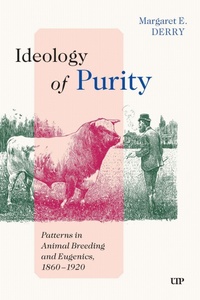
Ideology of Purity
Patterns in Animal Breeding and Eugenics, 1860-1920
Published on 16. December 2025
Book
Hardback
238 pages
978-1-4875-7032-3 (ISBN)
Description
Ideology of Purity challenges the assumption that animal breeding has served as a reliable model for eugenics through a direct comparison of the views of eugenicists with those of animal breeders.
Eugenicists have cited animal breeding to justify their conceptions on human heredity and purity, misunderstanding the true meaning behind these principles and practices. Rather than accepting eugenic rhetoric at face value, this book examines how concepts like purity have been understood and applied differently in animal breeding and human eugenics. It explores how government policies have responded to both groups and aligned their demands. Historian Margaret E. Derry shows that the state promoted different forms of "purity" for animals and humans, and that the perceived parallels were more rhetorical than real. Through an analysis of topics such as nature versus nurture and the role of selective breeding, this book uncovers fundamental differences in goals, methods, and assumptions surrounding breeding. By drawing the conclusion that connections between eugenics and animal breeding were largely constructed through suggestive language rather than substantive similarity, Derry offers a new and critical perspective on the historical relationship between science, ideology, and policy.
Eugenicists have cited animal breeding to justify their conceptions on human heredity and purity, misunderstanding the true meaning behind these principles and practices. Rather than accepting eugenic rhetoric at face value, this book examines how concepts like purity have been understood and applied differently in animal breeding and human eugenics. It explores how government policies have responded to both groups and aligned their demands. Historian Margaret E. Derry shows that the state promoted different forms of "purity" for animals and humans, and that the perceived parallels were more rhetorical than real. Through an analysis of topics such as nature versus nurture and the role of selective breeding, this book uncovers fundamental differences in goals, methods, and assumptions surrounding breeding. By drawing the conclusion that connections between eugenics and animal breeding were largely constructed through suggestive language rather than substantive similarity, Derry offers a new and critical perspective on the historical relationship between science, ideology, and policy.
More details
Language
English
Place of publication
Toronto
Canada
Target group
College/higher education
Professional and scholarly
Dimensions
Height: 158 mm
Width: 238 mm
Thickness: 21 mm
Weight
456 gr
ISBN-13
978-1-4875-7032-3 (9781487570323)
Copyright in bibliographic data and cover images is held by Nielsen Book Services Limited or by the publishers or by their respective licensors: all rights reserved.
Schweitzer Classification
Person
Margaret E. Derry is an adjunct professor of history at the University of Guelph.
Content
Introduction
1. Heredity and Breeding from Antiquity to the Nineteenth Century
2. Rhetoric: Breed, Race, and Class Ideology
3. Francis Galton and Hereditary Theory
4. Galton's Eugenics and Animal Breeding
5. Purity: Its Regulation in Eugenics and Animal Breeding
6. Purity as a Breeding Ideal and the General Farmer
7. Biologist/Geneticist Support of Eugenics in Relation to Animal Breeding
8. Animal Breeding Reform: Galton's Failure and Ultimate Success
Concluding Remarks
Notes
Bibliography
Index
1. Heredity and Breeding from Antiquity to the Nineteenth Century
2. Rhetoric: Breed, Race, and Class Ideology
3. Francis Galton and Hereditary Theory
4. Galton's Eugenics and Animal Breeding
5. Purity: Its Regulation in Eugenics and Animal Breeding
6. Purity as a Breeding Ideal and the General Farmer
7. Biologist/Geneticist Support of Eugenics in Relation to Animal Breeding
8. Animal Breeding Reform: Galton's Failure and Ultimate Success
Concluding Remarks
Notes
Bibliography
Index