

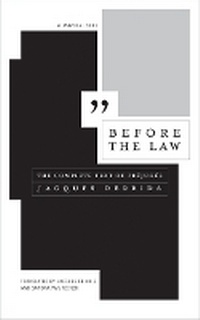
Before the Law
The Complete Text of Prejuges
Published on 23. October 2018
Book
Paperback/Softback
96 pages
978-1-5179-0551-4 (ISBN)
Description
Thinking judgment in relation to the work of Jean-FranCois Lyotard
"How to judge-Jean-FranCois Lyotard?" It is from this initial question that one of France's most heralded philosophers of the twentieth century begins his essay on the origin of the law, of judgment, and the work of his colleague Jean-FranCois Lyotard. If Jacques Derrida begins with the term prEjugEs, it is in part because of its impossibility to be rendered properly in other languages and also contain all its meanings: to pre-judge, to judge before judging, to hold prejudices, to know "how to judge," and more still, to be already prejudged oneself.
Striving to contain that which comes before the law, that is in front of the law and also prior to it, how to judge Jean-FranCois Lyotard then becomes perhaps a beneficial attempt for Derrida to explore humanity's rapport with judgment, origins, and naming. For how does one come to judge the author of the Differend? How does one abstain from judgment to accept the term prEjugEs as suspending judgment and at once as taking into account the impossibility of speaking before the law, prior to naming or judging? If this task indeed seems insurmountable, it is the site where Lyotard's work itself is played out. Hence this sincere and intriguing essay presented by Jacques Derrida, published here for the first time in English.
"How to judge-Jean-FranCois Lyotard?" It is from this initial question that one of France's most heralded philosophers of the twentieth century begins his essay on the origin of the law, of judgment, and the work of his colleague Jean-FranCois Lyotard. If Jacques Derrida begins with the term prEjugEs, it is in part because of its impossibility to be rendered properly in other languages and also contain all its meanings: to pre-judge, to judge before judging, to hold prejudices, to know "how to judge," and more still, to be already prejudged oneself.
Striving to contain that which comes before the law, that is in front of the law and also prior to it, how to judge Jean-FranCois Lyotard then becomes perhaps a beneficial attempt for Derrida to explore humanity's rapport with judgment, origins, and naming. For how does one come to judge the author of the Differend? How does one abstain from judgment to accept the term prEjugEs as suspending judgment and at once as taking into account the impossibility of speaking before the law, prior to naming or judging? If this task indeed seems insurmountable, it is the site where Lyotard's work itself is played out. Hence this sincere and intriguing essay presented by Jacques Derrida, published here for the first time in English.
Reviews / Votes
"This excellent translation gives the whole text, parts of which had remained untranslated into English. It has discreet and careful annotation, giving full details for the references and quotations, something the original publication did not do, thus pinning down what was being encouraged to slip away."-French StudiesMore details
Series
Language
English
Place of publication
Minnesota
United States
Target group
Professional and scholarly
Dimensions
Height: 203 mm
Width: 127 mm
Thickness: 51 mm
ISBN-13
978-1-5179-0551-4 (9781517905514)
Copyright in bibliographic data and cover images is held by Nielsen Book Services Limited or by the publishers or by their respective licensors: all rights reserved.
Schweitzer Classification
Persons
Jacques Derrida (1930-2004) was director of studies at the Ecole des hautes Etudes en sciences sociales, Paris, and professor of humanities at the University of California, Irvine.
Sandra van Reenen is lecturer in French at the University of the Western Cape, South Africa.
Jacques de Ville is professor of law at the University of the Western Cape, South Africa. His recent publications include Jacques Derrida: Law as Absolute Hospitality and Constitutional Theory: Schmitt after Derrida.
Sandra van Reenen is lecturer in French at the University of the Western Cape, South Africa.
Jacques de Ville is professor of law at the University of the Western Cape, South Africa. His recent publications include Jacques Derrida: Law as Absolute Hospitality and Constitutional Theory: Schmitt after Derrida.