

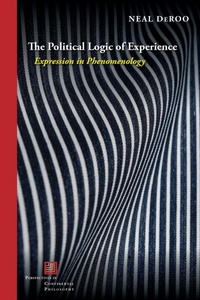
The Political Logic of Experience
Expression in Phenomenology
Published on 7. June 2022
Book
Hardback
240 pages
978-1-5315-0004-7 (ISBN)
Description
The Political Logic of Experience argues that experience and phenomenology are essentially political, with profound implications for our understanding of subjectivity, epistemology, experience, the phenomenological method, and politics.
Drawing on work from across the phenomenological tradition, it develops an account of expression as the internal relationship uniting knowing, being, and doing with both transcendental conditions and empirical phenomena. This expressive unification generates subjectivity as an expression of particular communities and subjects as an expression of subjectivity. Subjectivity and experience are therefore both revealed to be inherently political prior to their expression in particular subjects.
In clarifying the political nature of experience and the constitution of subjectivity, the book puts the work of critical phenomenology in dialogue with transcendental phenomenology to reveal the need for a phenomenological politics: a field tasked with explaining the expressive, co-constitutive, and necessarily political relationships between subjects and their communities. It is only through such a phenomenological politics that we can properly make sense of the epistemological, ontological, and practical significance of issues like racism and sexism, problems that concern our very experience of the world. The book reveals phenomenology to be both essentially political and politically essential, as it emerges within particular communities and shapes and transforms how individuals within those communities experience the world.
Touching on issues of transcendental phenomenology, political strategy, historical interpretation and inter-disciplinary phenomenological method, the book argues for foundational claims pertaining to phenomenology, politics, and social criticism that will be of interest to those working in philosophy, gender studies, race, queer theory, transcendental and applied phenomenology, and beyond.
Drawing on work from across the phenomenological tradition, it develops an account of expression as the internal relationship uniting knowing, being, and doing with both transcendental conditions and empirical phenomena. This expressive unification generates subjectivity as an expression of particular communities and subjects as an expression of subjectivity. Subjectivity and experience are therefore both revealed to be inherently political prior to their expression in particular subjects.
In clarifying the political nature of experience and the constitution of subjectivity, the book puts the work of critical phenomenology in dialogue with transcendental phenomenology to reveal the need for a phenomenological politics: a field tasked with explaining the expressive, co-constitutive, and necessarily political relationships between subjects and their communities. It is only through such a phenomenological politics that we can properly make sense of the epistemological, ontological, and practical significance of issues like racism and sexism, problems that concern our very experience of the world. The book reveals phenomenology to be both essentially political and politically essential, as it emerges within particular communities and shapes and transforms how individuals within those communities experience the world.
Touching on issues of transcendental phenomenology, political strategy, historical interpretation and inter-disciplinary phenomenological method, the book argues for foundational claims pertaining to phenomenology, politics, and social criticism that will be of interest to those working in philosophy, gender studies, race, queer theory, transcendental and applied phenomenology, and beyond.
More details
Series
Edition
New edition
Language
English
Place of publication
New York
United States
Target group
Professional and scholarly
Edition type
New edition
Product notice
Cloth over boards
Dimensions
Height: 229 mm
Width: 152 mm
Thickness: 19 mm
Weight
531 gr
ISBN-13
978-1-5315-0004-7 (9781531500047)
Copyright in bibliographic data and cover images is held by Nielsen Book Services Limited or by the publishers or by their respective licensors: all rights reserved.
Schweitzer Classification
Other editions
Additional editions
E-Book
06/2022
Fordham University Press
€34.49
Available for download
Person
Neal DeRoo is Professor of Philosophy and Canada Research Chair in Phenomenology and Philosophy of Religion, at the King's University, Edmonton. He is the author of Futurity in Phenomenology: Promise and Method in Husserl, Levinas, and Derrida.
Content
List of Abbreviations ix
Introduction: Experience and the Problem of Expression 1
1 A Phenomenological Account of Expressivity 27
2 Material-Spiritual Flesh: The Subjective Implications of Expressivity 47
3 From Sense to Sensings: The Epistemological Implications of Expressivity 67
4 Making Sense of Experience: The Transcendental Implications of Expressivity 87
5 The Subject, Reduction, and Uses of Phenomenology:
The Methodological Implications of Expressivity 113
6 Toward a Phenomenological Politics: The Political Implications of Expressivity 135
Conclusion: The Logic of Phenomenality 159
Acknowledgments 181
Notes 183
Works Cited 221
Index 233
Introduction: Experience and the Problem of Expression 1
1 A Phenomenological Account of Expressivity 27
2 Material-Spiritual Flesh: The Subjective Implications of Expressivity 47
3 From Sense to Sensings: The Epistemological Implications of Expressivity 67
4 Making Sense of Experience: The Transcendental Implications of Expressivity 87
5 The Subject, Reduction, and Uses of Phenomenology:
The Methodological Implications of Expressivity 113
6 Toward a Phenomenological Politics: The Political Implications of Expressivity 135
Conclusion: The Logic of Phenomenality 159
Acknowledgments 181
Notes 183
Works Cited 221
Index 233