

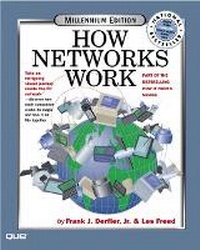
How Networks Work, Millennium Edition
Published on 15. September 2000
Book
Paperback/Softback
240 pages
978-0-7897-2445-8 (ISBN)
Description
Part of the best-selling How It Works series, How Networks Work is a stunning, full-color illustrated title on networking technology. Each spread provides the reader with the information necessary to understand the fundamentals of connectivity, and each detailed illustration is labeled and annotated in easy to comprehend terms, helping the reader cut through the difficult vocabulary of the networking world. In this excursion through the inner-workings of all the network pieces, you?ll see the inside of a modem and the purpose of each component, how a wiring hub fits into a network operating system, how data goes in and out of a network interface card (NIC), and much more.
More details
Language
English
Place of publication
United States
Publishing group
Pearson Education (US)
Target group
College/higher education
Dimensions
Height: 253 mm
Width: 210 mm
Thickness: 13 mm
Weight
666 gr
ISBN-13
978-0-7897-2445-8 (9780789724458)
Copyright in bibliographic data and cover images is held by Nielsen Book Services Limited or by the publishers or by their respective licensors: all rights reserved.
Schweitzer Classification
Other editions
New editions
Frank J. Derfler | Les Freed
How Networks Work
Book
10/2002
6th Edition
Que Corporation,U.S.
€47.22
Article exhausted; check for reprint
Persons
Frank J. Derfler, Jr. and Les Freed are a proven networking best-selling combination. In addition to authoring the wildly successful How Networks Work, 4th Edition, they also wrote Get a Grip on Network Cabling, a success for Ziff Davis Press and still being used in many college and technical school classrooms as the coursebook for cabling classes. Frank is a Senior Networking Editor and Les is a Contributing Editor at PC Magazine, where they review the latest networking products and technology for the world's largest computer magazine. Among their many contributions to the computer and networking world, Frank and Les have also co-authored Practical Network Cabling (Que 12/98) and Frank has written Practical Networking (Que 12/98) and Using Networks (Que 3/98).
Content
Introduction.
I. COMMUNICATING BY WIRE.
1. The Telegraph.
2. The Telephone.
3. Printing Telegraphs.
II. MIXING COMPUTERS AND TELEPHONES.
4. The Early Networks.
5. From Keypunches to Terminals to the Carterfone.
6. Alphabet Soup: Morse, Baudot, ASCII, and EBCDIC.
7. The Bell 103 Modem.
8. Dialing for Data.
9. The RS-232C Serial Interface.
10. The Personal Computer as a Terminal.
11. Smart Modems.
12. Computer Telephony Integration.
III. LOCAL AREA NETWORKS (LANS).
13. A Network Model.
14. Network Operating Systems.
15. The Network Interface Card.
16. Network Cabling.
17. Server-Based LANs.
18. Peer-to-Peer Networks.
19. Enterprise Network Systems.
20. LAN-to-LAN Connections.
IV. LINKS BETWEEN LANS.
21. Bridges, Routers, and Switches.
22. Metropolitan Area Networks (MANs).
23. Circuit-Switched Digital Services.
24. Packet-Switching Networks.
V. THE INTERNET.
25. Internet Connections.
26. Network Security.
VI. NETWORKS FOR E-BUSINESS.
27. E-Business Infrastructure.
Index.
I. COMMUNICATING BY WIRE.
1. The Telegraph.
2. The Telephone.
3. Printing Telegraphs.
II. MIXING COMPUTERS AND TELEPHONES.
4. The Early Networks.
5. From Keypunches to Terminals to the Carterfone.
6. Alphabet Soup: Morse, Baudot, ASCII, and EBCDIC.
7. The Bell 103 Modem.
8. Dialing for Data.
9. The RS-232C Serial Interface.
10. The Personal Computer as a Terminal.
11. Smart Modems.
12. Computer Telephony Integration.
III. LOCAL AREA NETWORKS (LANS).
13. A Network Model.
14. Network Operating Systems.
15. The Network Interface Card.
16. Network Cabling.
17. Server-Based LANs.
18. Peer-to-Peer Networks.
19. Enterprise Network Systems.
20. LAN-to-LAN Connections.
IV. LINKS BETWEEN LANS.
21. Bridges, Routers, and Switches.
22. Metropolitan Area Networks (MANs).
23. Circuit-Switched Digital Services.
24. Packet-Switching Networks.
V. THE INTERNET.
25. Internet Connections.
26. Network Security.
VI. NETWORKS FOR E-BUSINESS.
27. E-Business Infrastructure.
Index.