

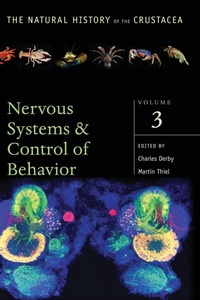
Crustacean Nervous Systems and Their Control of Behavior
Volume III
Published on 13. November 2014
Book
Hardback
592 pages
978-0-19-979171-2 (ISBN)
Description
Crustacean Nervous Systems and their Control of Behavior is the third volume of the series The Natural History of the Crustacea. This volume is on the functional organization of crustacean nervous systems, and how those nervous systems produce behavior. It complements other volumes on related topics of feeding biology, reproductive biology, endocrine systems, and behavioral ecology. There is a rich history of the study of the neurobiology of crustaceans, going back over 150 years. This has included studies on how their nervous systems allow them to perform behaviors that are adapted to their particular environments, as well as studying them as model organisms to understand basic biomedical principles about neural function, such as sensory transduction and processing, synaptic transmission and integration, neuromodulation, and learning and memory.
The volume has three sections that build progressively on each other. The first section is on the basic organizational features of the crustacean nervous system and the principles upon which it is built. The second section is on sensory ecology - the organization of each sensory system and how it is used in intra- and interspecific interactions, within an ecological context. The third section uses case studies of how crustacean nervous systems are organized to perform complex behaviors and interactions, such as walking, escape, social interactions, and memory and learning. Taken together, the 20 chapters synthesize our modern understanding of the neural control of behavior in crustaceans, based on the most recent technologies in physiological recording, molecular biology, and computational science. This volume will be useful to students and researchers as a concise summary of current knowledge of crustacean neuroscience.
The volume has three sections that build progressively on each other. The first section is on the basic organizational features of the crustacean nervous system and the principles upon which it is built. The second section is on sensory ecology - the organization of each sensory system and how it is used in intra- and interspecific interactions, within an ecological context. The third section uses case studies of how crustacean nervous systems are organized to perform complex behaviors and interactions, such as walking, escape, social interactions, and memory and learning. Taken together, the 20 chapters synthesize our modern understanding of the neural control of behavior in crustaceans, based on the most recent technologies in physiological recording, molecular biology, and computational science. This volume will be useful to students and researchers as a concise summary of current knowledge of crustacean neuroscience.
Reviews / Votes
This excellent book will surely be a major resource for research scientists and students for many years to come. * Malcolm Dando, The Biologist * This excellent book will surely be a major resource for research scientists and students for many years to come. * Malcolm Dando CBiol FSB, The Biologist * This volume is a wonderful compendium providing details and current insights about recent advances in our understanding of the crustacean nervous system. In addition to being a timely review for a broad spectrum of scientists and teachers, this publication will be an excellent resource for uninitiated novices as well as seasoned crustacean neurobiologists. It will become an indispensable resource in the scientific community. * Carl L. Thurman II, Quarterly Review of Biology * This series forms a reference work in the truest sense, one that will be referred to frequently for many years to come. The whole series would be an excellent addition to a reference library; these individual volumes are essential for anyone involved in research on the neurobiology or physiology of crustaceans, or indeed, other invertebrates. * Adrian J. Wolstenholme, Invertebrate Neuroscience * A clearly written, beautifully illustrated, and entirely comprehensive review of the nervous systems of crustaceans, this volume is sure to be THE classic source for the field for many years - likely decades - to come. It will be required reading for all who work on crustacean behavior and sensory biology. * Sonke Johnsen, Duke University * This volume is a welcome compendium that provides the reader with important insights about the crustacean nervous system. It is satisfyingly rich in information and scholarship. It is exactly what one wants from a work of this kind and is a most welcome addition to the neuroscientist's bookshelf. * Nicholas Strausfeld, University of Arizona * In these days of fragmented information overload, it is rare to find such a useful compendium focused on a group of animals important in forming the basis for our current understanding of neuroscience. The volume presents contributions from knowledgeable experts in the field offering the reader timely reviews of subjects ranging from sensation to motor patterns and behavior. * Thomas Finger, University of Colorado School of Medicine *More details
Series
Language
English
Place of publication
New York
United States
Target group
College/higher education
Professional and scholarly
Illustrations
134 illustrations
Dimensions
Height: 260 mm
Width: 183 mm
Thickness: 36 mm
Weight
1290 gr
ISBN-13
978-0-19-979171-2 (9780199791712)
Copyright in bibliographic data and cover images is held by Nielsen Book Services Limited or by the publishers or by their respective licensors: all rights reserved.
Schweitzer Classification
Other editions
Additional editions
Charles Derby | Martin Thiel
Nervous Systems and Control of Behavior
E-Book
09/2014
1st Edition
OUP eBook
€124.99
Available for download
Persons
Martin Thiel is a marine biologist with strong interests in animal behavior and natural history. During the past 20 years, he has conducted studies on crustacean behavior ranging from evolution of parental care behaviors to mating interactions and anti-predator behaviors. He is also interested in dispersal ecology and biogeography, and in promoting the participation of citizen scientists in marine research.
Charles Derby is a Regents Professor of Neuroscience and Biology at Georgia State University who studies how animals use sensory information in solving life's challenges, such as finding high-quality food, identifying mates, and avoiding predators. His focus has been the chemical senses of decapod crustaceans, especially spiny lobsters, clawes lobsters, and brachyuran crabs.
Charles Derby is a Regents Professor of Neuroscience and Biology at Georgia State University who studies how animals use sensory information in solving life's challenges, such as finding high-quality food, identifying mates, and avoiding predators. His focus has been the chemical senses of decapod crustaceans, especially spiny lobsters, clawes lobsters, and brachyuran crabs.
Content
Table of Contents ; Chapter 1. Crustacean Nervous Systems and their Control of Behavior - An Introduction ; Charles Derby and Martin Thiel ; Chapter 2. Adaptive Trends in Malacostracan Brain Form and Function Related to Behavior ; David C. Sandeman, Matthes Kenning, and Steffen Harzsch ; Chapter 3. Sensory Systems of Crustaceans ; DeForest Mellon ; Chapter 4. Peripheral Components of Crustacean Motor Systems ; Harold Atwood ; Chapter 5. Modulation of Crustacean Networks for Behavior ; Ronald Harris-Warrick ; Chapter 6. Synapses in Crustaceans ; Gregory Lnenicka ; Chapter 7. Adult Neurogenesis in Crustaceans ; Manfred Schmidt ; Chapter 8. Visual Systems of Crustaceans ; Raymon Glantz ; Chapter 9. Sensory Ecology of Vision in Crustaceans ; Thomas W. Cronin and Kathryn D. Feller ; Chapter 10. The Chemical Senses and Chemosensory Ecology of Crustaceans ; Charles D. Derby and Marc J. Weissburg ; Chapter 11. Mechanoreception in Crustaceans of the Pelagic Realm ; Petra H. Lenz and Daniel K. Hartline ; Chapter 12. The Geomagnetic Sense of Crustaceans and its Use in Orientation and Navigation ; Kenneth J. Lohmann and David A. Ernst ; Chapter 13. The Crustacean Stomatogastric Nervous System ; Eve Marder, Marie L. Goeritz, Gabrielle J. Gutierrez, Albert Hamood, Ted Brookings, Jonathan Caplan, Sara Haddad, Tilman Kispersky, and Sonal Shruti ; Chapter 14. Neural Control of Posture and Walking in Crustaceans ; Daniel Cattaert ; Chapter 15. The Escape Behavior of Crayfish ; Franklin B. Krasne, William J. Heitler, and Donald H. Edwards ; Chapter 16. Biological Rhythms and their Neural Basis in Crustaceans ; Maria Luisa Fanjul-Moles ; Chapter 17. Neurobiology of Social Status in Crustaceans ; Jens Herberholz ; Chapter 18. Path Integration, Vision, and Decision-Making in Fiddler Crabs ; Jochen Zeil and Jan M. Hemmi ; Chapter 19. Neurobiology of Learning and Memory of Crustaceans ; Daniel Tomsic and Hector Maldonado ; Chapter 20. Crustaceans as Model Systems for Teaching Neuroscience: Past, Present, and Future ; Bruce R. Johnson, Robert A. Wyttenbach, and Ronald R. Hoy