

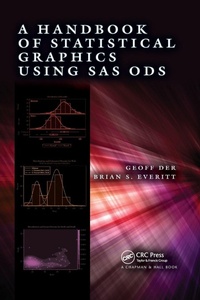
A Handbook of Statistical Graphics Using SAS ODS
1st Edition
Published on 19. September 2019
Book
Paperback/Softback
244 pages
978-0-367-37842-4 (ISBN)
Description
Easily Use SAS to Produce Your Graphics
Diagrams, plots, and other types of graphics are indispensable components in nearly all phases of statistical analysis, from the initial assessment of the data to the selection of appropriate statistical models to the diagnosis of the chosen models once they have been fitted to the data. Harnessing the full graphics capabilities of SAS, A Handbook of Statistical Graphics Using SAS ODS covers essential graphical methods needed in every statistician's toolkit. It explains how to implement the methods using SAS 9.4.
The handbook shows how to use SAS to create many types of statistical graphics for exploring data and diagnosing fitted models. It uses SAS's newer ODS graphics throughout as this system offers a number of advantages, including ease of use, high quality of results, consistent appearance, and convenient semiautomatic graphs from the statistical procedures.
Each chapter deals graphically with several sets of example data from a wide variety of areas, such as epidemiology, medicine, and psychology. These examples illustrate the use of graphic displays to give an overview of data, to suggest possible hypotheses for testing new data, and to interpret fitted statistical models. The SAS programs and data sets are available online.
Diagrams, plots, and other types of graphics are indispensable components in nearly all phases of statistical analysis, from the initial assessment of the data to the selection of appropriate statistical models to the diagnosis of the chosen models once they have been fitted to the data. Harnessing the full graphics capabilities of SAS, A Handbook of Statistical Graphics Using SAS ODS covers essential graphical methods needed in every statistician's toolkit. It explains how to implement the methods using SAS 9.4.
The handbook shows how to use SAS to create many types of statistical graphics for exploring data and diagnosing fitted models. It uses SAS's newer ODS graphics throughout as this system offers a number of advantages, including ease of use, high quality of results, consistent appearance, and convenient semiautomatic graphs from the statistical procedures.
Each chapter deals graphically with several sets of example data from a wide variety of areas, such as epidemiology, medicine, and psychology. These examples illustrate the use of graphic displays to give an overview of data, to suggest possible hypotheses for testing new data, and to interpret fitted statistical models. The SAS programs and data sets are available online.
More details
Language
English
Place of publication
Oxford
United Kingdom
Publishing group
Taylor & Francis Ltd
Target group
College/higher education
Dimensions
Height: 234 mm
Width: 156 mm
Weight
453 gr
ISBN-13
978-0-367-37842-4 (9780367378424)
Copyright in bibliographic data and cover images is held by Nielsen Book Services Limited or by the publishers or by their respective licensors: all rights reserved.
Schweitzer Classification
Other editions
Additional editions
Geoff Der | Brian Everitt
A Handbook of Statistical Graphics Using SAS ODS
Book
08/2014
1st Edition
CRC Press
€98.50
Shipment within 15-20 days
Geoff Der | Brian Everitt
A Handbook of Statistical Graphics Using SAS ODS
E-Book
08/2014
1st Edition
Chapman & Hall/CRC
€91.99
Available for download
Geoff Der | Brian Everitt
A Handbook of Statistical Graphics Using SAS ODS
E-Book
08/2014
Chapman and Hall
€92.49
Available for download
Persons
Der, Geoff; Everitt, Brian
Content
An Introduction to Graphics: Good Graphics, Bad Graphics, Catastrophic Graphics and Statistical Graphics. An Introduction to ODS Graphics. Graphs for Displaying the Characteristics of Univariate Data: Horse Racing, Mortality Rates, Forearm Lengths, Survival Times and Geyser Eruptions. Graphs for Displaying Cross-Classified Categorical Data: Germinating Seeds, Piston Rings, Hodgkin's Disease and European Stereotypes. Graphs for Use When Applying t-Tests and Analyses of Variance: Skulls, Cancer Survival Times and Effect of Smoking on Performance. Linear Regression, the Scatterplot and Beyond: Galaxies, Anaerobic Threshold, Birds on Islands, Birth and Death Rates, U.S. Birth Rates during and after World War II, and Air Pollution in U.S. Cities. Graphs for Logistic Regression: Blood Screening, Women's Role in Society and Feeding Alligators. Graphing Longitudinal Data: Glucose Tolerance Tests and Cognitive Behavioural Therapy (CBT) for Depression. Graphs for Survival Data: Motion Sickness and Breast Cancer. References. Index.